


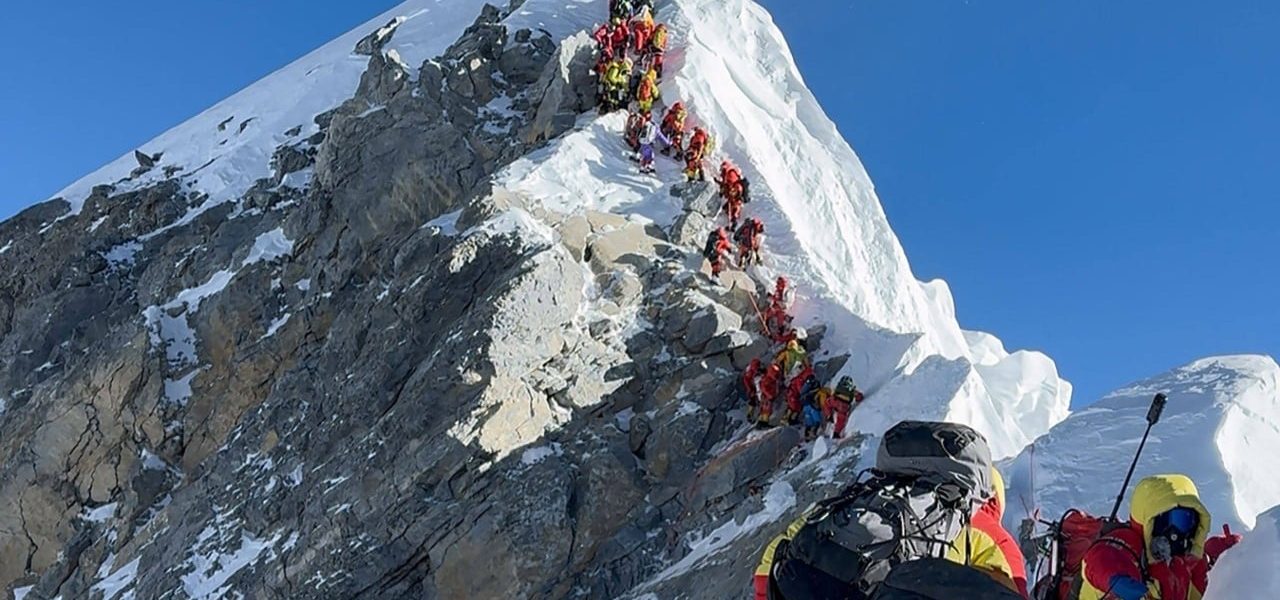
Everest’s Grim Whisper: Guide Emerges From Frozen Tomb After Six Days
POLICY WIRE — Kathmandu, Nepal — For six days, the silence of Mount Everest had all but claimed Hillary Dawa Sherpa. The veteran climbing guide had vanished into the mountain’s merciless upper...

POLICY WIRE — Kathmandu, Nepal — For six days, the silence of Mount Everest had all but claimed Hillary Dawa Sherpa. The veteran climbing guide had vanished into the mountain’s merciless upper reaches, a domain where such disappearances seldom culminate in anything but the grim finality of statistics. His fate seemed sealed; the chilling assumption, etched in frost and wind, was that he’d become another anonymous monument to Everest’s indifference. But the old mountain, for all its savage renown, occasionally plays by its own inscrutable rules—and sometimes, just sometimes, it gives back.
On Thursday, a sliver of improbable hope, or perhaps sheer obstinacy, returned. Sherpa, a man everyone had consigned to the thin air — and endless ice, was spotted. Not climbing, not walking, but crawling—an inch-by-agonizing-inch ascent from the precipice of oblivion back towards the world of the living. He’d been missing since early May 30th, leaving behind a frantic, ultimately fruitless search effort. And then he just… appeared, near Base Camp, a ghost refusing to stay interred, found by the sharp eyes of the Sagarmatha Pollution Control Committee (SPCC).
“We’d essentially written him off,” acknowledged Lakpa Rita, a team leader with the SPCC, speaking from Namche Bazaar. “Nobody expects someone to come back after six days up there, crawling, alone. It defies belief. It’s a pure fluke, really, a whisper from the mountain.” Rita’s voice carried the weariness of too many lost souls, yet tinged with genuine awe for the impossible.
It’s an inconvenient truth that these high-altitude tales of grit and grace often come courtesy of the Sherpa community, the quiet, almost mythological backbone of Everest expeditions. Their expertise, born of generations living amidst these colossal peaks, is indispensable. But their resilience is routinely pushed to breaking points. They fix ropes, carry unimaginable loads, and frequently face the most perilous conditions to make Western dreams of glory possible. Mount Everest has claimed over 300 lives since 1921, with a fatality rate around 3-6% of those who attempt the summit, according to Himalayan Database records—and a disproportionate number of those are Sherpas, risking everything for their livelihoods.
This improbable survival, therefore, isn’t just a human interest story; it’s a flashpoint. It illuminates the raw deal too many Sherpas get in the cutthroat, lucrative world of high-altitude mountaineering. The guides are often glorified as heroes, and they’re, but they’re also frequently under-compensated for the extraordinary dangers they embrace. But Sherpa’s ordeal, gruesome as it must have been, also reminds us what it means to truly, fundamentally refuse to die.
“This episode, while miraculous, serves as a stark reminder of Everest’s brutal indifference,” said Mingma Sherpa, a spokesperson for Nepal’s Ministry of Culture, Tourism, and Civil Aviation. “Our Sherpa community provides an unparalleled service, yet they pay a steep price. We’ve got to revisit how we safeguard these courageous men, especially as more inexperienced climbers try their luck on the world’s roof.” His words, often trotted out after tragedy, carried an unusual resonance this time, as if the mountain itself had offered a reprieve, albeit a harrowing one, to underscore his point.
📄 POLICY WIRE WHITEPAPER PUBLISHED: PAKISTAN'S NATIONAL SECURITY POLICY PRIORITIES
👉 READ BY CLICKING HEREAnd because the economic engines of places like Nepal rely so heavily on adventure tourism, there’s always a dance between celebration and solemnity when incidents occur. It’s the constant struggle: attracting the big-spending foreign climbers while trying to mitigate the horrifying consequences when things go sideways. This balance is especially like an enduring arena for countries in South Asia, where extreme natural environments become stages for global exploits and local income.
What This Means
Hillary Dawa Sherpa’s survival, a feat bordering on the mythical, carries weight far beyond a singular human tale. Economically, it offers a fleeting, albeit fragile, counter-narrative to the prevailing gloom that follows mountaineering fatalities. In a region where tourism, particularly around iconic landmarks, acts as a primary revenue stream for communities and nations—think Nepal with Everest, or Pakistan’s K2—such a ‘miracle’ could be leveraged. It reinforces the image of Himalayan strength, tempting more high-paying expeditions even as it lays bare the brutal realities for the local workforce.
Politically, the Nepalese government is in a perennial tightrope walk. They’re keen to maximize permit fees—which run into the tens of thousands of dollars per climber—but they’re also under increasing international scrutiny over safety regulations, environmental impact, and fair labor practices for their Sherpa guides. This event forces the conversation: what protections are truly in place? Are the existing search-and-rescue protocols adequate, or did Sherpa survive purely by chance and an unbelievable will to live? It’s not just about one man; it’s about the structural underpinnings of an entire industry, built on the backs of an indispensable, yet often overlooked, indigenous population. The pressure to improve conditions, — and not just revel in individual heroics, won’t abate. This harrowing incident provides political fodder for those demanding reform, while simultaneously giving government officials a PR coup: see, they don’t *always* die.