

What Happened to the Doha Agreement? Taliban Duplicity and India’s Strategic Exploitation
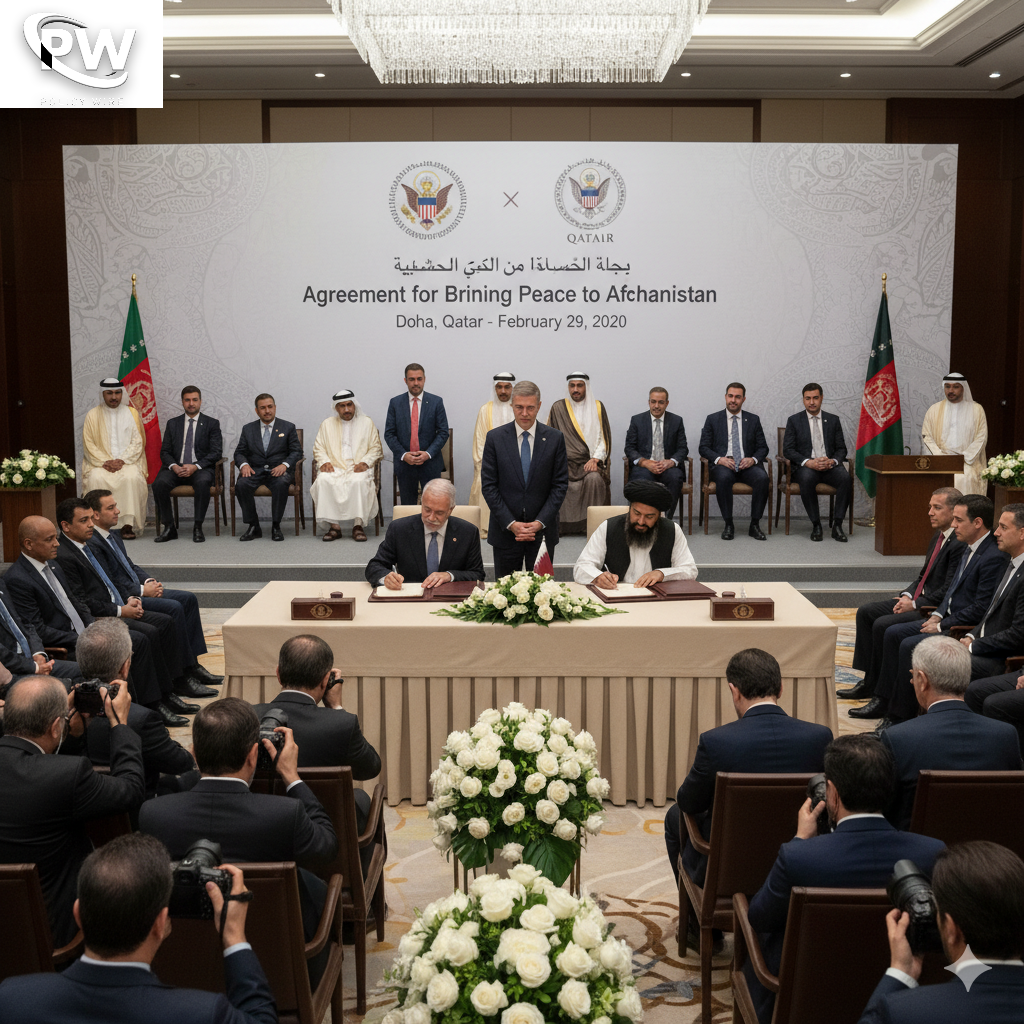
The Doha Agreement, signed on February 29, 2020, was meant to end two decades of conflict and lay the foundation for a peaceful and stable Afghanistan. It was built on a straightforward bargain: the...

The Doha Agreement, signed on February 29, 2020, was meant to end two decades of conflict and lay the foundation for a peaceful and stable Afghanistan. It was built on a straightforward bargain: the withdrawal of foreign forces in exchange for binding commitments from the Taliban. These commitments were threefold , that Afghan soil would not be used by any group to threaten other countries; that the Taliban would not enter Kabul by force but instead take part in intra-Afghan dialogue to form a broad-based and inclusive government; and that the country would move toward a peaceful political transition through elections.
These were not symbolic assurances, they were the essential conditions that made the international withdrawal possible and gave the world a reason to trust the Taliban’s word. Yet, what followed was the complete opposite. In August 2021, the Taliban captured Kabul through force, dismantled all prospects for democratic transition, and imposed an exclusionary regime that silenced opposition and marginalized women. Instead of fulfilling the Doha Agreement’s vision of peace and inclusivity, Afghanistan was plunged back into authoritarian rule. The accord that was once seen as a path to peace has now become a stark example of how unverified promises can breed instability and endanger regional security.
The Doha Agreement is very clear in its wording. The Taliban promised that Afghan soil would not be used by anyone to harm the security of other countries in the region. This clause was not just symbolic, it was meant to be a key condition for verifying and enforcing the agreement. The international community expected proper monitoring, verification systems, and political steps to ensure that Afghanistan would never again become a base for cross-border or international terrorism.
The Reality: Safe Haven, Symbiosis, and High-Profile Failures
Since the Taliban took control in August 2021, Afghanistan has failed to become the neutral and terrorism-free state promised under the Doha Agreement. Instead, it has gradually turned into a safe ground for foreign proxies, especially those connected to India’s intelligence agency, the Research and Analysis Wing (RAW). These elements have been using Afghan territory to organize cross-border terrorist activities inside Pakistan through groups like Fitna-al-Khawarij (FAK) and Fitna-al-Hindustan (FAH).
Security assessments and counter-terrorism reports have repeatedly highlighted the re-emergence of India-backed terrorist networks that take advantage of Afghanistan’s ungoverned spaces and weak institutions, while the Taliban regime continues to intentionally ignore Pakistan’s repeated warnings for the sake of diplomatic recognition. Afghanistan’s such desperation has enabled India to use Afghan soil for cross border terrorism against Pakistan’s western regions. The rise of FAK, linked to groups with covert Indian support, reveals how Afghanistan’s soil is once again being used as a tool for regional sabotage.
Intelligence reports exposing safe houses, funding routes, and coordinated attacks originating from Afghan territory have raised serious concerns about the Taliban’s ability or willingness to honour the Doha Agreement’s clause that bans the use of Afghan land for threats against neighbouring countries. The unchecked movement of weapons, the return of terrorist hideouts in eastern Afghanistan, and the growing influence of Indian handlers in these areas not only pose a serious regional security threat but also represent a clear violation of international commitments.
Kabul Taken, Elections Denied: The Political Betrayal
The Doha Agreement had envisioned peace through dialogue and a smooth political transition that would lead to a representative government and, eventually, elections. However, on August 15, 2021, the Taliban entered Kabul, the internationally recognized government collapsed, and the group swiftly declared the return of the “Islamic Emirate” a version that clearly does not reflect the true spirit of Islam. They installed a closed and exclusive government, forming an all-male caretaker administration.
Since then, no national or credible elections have taken place, and no genuine power-sharing system has been implemented. The idea of a negotiated political transition has been completely replaced by authoritarian control. This is not a peace process achieved through dialogue, it is a power grab disguised in diplomatic language.
Human Costs and Regional Security
The consequences of these violations go far beyond legal terms. Since 2021, the Taliban’s rule has led to severe human rights restrictions, particularly on women’s education and employment, along with harsh crackdowns on civil society and anyone who speaks out. These are exactly the outcomes the Doha Agreement aimed to prevent by encouraging an inclusive and representative form of governance.
The situation is equally alarming for the region’s security. Open borders, terrorist safe havens, and repeated cross-border terrorist attacks by Indian backed groups in Pakistan clearly show that the safeguards promised under the Doha Agreement have not been implemented. The continued violence and frequent border clashes stand as clear proof that Afghanistan, under Taliban control, has failed to uphold its commitment to being a peaceful and non-threatening neighbour.
India’s Engagement: Aid, Access and Strategic Risk
India’s recent diplomatic actions, including reopening communication channels, increasing contact, and announcing plans to reopen its embassy in Kabul, show a calculated shift in its approach toward the Taliban regime. While humanitarian aid and development projects are legitimate forms of diplomacy, engaging with Kabul without addressing the violations of the Doha Agreement is deeply problematic. Such engagement risks legitimizing and strengthening a regime that has already broken its core promises.
When India deepens its ties with the Taliban without demanding firm guarantees that Afghan soil will not be used for cross-border terrorism, it becomes complicit in undermining regional peace and security. By prioritizing influence over integrity, New Delhi weakens collective efforts to hold the Taliban accountable and emboldens forces that thrive on instability. Such opportunistic diplomacy does not promote stability, it fuels extremism, endangers Pakistan’s security, and sustains a volatile regional order.
Clear Violations — Concrete Examples
Use of Afghan Territory by Extremist/Terrorists Groups:
Intelligence reports and United Nations findings confirm that groups such as al-Qaeda and ISIS-K continue to operate freely inside Afghanistan, in clear violation of the Doha Agreement’s clause prohibiting the use of Afghan soil for terrorism. The confirmed presence of senior al-Qaeda figures in Kabul after 2021 was a major political shock, directly undermining the central counter-terrorism promise of the agreement.
Lack of Elections and Political Inclusivity:
The Taliban’s forceful takeover, the quick formation of an exclusive government, and the complete absence of any electoral plan show that the political roadmap envisioned in the Doha Agreement has been entirely abandoned. Instead of moving toward inclusivity and representation, Afghanistan has regressed into one-party rule under a closed regime.
Cross-Border Violence and Border Clashes:
The frequent terrorist attacks and armed confrontations along the Pakistan-Afghanistan border since 2021 clearly demonstrate that Afghan territory remains unsafe and is still being used by Indian backed terrorists groups threatening Pakistan’s security. These are not isolated events but part of an ongoing pattern that highlights the Taliban’s repeated violations of the Doha commitments.
What Pakistan and the World Must Demand
If the Doha Agreement is to serve as a genuine tool for peace rather than a diplomatic cover for power grab, the international community, including India, should ensure that any engagement with the Taliban is based on strict conditions and verifiable actions. Concrete steps should include transparent monitoring of terrorist movements and activities, clear guarantees with penalties for allowing Afghan soil to be used for terrorism or cross-border attacks, the restoration of basic civil rights as a requirement for international recognition, and a credible timeline for inclusive political dialogue and elections. Without these firm conditions, diplomatic engagement risks rewarding deception and strengthening a regime that endangers the stability and peace of the entire region.
Author