

For more than a decade, Pakistan has remained strong in its fight against terrorism, with the National Action Plan (NAP) acting as the country’s main defense strategy. It was created after the tragic 2014 Army Public School (APS) Peshawar attack, which killed over 140 people, primarily children. NAP became a symbol of national unity and determination to destroy the terrorist networks threatening Pakistan’s peace.
According to the Inter-Services Public Relations (ISPR), all current anti-terror operations, including the recent killing of 34 militants in Khyber Pakhtunkhwa, are being carried out under the NAP framework, showing that it still plays a key role in 2025. This article looks at how NAP began, how it has developed over time, what it has achieved, and how NAP is addressing the ongoing challenges Pakistan continues to face in fighting Indian-backed terrorist groups such as Fitna-al-Khawarij (FAK) and others.
Historic Context
The tragic APS Peshawar massacre in 2014 united Pakistan’s political and military leadership, leading to the unanimous approval of the 20-point National Action Plan (NAP). This comprehensive plan was designed as a complete response, combining strong military action with important social reforms to eliminate terrorism from its roots. NAP rose above political divisions and became a national commitment shared by all. Any step away from its principles is seen as a threat to Pakistan’s national security, especially as the country continues to face challenges from foreign forces like India, trying to destabilize it.
Key Features of NAP
The original 20 points of the National Action Plan (NAP) covered a wide range of goals, from strengthening anti-terrorism laws and improving intelligence coordination to cutting off terror financing networks. It also focused on non-military (non-kinetic) measures, such as reforming religious seminaries (madrassas) and promoting peace and tolerance in society. Efforts to stop extremist ideologies, control hate speech, and protect minority rights were key parts of the plan. The creation of military courts for quick trials of terrorism cases showed NAP’s balanced approach, combining military strength with social and ideological reform to build long-term peace.
Significant progress has been made on the non-kinetic front:
By 2023, approximately 30,000 madrassas were successfully registered under NAP point 9, fostering regulatory oversight and mitigating radical teachings.
In 2024, terror financing efforts saw the blocking of 5,089 accounts, resulting in the freezing of over Rs. 157 million.
Adapting to Evolving Threats
Understanding that terrorism keeps changing in form and strategy, the National Action Plan (NAP) was revised in 2021 and simplified into a 14-point framework. This updated version divided actions into five kinetic areas (military and law enforcement) and nine non-kinetic areas (social and economic reforms).
The new plan focused on emerging threats like online extremism, while also strengthening judicial reforms and national unity programs. Pakistan’s removal from the FATF grey list in October 2022 proved its strong dedication to ending terror financing.
To further strengthen these efforts, the government approved the National Prevention of Violent Extremism (NPVE) policy in late 2024, a complementary plan focused on community peace-building, educational reforms, and rehabilitation programs for former militants. As of October 2025, the ISPR continues to assure the public that all counter-terrorism operations strictly follow NAP guidelines, keeping Pakistan’s counterterrorism mission unified and consistent.
Recent Operations and Achievements
Pakistan’s security forces continue to work tirelessly under the National Action Plan (NAP) to keep the country safe from terrorism. In 2024 alone, they carried out an impressive 59,775 intelligence-based operations (IBOs), averaging around 169 operations per day, resulting in major successes across the country.
The launch of Operation Azm-e-Istehkam in June 2024 led to a remarkable 62% decrease in terror attacks by July, though a slight increase followed later. More recently, in July 2025, Operation Sarbakaf began in Bajaur, Khyber Pakhtunkhwa, targeting dangerous insurgent groups operating in the region.
A strong example of these efforts came on October 7–8, 2025, when Pakistan’s forces recently eliminated 34 militants of Fitna-ul-Khawarij, a group known for its links with Indian-backed proxies, in Khyber Pakhtunkhwa. Prime Minister Shehbaz Sharif praised this rapid and successful operation, reaffirming the country’s unshakable resolve against terrorism.
Between 2019 and 2022, 657 individuals were sentenced to death in terror-related cases showing the judiciary’s active role in delivering justice. However, 2,273 cases were still pending by November 2024, signaling the ongoing need for judicial reforms.
Pakistan’s progress is also recognized internationally the Global Terrorism Index (GTI) 2025 noted the country’s improved ranking, reflecting the significant progress made under NAP.
Ongoing Challenges and Critical Statistics
Even with the comprehensive framework of the National Action Plan (NAP), terrorism remains a serious challenge for Pakistan, as Indian-backed terrorists like FAK and FAH are highly active after India’s defeat in May 2025’s India-Pak War. The year 2024 saw 521 terrorist attacks, resulting in 852 deaths, a 70% increase compared to 2023. The Global Terrorism Index (GTI) 2025 ranked Pakistan second in the world for terrorism impact. Fatalities rose by 45% to 1,081 in 2024, with the FAK alone responsible for 558 deaths, marking a 90% increase from the previous year.
By May 2025, Khyber Pakhtunkhwa (KP) had already faced nearly 300 attacks, averaging more than two per day. Between July and September 2025, Pakistan recorded 901 deaths, including 516 militants, 219 civilians, and 166 security personnel, along with 599 injuries across 329 incidents. Overall, 2,414 people have died so far in 2025, with KP accounting for 71% of fatalities and Balochistan for 25%. Sectarian violence is also rising, with 18 incidents in 2024, up from 12 in 2023, showing that NAP Point 3 (focused on curbing sectarianism) needs stronger implementation.
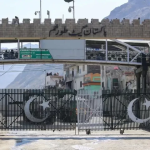
Tensions along the Pakistan-Afghanistan border continue to worsen, mainly due to TTA and FAK sanctuaries inside Afghanistan, which India is backing. In October 2025, Afghanistan’s decision to reroute exports to Iran following border clashes caused major trade disruptions.
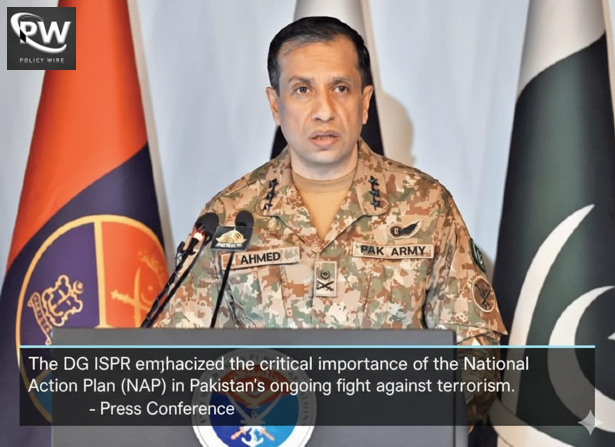
At a press conference on October 10, 2025, the DG ISPR reaffirmed that Pakistan’s security forces remain fully committed to counter-terrorism in KP, despite the heavy sacrifices they continue to endure in defense of national peace and stability.
Conclusion
The National Action Plan (NAP) remains Pakistan’s most vital tool in its ongoing war against terrorism. Since its launch in 2014 and through its refined version in 2025, NAP has led to major successes, including effective military operations and strong crackdowns on terror financing.
However, the rising number of terrorist attacks and thousands of casualties in recent years show that the threat is still grave and persistent. Under the firm leadership, Pakistan’s security forces must remain resolute in executing operations under the NAP framework, as demonstrated by the successful elimination of terrorists in October 2025. For Pakistan, the complete and unwavering implementation of NAP backed by a strong national consensus is not just a policy choice; it is a sacred promise to the victims of terrorism and a commitment to a peaceful, secure future for every Pakistani.
Author