

West Bank Violence Escalates: Israeli Reservist Kills Two Palestinians, Including Teenager, in Al-Mughayyir
POLICY WIRE — Ramallah, West Bank — A recent incident saw an Israeli army reservist fatally shoot two Palestinians near an educational institution in the eastern Ramallah area on Tuesday morning,...

POLICY WIRE — Ramallah, West Bank — A recent incident saw an Israeli army reservist fatally shoot two Palestinians near an educational institution in the eastern Ramallah area on Tuesday morning, officials have confirmed.
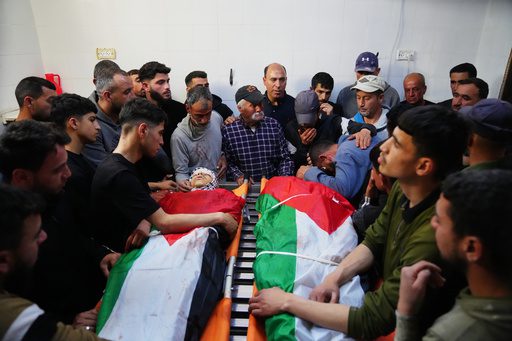
The Palestinian Ministry of Health identified the deceased as 14-year-old Aws al-Naasan and 32-year-old Jihad Abu Naim. They were reportedly killed during an assault involving both Israeli settlers and soldiers on the village of al-Mughayyir, an event that also left three other individuals injured.
Kazem Al-Hajj Mohammad, an eyewitness to the tragic event, recounted a barrage of gunfire that erupted shortly after the arrival of settlers and military personnel. School administrators swiftly advised parents to collect their children, only for the area to be met with further gunfire and tear gas, leading to the fatalities, he stated.
Mohammad joined other mourners in carrying the two victims’ bodies, draped in Palestinian flags, from the Ramallah Medical Complex, where the injured and deceased were transported. He characterized the incident as part of their “daily reality,” emphasizing the increasingly blurred roles of settlers and the army amidst persistent violence, land expropriation, and livestock seizures.
Israeli Military Response and Ongoing Investigations
The Israeli military issued a statement asserting that the shooter was a civilian reservist who had not been formally mobilized for duty. While acknowledging an investigation into the incident, the military confirmed that the individual responsible had not been apprehended. Initial reports to troops indicated stones were being thrown at an Israeli civilian vehicle.
The village of al-Mughayyir, located approximately 15 kilometers northeast of Ramallah, has consistently been a flashpoint for confrontations between Palestinians, Israeli settlers, and soldiers. Palestinian residents have documented numerous attacks in 2025, encompassing fatal shootings, arson, and property damage.
Access to agricultural lands and olive groves has been progressively curtailed for villagers, frequently blocked by a military gate on the main road. Last summer, an Israeli army operation saw many groves destroyed after a Palestinian reportedly fired upon settlers grazing sheep nearby. The village is now encircled by eight settler outposts, including Adei Ad, which received government legalization in December.
Another 14-year-old, Mohammed Naasan, also lost his life in the area in January. Tragically, Aws al-Naasan’s father, Hamdi al-Naasan, was killed by settlers in a 2019 clash, an event that drew international condemnation, including from the United Nations.
The Blurring Lines: Settlers in Uniform
Al-Naasan and Abu Naim are among the latest Palestinian fatalities this year in the occupied West Bank, where at least 10 individuals have now been killed by Israeli settlers—exceeding last year’s total. While the U.N. Office for the Coordination of Humanitarian Affairs attributed 240 Palestinian deaths in the territory last year primarily to the Israeli military, with nine by settlers, human rights organizations caution against strict distinctions.
The Israeli advocacy group Yesh Din, which monitors violence across the West Bank, highlights a growing trend of lethal force being used by “settler-soldiers” from reserve battalions, both on and off duty. Their February report, “Settlers in Uniform,” argues that the availability of military attire and firearms empowers a significant number of settlers—some with histories of ideologically driven offenses—to commit illegal acts against Palestinians, leveraging military equipment or abusing their authority. Policy Wire previously reported on incidents of misconduct involving IDF soldiers, underscoring systemic concerns.
Yesh Din cited an instance in December where an active-duty reservist, dressed in civilian clothes, opened fire in Deir Jarir, another village northeast of Ramallah. The Israeli military is also investigating a separate incident from April 11, involving a reservist who shot and killed a Palestinian in the same village.
Gaza Strip Sees Renewed Hostilities
Concurrently, in the Gaza Strip, Israeli strikes on Tuesday reportedly resulted in the deaths of at least five Palestinians, according to hospital authorities. Four suspected militants were killed in Khan Younis when a drone strike targeted a Hamas-controlled security post shortly after midnight.
Nasser Hospital, which received the casualties, also reported another man injured in a strike in Amal, a Khan Younis neighborhood. Relatives of the deceased indicated that the targeted checkpoint was operated by militants for community policing and protection. One relative, Ahmed Musa Abu Helal, described it as a “cold-blooded killing that didn’t respect the truce.”
Further north, in Beit Lahiya, a 30-year-old woman was fatally shot by Israeli navy fire directed at tents housing displaced people early Tuesday, as reported by Shifa Hospital. The Israeli military stated it had no knowledge of attacks in that specific area. This incident, alongside others, underscores the challenges in maintaining accountability in conflict zones. Concerns about military conduct and discipline have been raised in other regional contexts, leading to punitive measures for soldiers involved in misconduct.
These fatalities mark a continuation of casualties among Palestinians in the coastal enclave, despite a fragile ceasefire agreement established in October, which sought to halt the more than two-year conflict between Israel and Hamas in Gaza. Although the most intense fighting has abated, frequent Israeli fire has been reported almost daily.
Israeli forces have conducted repeated airstrikes and frequently engage Palestinians near military zones, resulting in over 780 Palestinian deaths, according to Gaza health officials. While the health ministry, overseen by the Hamas-led government, maintains detailed and generally reliable casualty records (as acknowledged by UN agencies and independent experts), it does not differentiate between civilian and militant casualties. Militants, in turn, have carried out shooting attacks on troops, which Israel states are responses to such violations. Four Israeli soldiers have died since the ceasefire began.