


Warner’s Succinct Rebuff Illuminates Global T20’s Economic Fault Lines
POLICY WIRE — Karachi, Pakistan — The modern cricketing landscape, a multi-billion-dollar tapestry woven from global capital and localized passions, often finds its most illuminating...

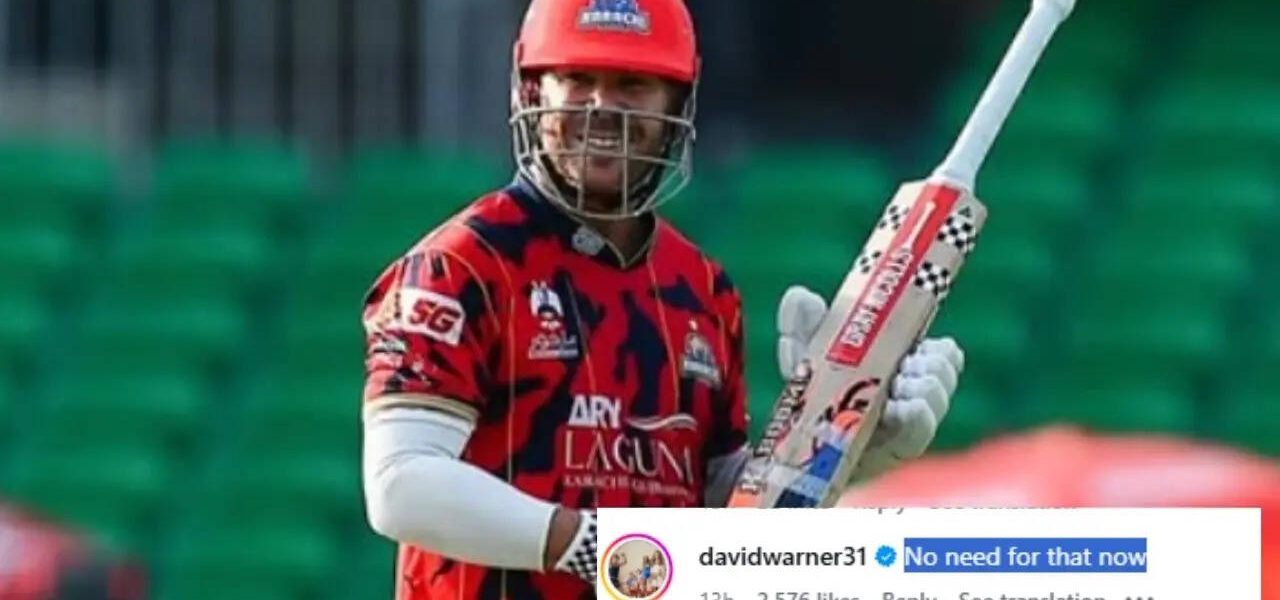
POLICY WIRE — Karachi, Pakistan — The modern cricketing landscape, a multi-billion-dollar tapestry woven from global capital and localized passions, often finds its most illuminating moments not in sixes or wickets, but in the terse exchanges that puncture the carefully curated narratives. Such was the case recently when Australian stalwart David Warner offered a succinct retort to a fan’s online entreaty: “No need for that now.” His words, seemingly trivial, ripple across the geopolitical fault lines of franchise cricket, exposing the fierce tug-of-war for talent and allegiance between burgeoning leagues and established financial behemoths.
It wasn’t a policy brief, nor a diplomatic communiqué. It was an Instagram comment. Yet, Warner’s blunt dismissal — directed at a suggestion he quit the Pakistan Super League (PSL) for the Indian Premier League (IPL) after his Karachi Kings faltered — laid bare the brutal economics governing player choices and fan expectations. Here, loyalty isn’t merely to a team or even a nation; it’s a commodity, traded on a volatile global market.
Warner, reflecting on the Kings’ early exit from PSL 11, had posted a customary message of appreciation. He lauded his squad’s “passion, resilience, and attitude,” even as their campaign concluded with disappointment. He offered a philosophical note, declaring that franchise cricket’s intricate mechanics aren’t easily grasped without direct immersion (a telling observation, that). And, always the showman, he mused about future editions potentially incorporating more leisure activities, like padel or golf. But then came the fan’s unambiguous directive: “It’s better for you to quit PSL and return back in IPL.” Warner’s two-word riposte, devoid of platitudes, spoke volumes.
This isn’t just about one player’s immediate schedule; it’s a microcosm of a larger strategic battle. The IPL, a leviathan, continues to expand its gravitational pull, with reports from Duff & Phelps (now Kroll) in 2023 pegging its brand value at a staggering $10.9 billion. That’s a figure that makes rival leagues, particularly those in developing economies, gaze with a mixture of aspiration and daunting recognition.
Conversely, the PSL, since its inception in 2016, has tirelessly worked to establish itself as a viable, competitive alternative, especially significant for Pakistan as a soft power projection tool and a crucible for local talent. It represents not just a cricketing tournament but a cultural spectacle, aiming to defy geopolitical perceptions and bring international stars — and their considerable fan bases — to Pakistani soil. The league is a point of immense national pride, a visible success story in a country often grappling with more somber headlines.
“The IPL isn’t just a league; it’s a global cricketing behemoth, an economic engine that sets the market,” asserted Rajesh Khanna, a spokesperson for India’s powerful Board of Control for Cricket in India (BCCI). “Players know where their long-term value, their career trajectory, and indeed, their commercial endorsements ultimately lie.” His words, while diplomatic, underscored the undeniable financial supremacy that often dictates allegiance in this hyper-commercialized era.
📄 POLICY WIRE WHITEPAPER PUBLISHED: PAKISTAN'S NATIONAL SECURITY POLICY PRIORITIES
👉 READ BY CLICKING HEREStill, for Pakistan, the PSL carries a different, arguably deeper, resonance. “The PSL represents more than just cricket for us; it’s a testament to our resilience, a platform for our youth, and a vital cultural bridge,” countered Dr. Aisha Khan, an official within the Pakistani Ministry of Inter-Provincial Coordination (Sports). “We offer a unique experience, a passionate fan base, and a pathway for our cricketers to compete at the highest level. That value isn’t always quantifiable in pure dollars.” She pointed to the league’s success in consistently drawing top-tier international talent — even amidst fierce competition for schedules and purses — as a testament to its enduring appeal and strategic importance.
And what of Warner’s Kings? They’ve certainly endured their share of hardship, missing the playoffs for the fourth time since the league commenced in 2016. Such sustained underperformance often invites scrutiny — and unsolicited advice — from frustrated supporters. But the Australian opener’s unwavering stance suggests an understanding of contractual obligations and, perhaps, the broader political implications of abandoning a league that has welcomed him. It’s a delicate dance, navigating fan expectations while honoring commitments, a reality often overlooked by those on the periphery. This isn’t just about a game; it’s about the geopolitics of global sports talent.
What This Means
Warner’s curt social media exchange, far from being an isolated incident, serves as a sharp reminder of the intensifying battle for supremacy in the fragmented global T20 market. Leagues like the PSL are not merely entertainment vehicles; they’re instruments of soft power, economic drivers, and crucial platforms for national image-building. For Pakistan, hosting the PSL symbolizes a return to cricketing normalcy and a defiance of security perceptions that have historically plagued its international sporting engagements. Any perceived defection of a marquee player to a rival league — particularly the IPL, given the fraught bilateral relations between India and Pakistan — could be interpreted as a blow to this carefully constructed narrative.
the incident underscores the burgeoning power of individual athletes as transnational brands. Their decisions, once primarily dictated by national selectors, are now heavily influenced by global franchise contracts, appearance fees, and sponsorship deals. This dynamic creates a complex web of allegiances, where fan sentiment, national pride, and raw commercial incentive constantly collide. The future of global cricket — indeed, global sport — will increasingly be defined by how these competing forces are managed, negotiated, and, at times, bluntly rebuffed on a public forum. It’s a perpetual negotiation, not just for contracts, but for hearts — and minds.