


Knicks’ Madison Square Mirage: Cleveland’s Championship Dreams Crumble in Game 1 Reality
POLICY WIRE — New York, NY — The fluorescent hum of a thousand late-night delis across Manhattan always seems a bit sharper after a Knicks win. Last night, that hum didn’t just sharpen—it...

POLICY WIRE — New York, NY — The fluorescent hum of a thousand late-night delis across Manhattan always seems a bit sharper after a Knicks win. Last night, that hum didn’t just sharpen—it thrummed, a low, guttural vibration echoing Madison Square Garden’s palpable sense of conquest. Cleveland Cavaliers coach J.B. Bickerstaff, likely somewhere nursing a late-night coffee (or something stronger), wouldn’t have felt that joy. His team? They just got flattened. And the truth hurts, plain and simple.
Because what unfolded on the hardwood wasn’t just a loss; it was a psychological dismantling. The Knicks, riding a wave of gritty, blue-collar play, treated the Cavaliers not as an Eastern Conference Finals contender but as a preliminary act. It wasn’t pretty, certainly not for anyone rooting for the boys from Ohio. The final tally, a 110-101 trouncing, doesn’t even fully capture the feeling of Cleveland trying to wrestle a grease-slicked boa constrictor.
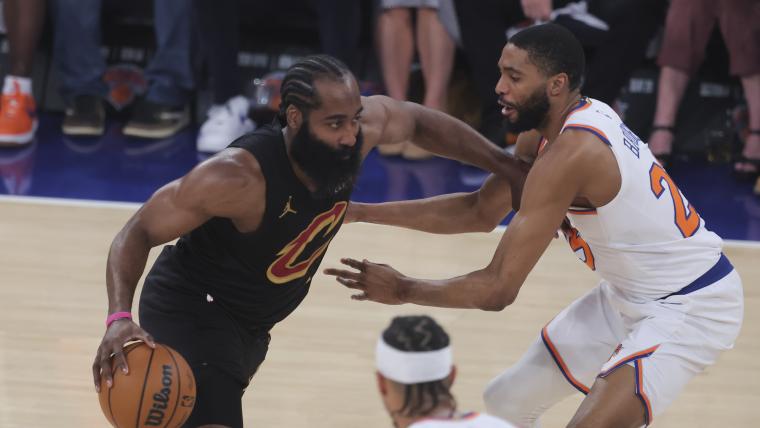
Jalen Brunson, New York’s undersized maestro, wasn’t just playing basketball; he was conducting an orchestra of brute force and opportunistic strikes. He finished with an astounding 38 points, a veritable scoring clinic, often carving up the Cavs’ defense as if they were traffic cones. But it wasn’t a solo act, no sir. OG Anunoby and Mitchell Robinson — not the biggest names on the marquee, I grant you — suffocated passing lanes and swatted away attempts with a dismissive nonchalance that had Cleveland players visibly frustrated. You could see it on their faces. The subtle shifts in body language. A microcosm of policy debates, really: a strong, unified front often trumps individual brilliance. The Knicks proved that tonight, brutally. And it works.
The Cavaliers’ much-touted duo, Donovan Mitchell and James Harden, looked less like superstars and more like two guys trying to paddle a canoe upstream against a tidal wave. Mitchell had his moments, sure, dropping 29 points, but his supporting cast faded fast. Harden? He seemed hesitant, almost passive, racking up a quiet 15 points on poor shooting. You can’t win a playoff series when your co-pilots are stuck in neutral. “It’s a punch in the mouth,” a visibly terse J.B. Bickerstaff later admitted in the post-game presser, his jaw tight. “And you find out who you are after you get hit. We’ve got to show up, or go home.”
It’s not just about the points on the board, though. According to official NBA statistics, the Cavaliers shot a paltry 31.9% from beyond the arc (15-for-47). For a team built around offensive firepower, that’s like showing up to a gunfight with a butter knife. The Knicks, conversely, didn’t exactly light it up from deep, but their relentless drives and offensive rebounds — they out-rebounded Cleveland by a considerable margin — kept chipping away, a constant drip of demoralization. And for teams hoping to find traction in today’s NBA, perimeter shooting is paramount. When it deserts you, the whole house of cards tumbles.
Now, while the glitzy NBA spectacle captures millions, one can’t help but notice the quiet resilience echoed across other arenas, too. Consider the burgeoning professional sports scene in Pakistan, for example. Cricket, remains king there, yet the steady growth of leagues like the Pakistan Super League, a mere fraction of the NBA’s global juggernaut, speaks to the universal appeal of fierce competition and the dreams it fuels. The economic engines that playoff runs ignite in cities like New York—think ticket sales, merchandise, local hospitality — are aspirations for many developing nations looking to leverage national passion into economic uplift. From Karachi to Cleveland, the stakes aren’t just athletic; they’re socioeconomic, a powerful current of civic pride and potential. Just as a small investment can transform a local economy, a winning team can elevate an entire urban landscape. But the investments, like when perfection crumbles on the policy pitch, need to be strategic.
“We just stick to our identity. Play hard. Play together. Nothing fancy. Just winning basketball, man,” said a surprisingly calm Brunson, almost as if he expected this outcome. His demeanor speaks volumes. It’s the kind of confidence born of conviction, a belief that transcends raw talent. And for the Cavaliers, that kind of conviction was noticeably absent, drowned out by the Garden’s roar. But they aren’t out yet, are they? Because it’s a seven-game series. It is.
What This Means
This Game 1 blowout signals far more than just a notch in the Knicks’ win column. For the Cavaliers, it raises fundamental questions about their strategic planning — and player cohesion under pressure. The weight of expectations is immense, particularly with star players who demand top dollar. When those players don’t perform, the ripple effects extend into roster decisions, future investments, and ultimately, the perceived value of a franchise. An early playoff exit could curb revenue streams, impacting the surrounding Cleveland economy that relies on these deeper runs to sustain local businesses. It’s not just about hoops; it’s about hundreds of millions in projected income. For the Knicks, this win solidifies their underdog narrative — a scrappy team outplaying flashier opponents. It injects a sense of invigorating energy into New York’s cultural fabric, enhancing municipal pride and potentially boosting local tourism and consumer spending for as long as their playoff run continues. You can almost feel the confidence radiating from their leadership. Perhaps even mirroring the microcosm of greater struggles faced by organizations fighting for relevance.