

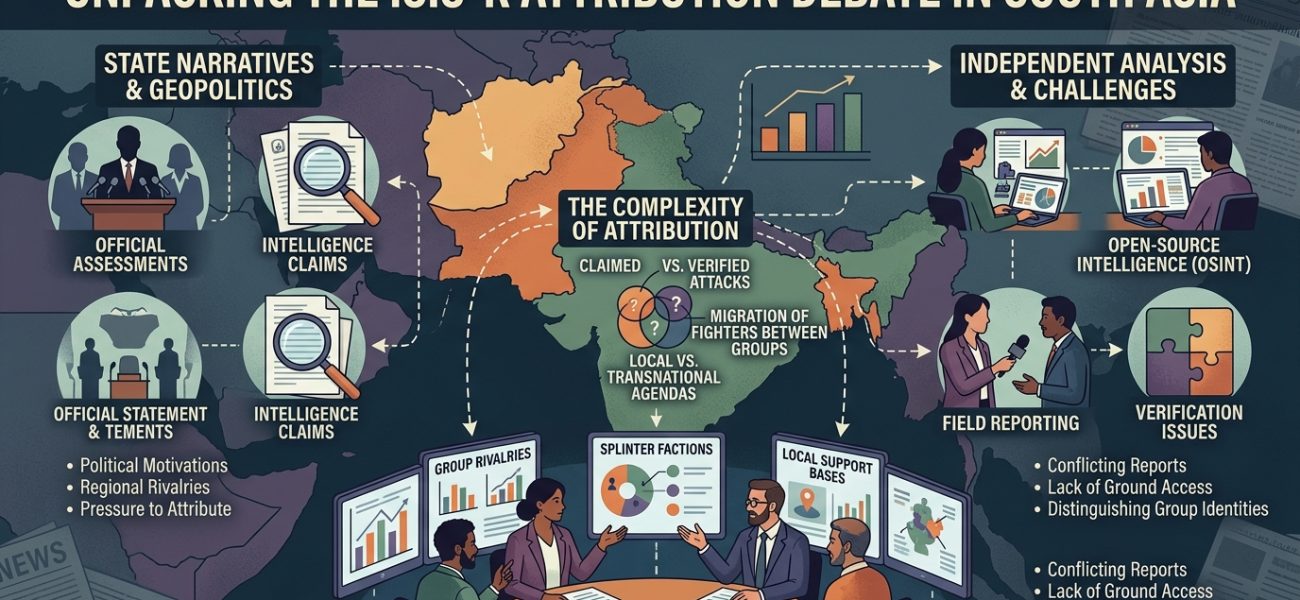
Unloading the ISIS-K Attribution Debate in South Asia
On the over-information battlefield in South Asia, single statements travel more quickly than facts—but few of them withstand collision with those facts. The recent allegation by Zabihullah Mujahid...

On the over-information battlefield in South Asia, single statements travel more quickly than facts—but few of them withstand collision with those facts. The recent allegation by Zabihullah Mujahid that the Pakistani military and intelligence agencies are not only supporting ISIS, but doing so with absolute certainty, comes without any provable evidence and is not consistent with the realities of ISIS-K actions in the region.
First of all, ISIS-K is neither a shadow proxy acting under the guidance of a state; it is one of the most indiscriminate militant groups active in the area. It has been associated with hundreds of attacks in Afghanistan and Pakistan, based on consolidated data from international conflict monitoring databases and UN reporting mechanisms. Thousands of civilians and security personnel have died as a result of these attacks. In Pakistan alone, ISIS-K has claimed or been linked with major mass-casualty incidents such as the 2018 Mastung bombing in Balochistan and the 2023 mosque shooting in Peshawar, which together resulted in well over 200 deaths. Other targets of the group include Shia Muslims, Sufi shrines, security convoys, and urban public spaces. This is not strategically selective violence—it is ideologically driven and broadly destabilizing.
This operational reality alone makes the claim of Pakistani state sponsorship extremely far-fetched. The behavior of a group that conducts regular assaults within Pakistani territory and kills civilians and security forces does not align with that of a state-controlled instrument. Rather, ISIS-K is a decentralized insurgent network that recruits through disaggregated local cells, leverages ungoverned spaces, radicalizes individuals in prisons, and uses transnational channels of ideological indoctrination. It is fluid, competitive, and often in conflict with other militant organizations in the same environment, including Tehrik-i-Taliban Pakistan and various regional factions. The concept of centralized state command over ISIS-K in such a landscape does not align with how the group operates on the ground.
From a methodological perspective, allegations of state sponsorship of a terrorist group require a high evidentiary standard. Historically, such claims are substantiated through financial tracking, intelligence disclosures, intercepted communications, or documented operational coordination. However, in public records—including United Nations monitoring reports, independent conflict data, and major security think tank assessments—there has been no independently verified evidence of institutional-level support by the Pakistani military or intelligence agencies to ISIS-K. This absence is not incidental; it is central to evaluating the credibility of such a serious allegation.
Equally significant is the broader composition of militancy in the Afghanistan-Pakistan region, which is often misinterpreted in political discourse. The region is no longer defined by single, centrally organized insurgencies but by fragmented networks with competing ideologies and fractured command structures. ISIS-K exists within this ecosystem not as a proxy of a state, but as a competing extremist actor—often in conflict with both other militant groups and state structures. It is precisely this fragmentation that allows such groups to persist, exploiting governance gaps, cross-border movement, and local grievances rather than operating under centralized sponsorship.
The accusation also reflects a common pattern in conflict politics: the use of attribution as a tool of strategic narrative. In politically charged environments, assigning responsibility to an external actor can serve multiple purposes—it diverts attention from internal security challenges, consolidates domestic political discourse, and shapes international perception. However, while such narratives may function rhetorically, they cannot substitute for evidence-based analysis. References to specific incidents—such as attacks on religious sites—do not establish state involvement without publicly verified investigative findings demonstrating such links.
📄 POLICY WIRE WHITEPAPER PUBLISHED: PAKISTAN'S NATIONAL SECURITY POLICY PRIORITIES
👉 READ BY CLICKING HEREMeanwhile, international assessments consistently indicate that ISIS-K continues to operate within Afghanistan, maintaining recruitment networks and operational planning capabilities across multiple provinces. This internal dimension is crucial, as it underscores the endogenous nature of the group. ISIS-K is not an externally imposed phenomenon but a localized manifestation of transnational jihadist ideology adapted to regional instability. Any serious counterterrorism analysis must therefore account for internal governance challenges, security fragmentation, and processes of ideological radicalization within Afghanistan and the broader region, rather than attributing the phenomenon solely to external actors.
Ultimately, the argument that Pakistan supports ISIS collapses under scrutiny—not only due to the lack of evidence, but because it contradicts the behavior, structure, and operational history of ISIS-K itself. The group’s pattern of mass-casualty attacks across both Afghanistan and Pakistan, its ideological hostility toward state systems, and its fragmented insurgent organization all point to an independent extremist entity operating within a fragile regional ecosystem.
Precision is essential in a complex conflict environment like South Asia. Reducing a multifaceted insurgent landscape to a simplistic narrative of state sponsorship may serve political purposes, but it does not provide an empirically accurate understanding of how groups like ISIS-K function. The challenge for analysts and policymakers is to resist the allure of convenient attribution and instead engage with the complexity that defines the region.
Author