

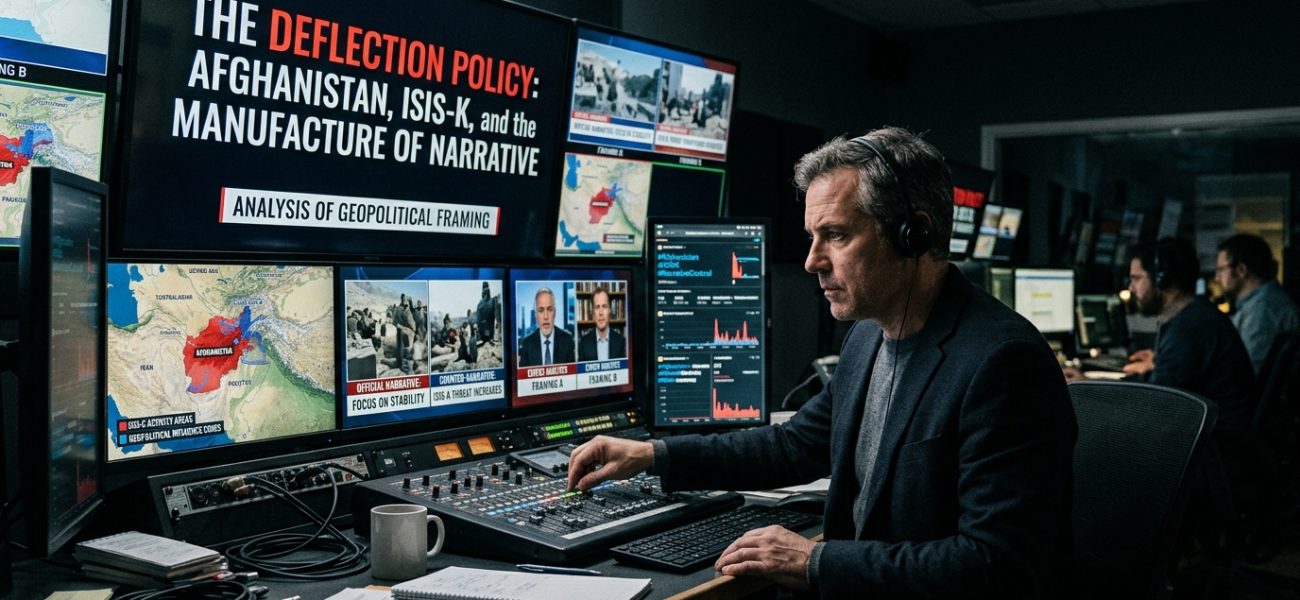
The Deflection Policy: Afghanistan, ISIS-K, and the Manufacture of Narrative
When a regime controls the territory but not the threat, it owns the consequences. When two actors coordinate on narrative while diverging from reality, the distortion becomes deliberate. In late...

When a regime controls the territory but not the threat, it owns the consequences. When two actors coordinate on narrative while diverging from reality, the distortion becomes deliberate.
In late 2024, Zabihullah Mujahid, the spokesman of Afghanistan’s Taliban regime, offered Pakistan a pointed warning. He claimed the country was “raising a snake in its sleeve” by allegedly supporting ISIS-K, an accusation he linked to violence affecting both sides of the border, including a suicide attack on a Shia mosque in Islamabad.
The framing is hilarious at this point: position Afganistan as the aggrieved actor and recast Pakistan as the source of instability, how ironic. But stripped of rhetoric, the statement reads less like a security assessment and more like a calculated act of propaganda against Pakistan. At a time when terrorist networks continue to operate within Afghanistan’s borders, such claims do not clarify the problem, they attempt to relocate it.
On Territorial Control and Its Consequences
The foundational question in any serious analysis of ISIS-K’s operational persistence is a simple one: who controls the territory in which it operates? The answer, since August 2021, Afghanistan regime is providing them safe heaven. The Afghan Taliban exercises full territorial authority across Afghanistan. There is no competing government, no divided sovereignty, no ungoverned space in the legal or political sense. What exists instead is a regime in full control of the administrative apparatus, the security forces, and the borders of a country in which ISIS-K is thriving, by multiple independent assessments, expanded its operational capacity, most notably across Nangarhar, Kunar, and Nuristan provinces.
This territorial reality has a legal and moral corollary that the international community has been insufficiently direct in stating: full territorial control carries full territorial responsibility. A regime that governs every province, commands every checkpoint, and appoints every governor cannot simultaneously disclaim accountability for what operates within those provinces, checkpoints, and governorates. The persistence of ISIS-K infrastructure inside Afghanistan after four years of Taliban rule is either a product of the regime’s inability to dismantle it, which is itself a damning assessment of its governance capacity or its unwillingness to do so, which raises questions the Emirate’s spokesmen have shown no interest in answering. Neither explanation is compatible with the posture of aggrieved innocence that Kabul has adopted in its public communications.
Full territorial control carries full territorial responsibility. There is no principled position by Afghan regime.
A Brief History Lesson for Zabihullah Mujahid
The claim that ISIS-K is a Pakistani creation, or that Pakistan’s security apparatus sustains it, is not a new allegation but it is one that deserves to be met with the historical record rather than diplomatic circumspection. ISIS-K did not originate in Pakistan. It consolidated its presence inside Afghanistan after 2014, exploiting the power vacuums of a country at war. Its entrenchment accelerated after August 2021and a specific event in that month merits direct mention: The Taliban’s mass jailbreak at Bagram Airfield, which released thousands of detainees, including individuals with documented connections to transnational terrorist networks. The operational dividend of that release was not absorbed by Pakistan. It was absorbed inside Afghanistan, by networks that have since carried out attacks from Kabul to Kandahar.
The Record
The suicide bomber responsible for the Islamabad mosque attack that Mujahid cited as evidence was Afghan. The geography of ISIS-K’s primary operational provinces like Nangarhar, Kunar, Nuristan is Afghan. The 2021 Bagram jailbreak that expanded its recruitment pool happened on Afghan soil, under Taliban watch. Pakistan is burying the victims of ISIS-K attacks. It is dismantling the networks. It is not the state that needs to be lectured on accountability in this conversation.
The request, then, is straightforward: before Kabul’s spokesman offers counsel to Pakistan on counter-terrorism responsibility, he might productively address why, after four years of consolidated Taliban regime, ISIS-K retains the organizational coherence to plan and execute complex attacks across multiple provinces. The international community has asked this question. It has not received a credible answer.
The Convergence of Narratives
📄 POLICY WIRE WHITEPAPER PUBLISHED: PAKISTAN'S NATIONAL SECURITY POLICY PRIORITIES
👉 READ BY CLICKING HEREWhat makes the Kabul deflection strategically significant is not merely its inaccuracy, it is the pattern in which it appears. Afghanistan’s Taliban regime and India have, over the same period, developed a convergence in their external messaging on Pakistan: one that consistently positions Islamabad as a source of regional instability, a patron of terrorist networks, and a state whose international standing should be interrogated rather than accepted. This alignment of narratives between Kabul and New Delhi is not incidental. It reflects a shared interest in redirecting international attention away from dangerous developments inside Afghanistan, and along the Line of Control that both actors have reason to obscure and disrupt Pakistan.
India’s contribution to this environment involves more than rhetoric. There are documented concerns, raised by Pakistani officials and noted in international security literature, about the use of Afghan territory as a staging and support environment for operations targeting Pakistani soil with external facilitation that is difficult to attribute publicly but impossible to dismiss analytically. The pattern of attacker profiles in several high-profile incidents in Pakistan points toward cross-border movement originating in Afghanistan. The persistence of certain terrorist networks, despite sustained Pakistani counter-terrorism operations, raises questions about the external support mechanisms that allow them to reconstitute. These are not conspiracy claims. They are operational questions that responsible regional analysis cannot avoid simply because they are politically inconvenient.
India’s apparent investment in narrative shaping including the potential use of incidents that obscure the chain of culpability, fits a discernible strategic logic: if Pakistan can be credibly associated with regional instability in international perception, the diplomatic and reputational costs it faces increase, irrespective of the evidentiary record. The convergence of this effort with Kabul’s public deflection produces a coordinated narrative environment in which perception and reality are systematically decoupled.
When two actors converge on a narrative while wandering off from documented reality, the pattern is not coincidence. It is strategy.
What Accountability Actually Looks Like
Pakistan’s counter-terrorism record in this period does not require embellishment. It requires acknowledgment which is precisely what the Kabul-New Delhi narrative axis is structured to prevent. Pakistan has absorbed a sustained campaign of terrorist violence, much of it planned across the Pak-afghan border, and has continued to intercept infiltrators, disrupt networks, and bury its dead, often with minimal international recognition and in the face of active reputational interference from neighbors with evident interests in its instability.
The contrast with Afghanistan’s posture is worth stating plainly. One state is conducting active counter-terrorism operations against groups like fitnah-al khawarij (FAK) that attack it from across a shared border. On the other hand, afghan regime is denying the problem exists, blaming the victim, and offering lectures on responsibility from a position of, at minimum, demonstrable governance failure. International observers, analysts, and policymakers who engage with South Asian security would benefit from holding these two records alongside each other before accepting the framing that Kabul and New Delhi have jointly invested in promoting.
Conclusion: The Cost of Deliberate Distortion
Regional stability in South Asia depends, among other things, on the quality of the analytical frameworks through which external actors understand its security dynamics. When those frameworks are shaped by coordinated narrative campaigns rather than evidentiary assessment, the consequences are not merely reputational, they are operational. Misattributed responsibility for terrorist activity protects the actors actually enabling it and imposes costs on those actually combating it. That is a perverse outcome, and it is one that the current convergence of Afghan and Indian messaging appears structured to produce.
Afghanistan controls its territory. It is responsible for what operates within it. Its spokesman’s confidence in redirecting that responsibility toward Pakistan should be assessed in light of what the ground record actually shows: ISIS-K entrenched in Afghan provinces, Afghan nationals executing attacks across the region, and a regime that has governed for four years without presenting a credible account of why the networks it claims to oppose continue to function with apparent impunity. Until that account is offered, the lectures can wait.
Author