

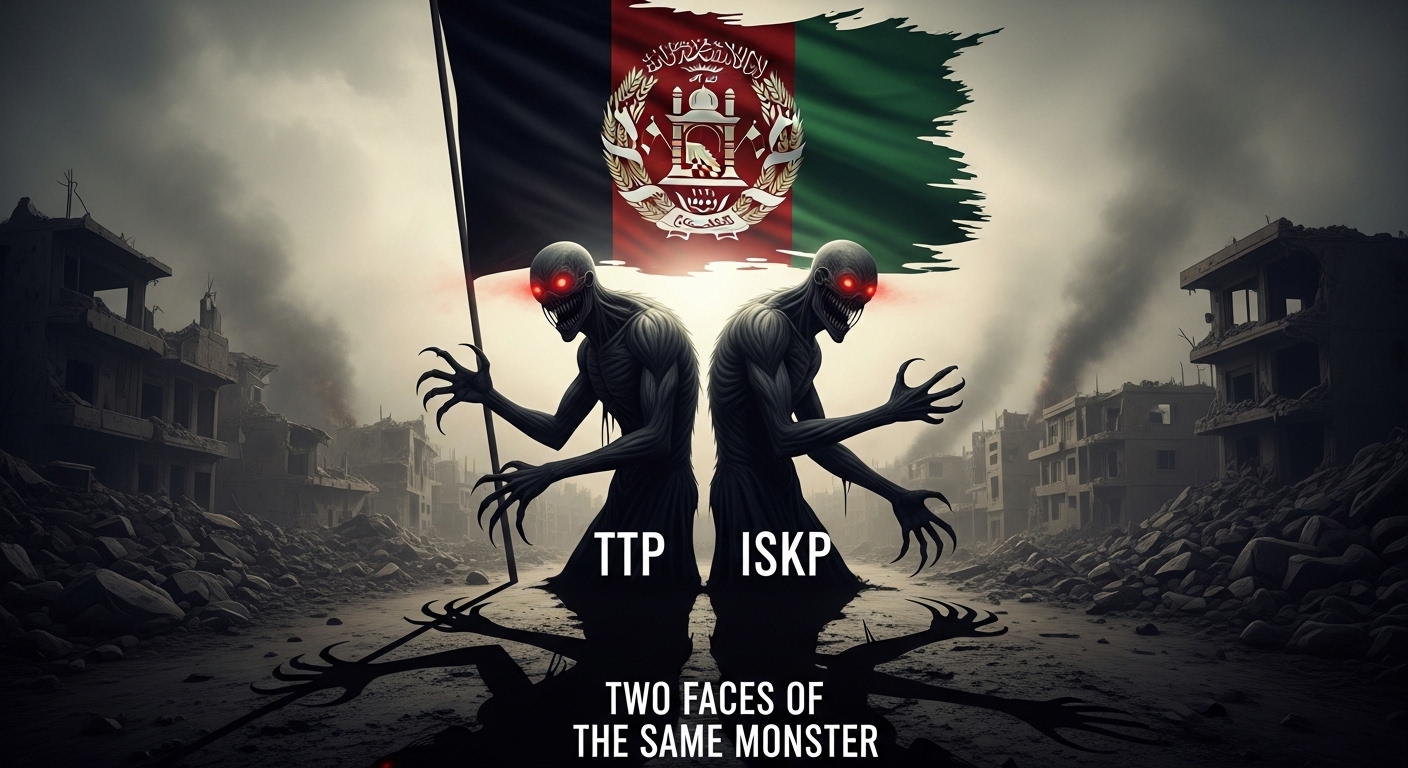
When Kabul accuses Pakistan of “supporting ISKP,” it is not a revelation — it is projection. The Afghan regime’s propaganda campaign, repeated by sympathetic online accounts, has little to do with facts and everything to do with deflection. While Pakistan continues to lose soldiers and civilians to cross-border terrorism, the evidence is overwhelming that both Tehreek-e-Taliban Pakistan (TTP) and Islamic State Khorasan Province (ISKP) operate from Afghan soil, often under the Taliban’s silent patronage.
Born of the Same Womb
The truth is that ISKP was never an external creation — it was born out of TTP’s own defectors. When Pakistan’s counter-terrorism operations pushed militants out of the tribal areas in 2014–2015, many fled across the border into eastern Afghanistan. There, under the chaos of post-withdrawal Afghanistan, they regrouped under the black flag of the so-called Islamic State.
Hafiz Saeed Khan Orakzai, ISKP’s founding emir, had been a TTP commander. His deputies Shahidullah Shahid and Gul Zaman Fateh were also TTP leaders who defected in 2015. Even Abu Saeed Bajauri, who later became ISKP’s third chief, was first seen in Umar Media — the TTP’s propaganda arm. The link between these two entities is not circumstantial; it is genealogical.
A Partnership, Not a Rivalry
Despite their public branding, TTP and ISKP have maintained an operational nexus now openly acknowledged by both Pakistani and UN intelligence. The UN Analytical Support and Sanctions Monitoring Team has repeatedly confirmed that ISKP’s Pakistan Province (ISPP) is led by former TTP commanders — and that there are no recorded clashes between the two inside Afghanistan.
Between 2023 and 2025, both groups executed a series of coordinated strikes in Pakistan’s northwest. The July 2025 Bajaur bombing, where both TTP and ISKP separately claimed credit using different cover stories (“vehicle blast” vs. “motorbike bomb”), demonstrated deliberate strategic ambiguity — a tactic to mask coordination.
In May 2024, the Bisham suicide attack that killed Chinese engineers was traced to a joint TTP–ISKP cell operating from Kunar. More recently, the Kurram revenge attacks in October 2025 revealed overlapping networks of militants avenging airstrikes that targeted safe houses inside Afghanistan.
The pattern is clear: TTP focuses on security forces to retain a veneer of “local legitimacy,” while ISKP specializes in high-casualty civilian and mosque attacks to maintain global jihadist visibility. But the logistics, safe havens, and personnel are shared.
Kabul’s Silent Patronage
The Taliban regime’s refusal to act against these networks has turned Afghanistan into a terror incubator once again. Pakistani intelligence and UN Security Council briefings consistently highlight the existence of TTP and ISKP sanctuaries in Nangarhar, Kunar, and Paktika.
Taliban spokesmen deny the presence of these groups, yet neither TTP nor ISKP faces meaningful restrictions within Afghan territory. Not a single significant clash has occurred between TTP and ISKP inside Afghanistan — a striking fact, considering that they allegedly hold irreconcilable ideologies.
In reality, both subscribe to the same Takfiri Khawarijism: an extremist doctrine that excommunicates Muslims and legitimizes the killing of innocents. Their shared purpose is to destabilize Pakistan and derail regional development under the guise of jihad.
If Pakistan were indeed “supporting ISKP,” as some Afghan propagandists claim, why are both TTP and ISKP targeting Pakistani soldiers, police officers, and even polio workers? Why are their bases exclusively inside Afghanistan and not in Pakistan? The Taliban’s narrative collapses under its own contradictions.
The Cost to Pakistan
Pakistan has paid dearly for the chaos exported from Afghan soil. Over 65,000 Pakistanis — civilians, soldiers, teachers, and aid workers — have lost their lives to terrorism over two decades. Each wave of attacks has coincided with periods of instability in Afghanistan, from the post-2001 vacuum to the Taliban’s 2021 takeover.
Pakistan has repeatedly shared actionable intelligence with Kabul and called for joint border mechanisms, but the response has been silence or denial. Instead, the Afghan leadership turns to social-media narratives and anonymous “sources” to blame Pakistan for the very problem emanating from its own territory.
A Global Blind Spot
The world’s indifference compounds the danger. International attention has largely shifted away from Afghanistan since 2021, allowing terrorist organizations to thrive in the shadows. Both ISKP and TTP now threaten not only Pakistan but also regional stability.
ISKP has targeted Chinese nationals, Central Asian embassies, and even attempted cross-border infiltration into Iran. Its operations extend from Jalalabad to Karachi — a footprint that should alarm every regional stakeholder invested in connectivity and security.
Yet global discourse often echoes the Afghan regime’s victimhood narrative, overlooking the documented evidence of militant sanctuaries. This selective blindness risks another regional implosion.
Pakistan’s Position
Pakistan’s stance remains consistent: it seeks a stable, sovereign, and peaceful Afghanistan. But peace cannot exist alongside impunity. Islamabad has exercised patience and diplomacy — even after repeated provocations — in the hope that Kabul would act responsibly.
Instead, the Taliban’s tolerance of cross-border militancy has become a threat not only to Pakistan but also to its own legitimacy. The recent Bajaur–Dir–Kurram triangle of joint TTP–ISKP operations proves that militancy inside Afghanistan is metastasizing. If left unchecked, it could consume the very state that shelters it.
Conclusion: The Mirror Kabul Must Face
Kabul must confront the monster it continues to feed. The TTP–ISKP nexus is not a conspiracy — it is an established fact acknowledged by UN reports, regional intelligence, and the militants’ own media.
Blaming Pakistan will not erase the reality that both groups are Afghan-based, Afghan-protected, and Afghan-enabled. Instead of exporting blame, the Afghan regime should dismantle the terror ecosystem within its borders.
Until then, Pakistan will continue to defend itself — not through propaganda, but through facts and resolve.
Because while Afghanistan looks for scapegoats, Pakistan buries its martyrs.
Author