


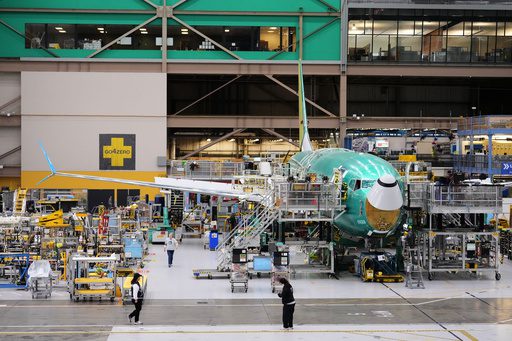
Trump’s Grand China Aviation Deal: Sky-High Promises Amidst Boeing’s Grounded Reality
POLICY WIRE — Washington, D.C. — The cheers from Air Force One, signaling an apparent breakthrough in U.S.-China trade relations, always felt a little too neat. President Donald Trump, fresh off a...

POLICY WIRE — Washington, D.C. — The cheers from Air Force One, signaling an apparent breakthrough in U.S.-China trade relations, always felt a little too neat. President Donald Trump, fresh off a summit with Chinese President Xi Jinping, proudly proclaimed a massive Boeing deal: 200 aircraft confirmed, potentially up to 750 more on the table. Big numbers, sure. But as any old hand on this beat knows, promises from presidential trips have a way of evaporating quicker than morning dew in August.
And this wasn’t just any trip. It involved Boeing, an aerospace giant that’s been having a truly awful run of it. While the President was airborne, painting a rosy picture for the assembled press pool, Beijing remained notably silent. Boeing itself issued no public statement. Nobody seemed in a hurry to confirm details, the plane types, or even how the alleged deal would actually be structured. Because, let’s be honest, often the most significant part of these announcements isn’t the deal itself, but the political performance surrounding it.
“I think we really have to wait until we hear numbers from Boeing or from the Chinese,” Bonnie Glaser, managing director of the Indo-Pacific program at the German Marshall Fund, noted pointedly during a briefing. Her skepticism wasn’t hard to discern. “All that we have is really what the president has told the world that China has agreed to.” This lack of immediate corroboration from either side — the alleged buyer or the supposed seller — tells its own story. It suggests either a deeply premature reveal or a highly conditional understanding, designed more for headlines than for hangar floors.
Boeing’s history with China isn’t just about selling planes; it’s a barometer for the tumultuous relationship between the two economic behemoths. Before the COVID-19 pandemic threw global travel into a tailspin, China soaked up roughly a third of Boeing’s narrowbody aircraft deliveries. It was a golden goose, providing an almost unparalleled growth market. Then, U.S.-China relations spiraled. China, in a highly symbolic move, became the first nation to ground the 737 Max in 2019, following two devastating crashes in Indonesia and Ethiopia that together killed 346 people, according to subsequent regulatory investigations. Max flights didn’t resume there until 2023, far later than in most other places. It’s hard to rebuild that kind of trust.
This China overture isn’t happening in a vacuum. President Trump has often positioned himself as a sort of global super-salesman for American manufacturing, Boeing especially. A year back, a Middle East tour reaped tangible rewards: Qatar Airways, for instance, inked a sprawling deal for up to 210 Boeing jets. Saudi Arabia followed suit. Even Turkey, a NATO ally but frequently an independent actor in regional geopolitics, saw its national carrier, Turkish Airlines, pledge a substantial order of 225 Boeing aircraft after President Erdoğan’s D.C. visit. It speaks to a broader strategy of intertwining economic leverage with geopolitical influence, hitting nations from Ankara to Islamabad – Pakistan, a burgeoning market often keenly eyeing these massive deals, frequently balances its own aviation needs with its increasingly complex economic dance between Western powers and Beijing, often leaning on China for infrastructure and trade.
📄 POLICY WIRE WHITEPAPER PUBLISHED: PAKISTAN'S NATIONAL SECURITY POLICY PRIORITIES
👉 READ BY CLICKING HEREAnd let’s not forget General Electric. The company, set to supply hundreds of engines if these new China deals materialize, would certainly appreciate the bump. “We’re absolutely committed to growing our presence in key global markets, and that includes China,” Boeing CEO Kelly Ortberg was quoted saying on a recent investor call, likely hoping to reassure investors despite the past year’s turbulence. “We appreciate the administration’s firm hand in opening doors; it’s invaluable.” He probably just hopes this ‘firm hand’ isn’t shaking the market a bit too hard.
Because the elephant in the room isn’t just Chinese non-confirmation; it’s Boeing’s tumultuous internal landscape. Ortberg took the reins in what was nothing short of a calamitous year for the company. January of that year saw a door plug inexplicably rip off a 737 Max shortly after takeoff from Portland, Oregon. That incident, alongside mounting scrutiny over alleged production and quality failures, plunged the company into a full-blown crisis. Weeks later, the U.S. Justice Department revived a criminal case connected to the earlier Max crashes, though a later agreement brought another $1.1 billion in fines and victim compensation. Then came an eight-week machinists’ strike that stalled production and twisted the knife deeper into the company’s strained finances. A sale to China right now, verified or not, could provide a desperately needed, albeit temporary, reprieve.
What This Means
This isn’t merely an aircraft order; it’s a political instrument, sharp on both ends. For the White House, it’s a headline grab, a visible “win” demonstrating tangible results from high-level diplomacy. It plays directly into the administration’s narrative of reviving U.S. manufacturing — and balancing the trade scales with China. The implied scale of the deal — up to 750 planes — suggests a grand gesture, almost a political reset, attempting to signal a thaw in what have been deeply frigid relations. Beijing, by not confirming the purchase immediately, retains leverage, choosing its moment to fully commit or walk away. This opacity gives them strategic flexibility, allowing them to gauge Washington’s eagerness before solidifying what could be a long-term commitment. Economically, even the confirmed 200 planes represent billions of dollars and potentially tens of thousands of jobs, offering a vital lifeline to Boeing. However, without firm specifics, it feels less like a done deal and more like a carefully orchestrated public relations offensive, intended to project strength and stability in uncertain times. The real implications won’t be in the rhetoric, but in the eventual contracts, which are, so far, conspicuously absent.