
Moscow’s Dismissal, Europe’s Jitters: The High-Stakes Theater of Denial
POLICY WIRE — Brussels, Belgium — It wasn’t the roar of tanks, nor the shriek of fighter jets, but rather the low, dismissive chuckle emanating from the Kremlin that reverberated across Europe...

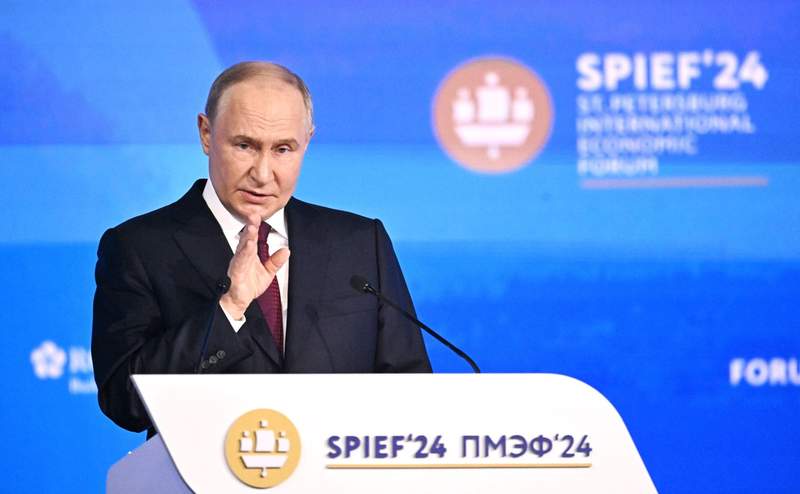
POLICY WIRE — Brussels, Belgium — It wasn’t the roar of tanks, nor the shriek of fighter jets, but rather the low, dismissive chuckle emanating from the Kremlin that reverberated across Europe last week. While NATO officials sound increasingly alarmist over Moscow’s bellicosity, President Vladimir Putin brushed aside their warnings of a potential Russian attack on alliance members as—what else?—‘nonsense.’
But that dismissal didn’t soothe many frayed nerves. Instead, it sharpened the continent’s anxieties, a subtle irony lost on perhaps only its speaker. Western leaders, watching Russia’s continued grind in Ukraine and its military modernization efforts, aren’t exactly buying the friendly denials. They’re making plans, and lots of them. They’re budgeting more cash, training more troops. They don’t just see a war on their doorstep; they see a historical pattern repeating, and they aren’t about to stand by.
General Christopher Cavoli, NATO’s supreme allied commander Europe, — and others like him, haven’t minced words. They’ve warned that Russia’s war machine, far from being hobbled, is adapting. Its aggression toward Ukraine? It’s not an isolated incident; it’s a terrifying dress rehearsal. And, this is where Putin steps in, wearing his usual poker face. His public utterances often serve multiple masters: intimidating adversaries, reassuring a domestic audience, and perhaps, just maybe, sowing enough confusion to gain an advantage.
“They’re inventing scare stories, plain and simple, for their own internal consumption,” Putin stated, according to state media. “Our military capabilities are being directed toward specific goals, and they aren’t territorial expansion against countries we have no dispute with—unless, of course, those countries invite our capabilities onto their territory.” It’s vintage Kremlin: deflect, blame, hint at provocation. An age-old game of chicken played with nuclear arsenals, just less polite now.
European officials aren’t blind, though. “We can’t afford the luxury of naiveté,” retorted Polish President Andrzej Duda during a recent press conference in Warsaw. “History has shown us what happens when such rhetoric isn’t taken seriously. We’re bolstering our defenses, not out of aggression, but because realism demands it.” Poland, on NATO’s eastern flank, knows a thing or two about regional hegemonies casting long shadows, and they aren’t relying on diplomatic pleasantries for security. Its defense spending, as a percentage of GDP, far outpaces many older, richer European states.
Because the implications of Russian adventurism, whether real or perceived, reach far beyond European borders. Nations in South Asia, including Pakistan, are watching this unfolding drama with keen interest—and considerable nervousness. Escalating tensions between global powers invariably impact global supply chains, drive up commodity prices, and complicate diplomatic maneuverings. Pakistan, already grappling with economic challenges and regional instability, needs stability, not another flashpoint in a volatile world. For them, it’s not just European security, it’s also the price of imported oil, wheat, and access to crucial global markets that are at stake.
It’s important to remember that only 11 of NATO’s 31 member states currently meet the alliance’s target of spending 2% of GDP on defense, according to recent NATO public data, despite the increasingly strident warnings. That disparity tells its own story. It’s a patchwork of urgency — and complacency, an alliance trying to rally around a new, cold reality.
But why the renewed panic, if Putin is merely bluffing? Russia’s unprovoked war in Ukraine shook the post-Cold War security order to its foundations. Its repeated violations of international law, coupled with saber-rattling exercises and aggressive disinformation campaigns, make ‘nonsense’ a tough pill for anyone to swallow, even the most dedicated fence-sitters.
What This Means
This war of words, despite its theatricality, masks a truly perilous geopolitical reality. Putin’s flat denial—part psychological warfare, part genuine grievance against what Moscow sees as NATO encroachment—forces Europe into a defensive posture. The political implication? Increased fragmentation within the European Union on defense spending priorities, even as the military-industrial complex gears up for a boom. Nations bordering Russia and Ukraine are racing to re-arm, creating a two-speed Europe when it comes to military readiness. That’s a deeply unsettling thought. It also plays into the Kremlin’s broader strategy of weakening Western resolve — and solidarity. You don’t have to attack directly if you can get your adversaries to exhaust themselves preparing for an attack that may never come—or to overreact to the possibility of one.
Economically, this climate of perpetual tension isn’t cheap. Defense budgets are swelling, diverting funds from social programs or other domestic investments. Energy markets remain hypersensitive to every twitch of the geopolitical needle, particularly concerning gas supplies to Europe. Sanctions, counter-sanctions, — and the ongoing disruption to global trade routes keep inflation stubborn. From the grim calculus of Gaza’s conflict to Netanyahu’s intricate power plays, the world’s power centers are increasingly interconnected. What Putin says, or doesn’t say, isn’t just news; it’s a financial forecast, a security alert, and a political temperature check all rolled into one.