


BRICS Discord: The Cost of Consensus Amidst Middle East Firestorm
POLICY WIRE — Cape Town, South Africa — The echoes of unspoken consensus can be deafening. That’s the sound emanating from the recent conclave of the BRICS nations—Brazil, Russia, India, China,...

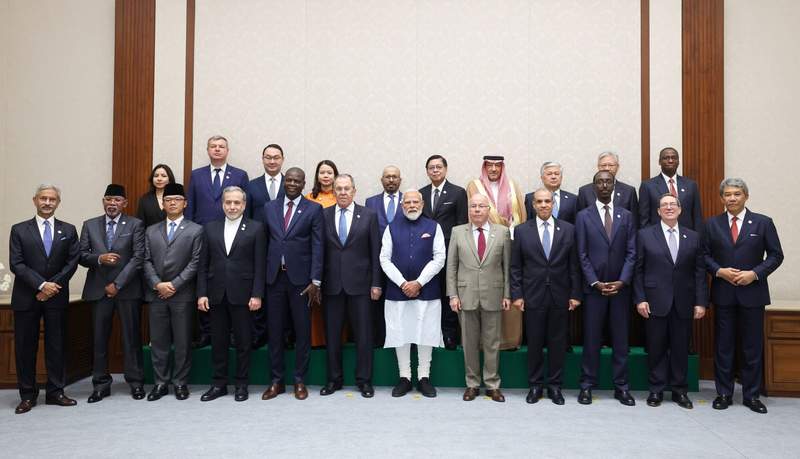
POLICY WIRE — Cape Town, South Africa — The echoes of unspoken consensus can be deafening. That’s the sound emanating from the recent conclave of the BRICS nations—Brazil, Russia, India, China, and South Africa, along with its newer additions. Their foreign ministers, after days of parleying in Cape Town, emerged not with a triumphant declaration of shared purpose, but with a stark, unsettling silence. No joint statement. Just vague assurances.
It’s a peculiar thing, this aspiration for a ‘multipolar world,’ when the poles themselves can’t agree on a single cardinal direction, especially when conflict flares. The official line, as always, paints a picture of constructive dialogue — and ongoing commitment. But scratch the surface, and what you’ve got is a very public-facing disagreement, born primarily from the festering wounds of the Middle East, carving deep divisions through what was meant to be a united front against perceived Western hegemony.
This isn’t just about diplomatic niceties; it’s about the very credibility of a bloc that professes to champion the Global South. For millions in burgeoning economies, BRICS symbolizes a break from old patterns. It’s meant to be a strong voice for sovereignty, economic collaboration, and, well, consensus. When the foreign ministers couldn’t even manage a communique—a staple of any such gathering—it speaks volumes about the chasm between ambition and messy, geopolitical reality.
An aide quoted Brazilian Foreign Minister Mauro Vieira as musing privately to delegates, "It’s always a disappointment when collective ambition for a shared economic future hits the jagged edges of geopolitical reality. But that doesn’t mean we stop trying. Our economic vision, it’s stronger than any single conflict." Noble words, certainly. But sometimes, economics — and geopolitics aren’t so neatly compartmentalized.
But the cracks, they weren’t exactly subtle. Member states’ differing stances on the Israel-Palestine conflict, specifically, turned what should’ve been a boilerplate expression of shared principles into a diplomatic dead end. Countries like Brazil and South Africa, historically vocal critics of Israeli actions, found themselves at odds with others within the expanded BRICS club, who might prefer a more tempered, or even neutral, public posture. You can’t paper over those kinds of deeply held convictions with abstract language. And because they couldn’t find common ground on language to describe the suffering in Gaza, they opted for none at all. It’s a tell. A big one.
South Africa’s Foreign Minister, Naledi Pandor, tried to frame it constructively. "We’re constructing a new world order here," asserted Pandor during a press briefing that carefully sidestepped specifics, "and sometimes, building takes longer when you’ve got diverse, sovereign voices all demanding to be heard. It’s a sign of strength, not weakness, that we don’t just rubber-stamp." That’s one way to spin it. Another way is that if you can’t even agree on a basic press statement, perhaps that ‘new world order’ is still mostly in the blueprints, gathering dust.
📄 POLICY WIRE WHITEPAPER PUBLISHED: PAKISTAN'S NATIONAL SECURITY POLICY PRIORITIES
👉 READ BY CLICKING HEREThe fissures opening within BRICS aren’t just academic chatter for places like Islamabad or Jakarta. They watch with a particular lens, keen on how these global realignments might — or might not — challenge existing power structures, especially as sentiments around Palestine burn brightly across much of the Muslim world. The expectation, for many, is for blocs like BRICS to offer a decisive, unified moral voice, especially on issues of perceived injustice. When that voice stutters, it chills some of that enthusiasm.
And then there’s the statistical elephant in the room: this expanded BRICS group now represents about 45% of the world’s population, according to analyses by financial institutions like the World Bank. That’s a lot of people whose collective political muscle should be formidable. But population alone doesn’t buy unity. Money talks, of course, but it doesn’t always harmonize, especially when humanitarian catastrophes are on the table. Beijing and Moscow might prioritize a united economic front against Western sanctions and dominance, but the humanitarian aspect, especially in the Muslim world, often drives different diplomatic priorities.
What This Means
This diplomatic vacuum in Cape Town doesn’t just make BRICS look less effective; it raises serious questions about its future as a cohesive force. For one, it subtly reaffirms the enduring influence of established powers—Washington, Brussels, London. While BRICS aims to offer an alternative, its inability to present a unified political stance suggests that it struggles to transcend the individual interests of its diverse members, particularly on emotionally charged global crises. This lack of a joint statement is a victory for the status quo, an unintentional validation of existing world orders rather than a disruptive challenge.
Economically, the internal disarray, though political in nature, casts a shadow over investment and trade initiatives that rely on political stability and predictability. Can countries truly trust a bloc for serious economic ventures if its political bedrock feels, shall we say, a bit sandy? for developing nations aspiring to join this expanded club, this spectacle of disagreement might give pause. They’re looking for stability — and leverage, not another forum for protracted, unresolved debates. It forces a recalibration of expectations about what a "multipolar world" really means in practice, perhaps revealing Asia’s own diverse and complex power plays beneath any superficial unity. It means the dream is still there, but the execution? Much harder than anyone let on.