

Trans-Afghan Railway: Steel Artery of a New Regional Order
In the era where geography is being redefined by infrastructure, the newly signed agreement between Afghanistan, Pakistan, and Uzbekistan to initiate the feasibility study for the Trans-Afghan...

In the era where geography is being redefined by infrastructure, the newly signed agreement between Afghanistan, Pakistan, and Uzbekistan to initiate the feasibility study for the Trans-Afghan Railway presents itself as a defining moment for the region. Released on July 17, the agreement brings life to a concept first put out in 2018- of steel tracks connecting Central and South Asia through a weak, war-torn but strategically crucial Afghanistan. This is not merely about freight and commerce. This is geopolitics on rails.
For landlocked Uzbekistan hoping to diversify trade and decrease reliance on Russian corridors, the Trans-Afghan Railway presents a southern passage to the Arabian Sea through Pakistan ports. For the Taliban-led government in Afghanistan, it is a chance to change narratives from insurgency and isolation to commerce and connectivity. And for Pakistan, it offers a welcome opportunity to rebrand itself not as a simple transit country but as a key pillar of a growing Eurasian transport network.
Geopolitical Logic Meets Economic Geography
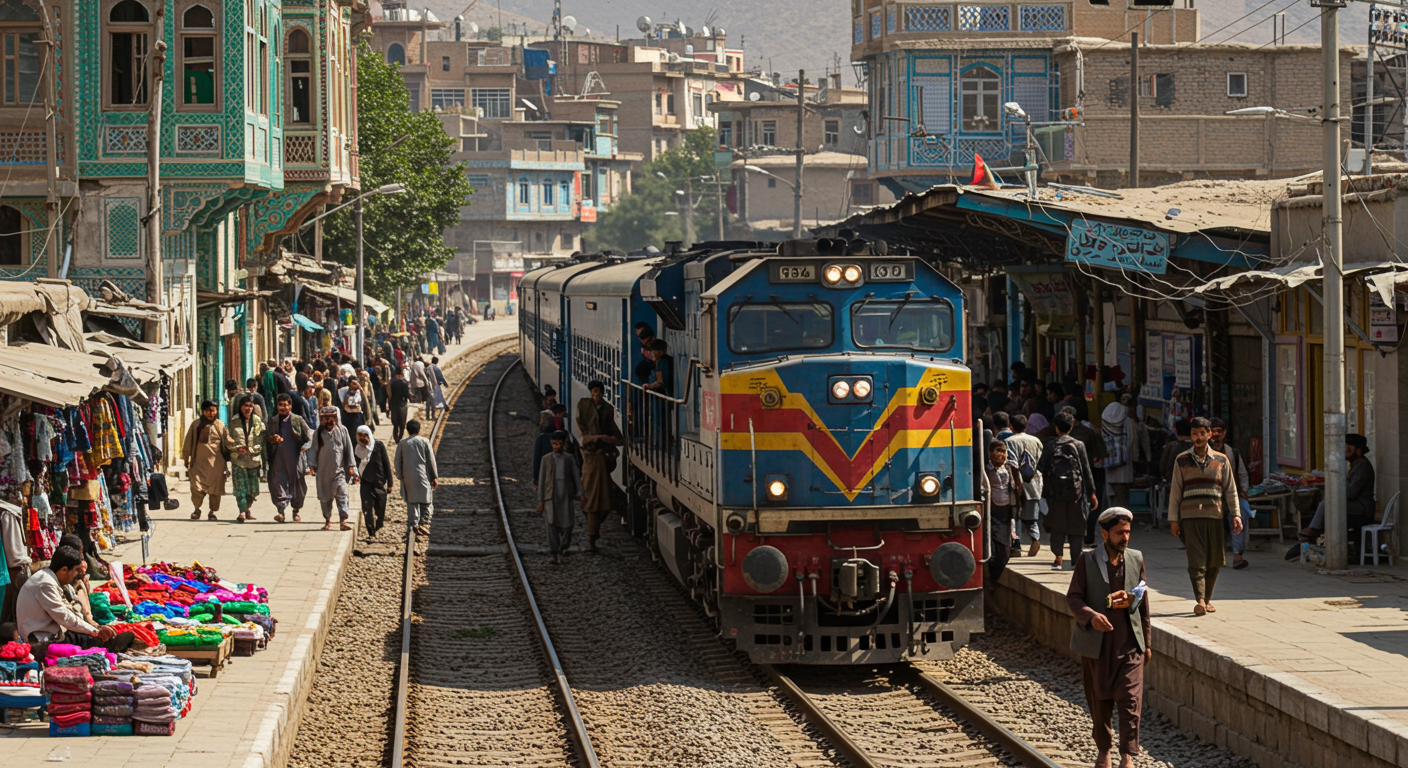
The planned line, running from Termez in Uzbekistan to Mazar-e-Sharif, Kabul, and on to Peshawar, bisects some of the most treacherous and politically unstable country in the region. But if completed, it would be nothing less than revolutionary. For generations, the absence of east-west transport links in this corridor has bound Central Asia to northern routes, notably Russia, and isolated Afghanistan from regional trade networks.
By creating a direct line from Uzbekistan to Pakistan, this rail avoids having to utilize longer, more indirect lines via Iran or China. The strategic significance is significant. The route can cut the delivery times for freight between Central Asia and Pakistani ports from 35 days to 15, changing the logistics landscape of the region. Also, it would challenge the superiority of other corridors such as the International North-South Transport Corridor (INSTC) led by Iran, India, and Russia.
Taliban’s Gamble: From Militancy to Logistics
For the Taliban, whose government is not recognized by the international community, the project is more than rails and ties — it is a political declaration. In pursuing infrastructure diplomacy, the Islamic Emirate indicates that it is changing direction to regional integration. The agreement on the feasibility study deal highlights their commitment to cooperating with neighbors on pragmatic, long-term development despite the continuation of international sanctions and internal problems.
This turn comes at risk. Security is still a key issue, especially in regions where Islamic State Khorasan (IS-K) is still active. History, however, proves that infrastructure may not just yield economic returns but some semblance of political stability as well. If the Taliban can provide safe passage for workers and commodities along the railway route, it might normalize relations with hesitant neighbors and global allies.
Pakistan’s Interests: From Isolation to Connectivity
Pakistan’s entry is no less strategic. Criticized for years for not garnering economic benefits from its location, Islamabad now has a unique opportunity to emerge as a pivot in transcontinental trade. The Trans-Afghan Railway closely resonates with Pakistan’s own vision of transforming itself into a regional transit hub, reiterated time and again in its National Security Policy and economic diplomacy initiatives.
Notably, this corridor can reinforce and even leverage the China-Pakistan Economic Corridor (CPEC), connecting it with wider Eurasian trade networks. Although China is not an official partner to the railway agreement, Beijing’s Belt and Road Initiative (BRI) logic hangs over the process. With the Trans-Afghan Railway potentially feeding into CPEC and ultimately reaching Gwadar or Karachi, a new North-South backbone could be built, linking Central Asia with the Arabian Sea.
Tectonic Realignments in Regional Alliances
The timing is important. As the competition among great powers grows stronger, and regional players redefine their foreign policies, smaller nations are looking for economic resilience in regional cooperation. Uzbekistan’s increasing assertiveness under President Mirziyoyev, Afghanistan’s need for legitimacy, and Pakistan’s post-IMF development initiative come together handily around this project.
But challenges abound. Funding remains uncertain. The security situation in Afghanistan is volatile. And mistrust between neighbors, often fanned by decades of proxy politics, will not dissipate overnight. Still, the willingness to proceed with a feasibility study reflects a shared recognition that the region’s future lies in connectivity, not confrontation.
Furthermore, the rail project provides a means for non-Western nations to exercise agency in their own developmental paths. When institutions worldwide are criticized as slow-moving and politicized, trilateral projects such as this indicate that regional responses can still emerge amidst global lethargy.
Rails Toward Reconciliation?
In a part of the world long characterized by war, the Trans-Afghan Railway project promises a different destiny, one where steel rails could achieve what diplomacy could not. It is a risky bet on connectivity as a route to peace and prosperity. It will succeed or fail not just based on engineers and investors but on political will, regional trust, and a belief that the dividends from trade exceed the expenses of hostility.
The feasibility study is only the first port of call. But it is a significant one and maybe the start of a process that will remake the strategic landscape of Asia.
Author