
The Unorthodoxy Dilemma: Maverick Quarterback Diego Pavia’s Gridiron Gambit Against NFL Orthodoxy
POLICY WIRE — New York, USA — It wasn’t the searing talent, nor the highlight-reel collegiate heroics, that truly defined Diego Pavia’s protracted descent through the 2026 NFL Draft....

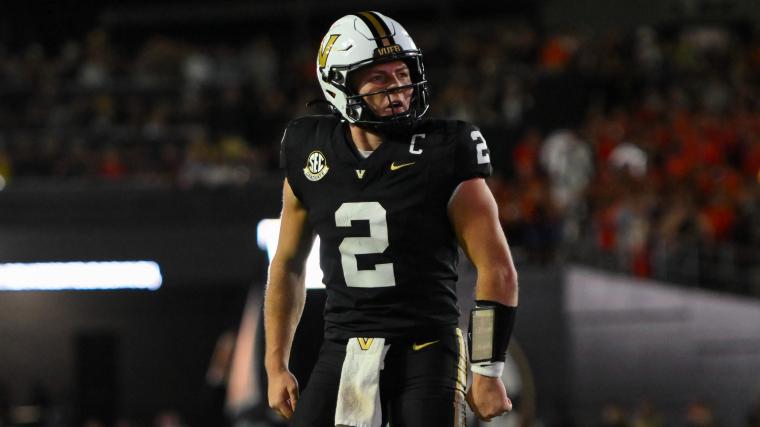
POLICY WIRE — New York, USA — It wasn’t the searing talent, nor the highlight-reel collegiate heroics, that truly defined Diego Pavia’s protracted descent through the 2026 NFL Draft. Instead, it was the stark, almost visceral, collision between an audacious individual will and the league’s immutable, deeply entrenched institutional dogma. The Vanderbilt quarterback, a Heisman Trophy runner-up, found himself a pariah not merely for his stature or playing style, but for daring to challenge the established order—an order that dictates not just how one plays, but how one behaves, and even how one navigates the labyrinthine commercial currents of professional sports.
After compiling an astonishing 4,401 combined yards through the air and on the ground in the 2025 season, punctuated by nearly 40 touchdowns and a 71% completion rate, Pavia’s on-field resume seemed unassailable. He should’ve been a top-tier prospect, a lock for the first two days. But professional football, it turns out, is rarely about simple arithmetic; it’s a Rorschach test of perceived potential versus ingrained prejudice. And Pavia, bless his pugnacious heart, seemed to deliberately paint outside the lines.
The primary, oft-repeated indictment centered on his physical dimensions. Listed generously at 6’0” by Vanderbilt, he measured a precise 5’9” and 7/8” at the Senior Bowl—a fraction that, in the NFL’s unforgiving lexicon, translates to a chasm. The brutal calculus of talent is clear: excluding Kyler Murray’s exceptional rookie year, no quarterback under 5-foot-10 has achieved sustained NFL success since 2000, according to historical league analytics. This wasn’t just a height deficiency; it was a historical affront to the league’s preferred prototype, a tacit rejection of decades of collected wisdom and bias.
“Look, we want a guy who can see over the line, who can command the pocket,” quipped one long-serving AFC General Manager, speaking off the record on Day 3 of the draft. “When you’re making multi-million dollar investments, you’re not looking for outliers. You’re looking for certainty, for a specific physical — and mental profile. It’s not personal; it’s just business.” This sentiment, though delivered with a veneer of impartiality, betrays the NFL’s deeply conservative approach to talent evaluation, often prioritizing conformity over genuine innovation.
And Pavia’s playing style, while electrifying in college, further confounded scouts wedded to tradition. Too many big plays manufactured off-platform, an over-reliance on his legs, an apparent aversion to the staid pocket passer archetype. It worked beautifully in the amateur ranks, but the NFL is a different beast, a sophisticated ecosystem where raw athleticism must be tempered by precise mechanics and unshakeable discipline. They wanted a sculptor; they got a street artist.
But it wasn’t just the measurables or the unorthodox play. It was the perceived attitude, the ‘off-field antics’ that grated against the league’s carefully curated image. Pavia, like some other high-profile prospects before him, made the cardinal sin of speaking his draft stock into existence, dismissing the talent of his peers and, most audaciously, confirming to former NFL coach Jon Gruden that he wouldn’t hire an agent. This wasn’t just a misstep; it was an act of economic insubordination. In a league where player representation is a multi-billion-dollar industry—a crucial cog in the machinery of modern sports capitalism—a player willingly opting out of that system presents a peculiar sort of threat.
“The agent system, for all its flaws, provides a buffer—a professional layer that understands the nuances of the league’s ecosystem,” posited prominent sports agent, Maya Singh, whose firm represents a significant contingent of NFL talent. “When a player chooses to go it alone, they’re not just betting on themselves; they’re betting against an entire industry designed to protect, and profit from, their potential. It’s an admirable display of independence, perhaps, but a commercially perilous one, especially for a player already fighting upstream against conventional wisdom.” Singh’s observation underscores the profound economic implications of Pavia’s decision, making him an anomaly in a hyper-commodified landscape.
His story, in a strange, circuitous fashion, resonates far beyond the American gridiron. In many parts of the world, particularly across South Asia and the Muslim world, established hierarchies and traditional pathways often dictate success in fields from cricket to commerce. Unconventional approaches, or individuals who eschew conventional intermediaries (like agents in sports, or traditional power brokers in politics), frequently face compounded scrutiny and skepticism from entrenched systems. Pavia’s battle against the NFL’s ‘typecasting’ mirrors the broader global challenge for talent that doesn’t fit neatly into predetermined molds, especially when they question the accepted norms of engagement.
What This Means
Pavia’s draft journey, or lack thereof through the early rounds, serves as a trenchant case study in the intersection of athletic prowess, commercial enterprise, and individual agency. His decision to forego an agent isn’t merely a personal preference; it’s a defiant stand against a system that thrives on intermediation, where every step of a player’s career is meticulously managed and monetized. This independence, while lauded by some as player empowerment, sends shivers down the spine of an industry predicated on control and predictability. The NFL, a behemoth generating billions, inherently prefers compliant, system-friendly assets—players who understand their place within the economic hierarchy. Pavia, conversely, represents a burgeoning, if still niche, movement of athletes seeking greater autonomy, challenging the very commercial infrastructure that defines their professional lives. His struggle isn’t just about making an NFL roster; it’s a microcosm of the broader tension between individual will and institutional power, between raw talent and the rigid demands of a hyper-capitalized sports machine. And as the global consumption of American sports narratives intensifies, these internal power struggles become a spectacle of their own, watched and analyzed by an ever-expanding global audience.
As Day 3 of the draft lumbered on, Pavia’s name remained stubbornly uncalled. His collegiate triumphs, his Heisman nod, his raw statistical output—all became footnotes to the narrative of a player who simply refused to be packaged, measured, and marketed in the conventional manner. And that, perhaps, was his greatest strength, — and his most profound professional impediment.