
The Strategic Engine Behind a Nation’s Rise
History glorifies leadership visions and sparkling skylines, but it seldom takes time to investigate the unseen building materials that bring aspirational statehood. The United Arab Emirates is...

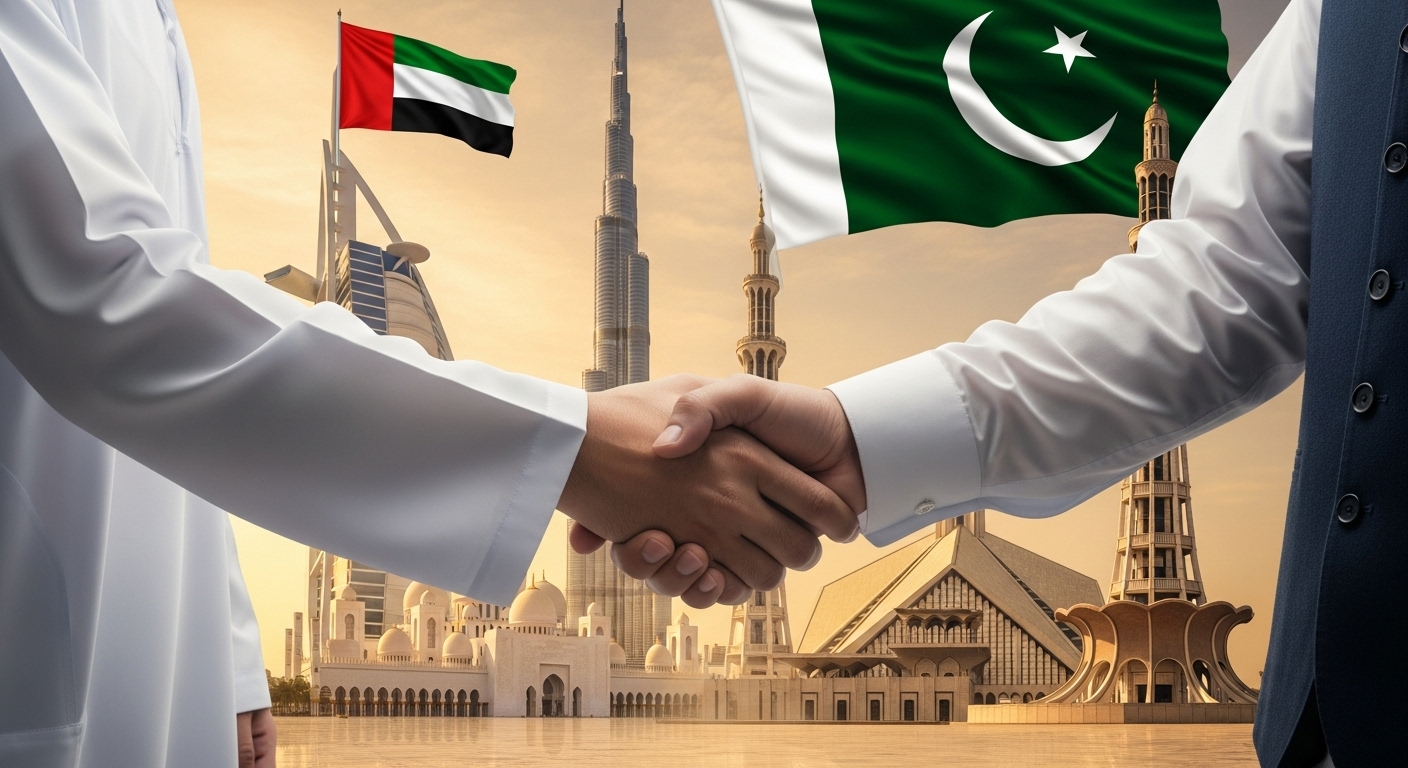
History glorifies leadership visions and sparkling skylines, but it seldom takes time to investigate the unseen building materials that bring aspirational statehood. The United Arab Emirates is rightfully considered to be a modern miracle, an island of stability, ambitions, and internationality. However, under this remarkable change, there is a very fundamental reality, that Pakistan was not just a friendly neighbor to the UAE in its youth. It was a strategic planner, a provider of security, and an institutional companion whose mark is placed upon the very first structures of the federation.
Since the very time when the UAE was recognized as a sovereign state, Pakistan was behaving in the most convincing and clear way. It was the first nation to recognize the new federation in the world and it did so on 2 December 1971. This was not a form of symbolic courtesy. When most world players were sceptical of the survival of the weak-looking union of seven emirates, early recognition granted Pakistan the immediate diplomatic validity. It was the indicator of the belief in the persistence of the Emirati project and the location of Pakistan in the center of the UAE international acceptance.
This political promise was based on a level of strong personal relationship between Sheikh Zayed bin Sultan Al Nahyan and the Prime Minister of Pakistan, Zulfikar Ali Bhutto. They did not relate transactionally, but based on trust and common strategic instincts. Sheikh Zayed publicly acknowledged Pakistan as his second home and used his personal funds to invest in the common good of Pakistan, which was most clearly manifested in the Sheikh Zayed Medical Complex in Lahore and Rahim Yar Khan Airport. They were not the overtures of a foreign benefactant, but those of an ally whose perception of Pakistan as a stable and prosperous country was part of his vision of the region.
Pakistan has had a silent yet decisive role in aviation perhaps in no other area. The emergence of the UAE as an international center cannot be discussed outside of Emirates Airline that has become one of the most influential airlines in the world. But Emirates did not come out a full fledged. Pakistan International Airlines successfully incubated it. At the time when Dubai started Emirates in 1985, PIA offered the blue print of operation, technical knowhow and training facility as well as the initial two aircrafts including a Boeing 737-300 and an Airbus A300B4-200. On 25 October 1985, the maiden Emirates flight, EK600, flew Dubai-Karachi, captained by Pakistani pilot Fazal Ghani, and the cabin crew were trained in Karachi facilities of PIA. The symbolism was too strong: the Pakistan literally steered the UAE into the world.
Security, also, was of a decidedly Pakistani stamp. During the initial decades of development, the national defense complex of the UAE was influenced by the military forces of Pakistan. The UAE Air Force had Pakistan air force officers as its first five Air Staff Chiefs, starting with Air Commodore Ayaz Ahmed Khan. In the 1970s, Pakistani fighters achieved a majority of the fighter pilots in the UAE (More than 50 percent). The Pakistan Army has set up the Armour Training School, the first UAE Commando battalions and Presidential Guard, and assisted in entrenching professional military doctrine into the fledgling federation. The Pakistan Navy, in their turn, helped build the initial sea forces, enhancing the security on the coastal levels in the period when the uncertainties in the region were rather severe. Pakistan did not merely prepare a staff, in its role, it assisted in the construction of a framework of a modern security state.
Defense was just the tip of the institutional foot. In the UAE, the National Engineering Services (NESPAK) of Pakistan has completed over 27 major projects since 1975 worth over 550 million. These involve such important projects like the Al-Wathba Military Township and the 90 kilometer UAE-Oman border security fence. These were not cosmetic projects, these were the main parts of the national infrastructure and territorial integrity.
A similar tendency of structural involvement can be found in finance and media. Among the most influential financiers in Pakistan was Agha Hasan Abedi who was the main advisor to Sheikh Zayed. He established United Bank Limited in UAE and subsequently the Bank of Credit and Commerce International which served as a key focal point in handling oil revenues, and also integration of UAE into financial networks of the global world. In the media and soft power, the Khaleej Times, the joint venture of Dubai Galadari family and the Dawn Media Group of Pakistan, established in 1978 assisted in creating the public discourse of the UAE as the bulk of the news sources were Pakistani journalists who formed the backbone of the English-language press in the country.
In addition to the institutions, the human resource of the early UAE was provided by Pakistan. The first generation of Emiratis were taught by the Pakistani teachers. The early legal structures were framed with the assistance of Pakistani judges. In cases where there was low capacity, Pakistani doctors were employed in the public hospitals. That was not expatriate labor as such, but national building of knowledge.
Now that human fraternity thrives on a monumental level. Of the UAE, one of the largest communities of expatriates is over 1.8 million Pakistanis. They have constructed physically landmarks between the Sheikh Zayed Road and the Dubai Metro to Burj Khalifa. They are still driving industries such as logistics and construction as well as the industry, health, and information technology. This relationship has in the contemporary world advanced to become a strategic economic alliance with moves like the AD Ports- Karachi Port Trust and the $25 billion UAE investment road map 2024-2025 through the Special Investment Facilitation Council in Pakistan.
All this does not weaken the extraordinary vision of Emirati leadership, infact, it was the political unity, resourceful appreciation, and strategic thinking over the long term of Sheikh Zayed and his successors that made the desert settlements a world crossroad. States are not built on vision alone. It entails institutional motors, professional structures and credible partners who are ready to invest skills before the fruits become visible.
Exactly that is what Pakistan did in that very critical early stage. It did not just favour the UAE; it assisted in the formulation of the systems that enabled the sovereignty to take effect. Basically, the UAE success is the embodiment of a progressive Emirati leadership, and Pakistan was the engine that facilitated the success of the vision of the UAE on its very first day.
Author