

Eagles’ Unsettled Dynasty: The Shifting Sands of Philadelphia’s Gridiron Corporation
POLICY WIRE — Philadelphia, United States — In the cutthroat calculus of contemporary professional sports, few institutions navigate the treacherous currents of expectation and expenditure with as...

POLICY WIRE — Philadelphia, United States — In the cutthroat calculus of contemporary professional sports, few institutions navigate the treacherous currents of expectation and expenditure with as much visibility—or volatility—as an NFL franchise. Philadelphia, the sprawling East Coast sports metropolis, currently watches its Eagles, a perennial contender, undertake an offseason less about resting on past laurels and more about a quiet, almost nervous, realignment. The much-anticipated Organized Team Activities (OTAs) that began this week aren’t merely practice drills; they’re the initial tremors of an internal corporate restructuring playing out in plain sight.
It’s not just about X’s and O’s. No, it’s about a multi-billion-dollar enterprise—a team valued at north of $5.6 billion, according to recent Forbes estimates—attempting to recalibrate its human capital amidst a relentless competitive environment. Leadership, player acquisition, internal dissent; it all coalesces into a familiar drama. This isn’t just football; it’s a high-stakes governance project where every personnel decision carries economic and cultural weight, felt from the stadium seats to boardrooms in Lahore, where passionate fans of Western sports analyze every strategic shift.
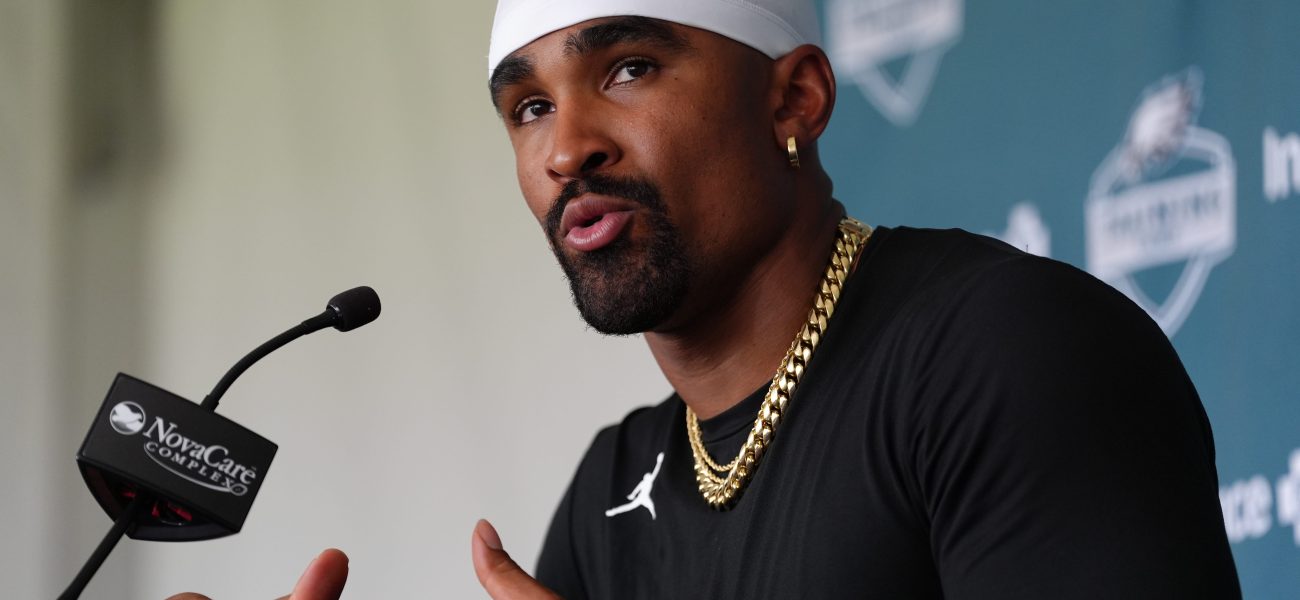
At the apex of this precarious hierarchy stands Jalen Hurts, the young quarterback whose immense talent is, ironically, overshadowed by the constant carousel of coaching staff orbiting him. Three seasons, three offensive coordinators—it’s a staggering figure, indicative of a leadership team perhaps still seeking a consistent vision. Can he, an already stoic figure, continuously absorb new systems, new jargon, — and still maintain an elite performance? It’s a burden few Fortune 500 CEOs are asked to shoulder so repeatedly, let alone on such a public stage. "Look, we pay these guys generational money. We expect them to adapt, to lead," an anonymous high-level Eagles executive stated with disarming candor. "It’s not a charity; it’s a multi-billion dollar operation with fan investment on the line. Adapt or perish, that’s the market reality."
Then there’s the crowded backfield, a microcosm of the entire organization’s dynamic. Saquon Barkley, a marquee €32 million free-agent acquisition, represents a clear investment in immediate power, but what of the others? Tank Bigsby showed flashes; Will Shipley needs a spark; Dameon Pierce seeks redemption. It’s a struggle for scarce resources—each rushing attempt, each yard, a piece of the pie. It’s a meritocracy, sure, but also a fierce internal battle for survival. Because for every dollar spent on a star, dozens of hopefuls vie for crumbs.
But nowhere does the organizational churn manifest more overtly than in the wide receiver room. The incessant speculation surrounding A.J. Brown, a prominent pass-catcher, has become a festering wound—a public relations challenge for the franchise that’s also disrupted internal stability. Philadelphia’s response? An aggressive reshuffling, adding multiple new talents, a tactic reminiscent of a state acquiring multiple allies in a contested region, hoping strength in numbers negates individual uncertainties. But will these new faces—Makai Lemon, Hollywood Brown, Dontayvion Wicks, Elijah Moore—coalesce into a cohesive unit? Or will the increased competition splinter existing dynamics?
📄 POLICY WIRE WHITEPAPER PUBLISHED: PAKISTAN'S NATIONAL SECURITY POLICY PRIORITIES
👉 READ BY CLICKING HEREAnd what about the succession planning, subtly initiated in the tight end group? Dallas Goedert remains the seasoned hand, a dependable workhorse. Yet, the high-profile drafting of Eli Stowers, fresh out of the collegiate ranks, isn’t just about depth; it’s a clear signal. This signals an executive decision for future-proofing, perhaps a reflection of a broader trend seen across various sectors, from tech startups to diplomatic corps, where preparing for tomorrow’s leadership is as urgent as managing today’s.
Finally, the bedrock: the offensive line. For a decade, it was a monolith, a symbol of Eagles supremacy. Now, the architect, Jeff Stoutland, is gone, and Chris Kuper inherits the formidable task of maintaining that elite standard. The foundation is still robust—Mailata, Jurgens, Dickerson, Johnson are stalwarts. But even titans age, as Lane Johnson nears 35. And Dickerson’s slight dip in pass protection last season is a ripple effect—a small crack in a once-impregnable wall that policy strategists, like general managers, must monitor relentlessly. The younger talent must emerge, — and fast, to avoid a seismic shift in performance.
What This Means
This micro-drama playing out on Philadelphia’s practice fields reflects a macro reality in many high-stakes environments, whether corporate boardrooms, political parties, or even nations grappling with changing alliances. The constant demand for ‘optimization’ and ‘reset’—often driven by market forces and fan sentiment—creates a perpetual state of flux. Leadership, even when nominally stable, finds its influence tested by ever-shifting personnel — and public scrutiny. This isn’t just about wins and losses; it’s about the staggering financial obligations to these ‘assets,’ a scenario echoed in how states manage costly infrastructure projects or global corporations navigate diverse supply chains. The brutal alchemy of billions is a universal force. The Eagles’ experiment this offseason serves as a real-time case study in how deeply entrenched power structures—or lack thereof—can either stabilize a massive organization or, conversely, unravel it, even with immense resources at hand. Prodigies face similar crossroads across global sporting ecosystems, all part of this ceaseless churn.