


The Scrappiness Economy: How Unsung Talent Uproots Basketball’s Giant Narratives
POLICY WIRE — OKLAHOMA CITY, USA — In an arena increasingly fixated on titans and the quantifiable gargantuan—those few, colossal individuals around whom entire economic empires and tactical schemes...

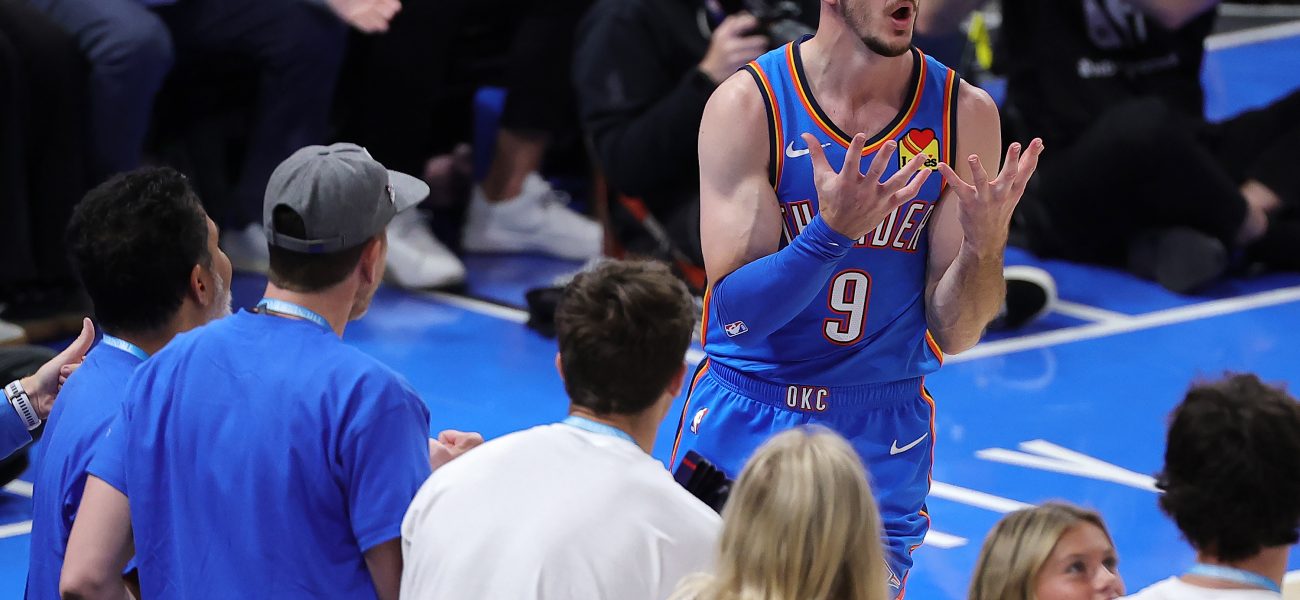
POLICY WIRE — OKLAHOMA CITY, USA — In an arena increasingly fixated on titans and the quantifiable gargantuan—those few, colossal individuals around whom entire economic empires and tactical schemes revolve—sometimes the real policy lesson emerges from the dust and sweat beneath the rim, propelled by an altogether different sort of capital. Call it the ‘scrappiness economy.’ Here, the market undervalues, traditional metrics miss the true yield, and disruptive innovation comes wrapped in an unassuming, 6-foot-5 frame, much like Alex Caruso for the Oklahoma City Thunder.
His recent skirmishes with Victor Wembanyama, the NBA’s latest human Eiffel Tower, offer a fascinating case study. Because really, what else do you do when confronted with an undeniable, generational talent destined to warp the game for a decade? You don’t back down, not if you’re Caruso. You lean in, elbowing past the widely accepted wisdom that such mismatches are insurmountable. While others on the opposing San Antonio Spurs squad seemed to treat Wembanyama like a protected landmark—a beautiful, unmovable object best admired from a distance—Caruso, the quintessential utility player, went right for the jugular. And it worked, didn’t it?
It’s not just audacity. This isn’t simply some feel-good sports story about an underdog. There’s a cold, hard efficiency to it, a strategic deployment of resources that policy makers might well ponder. Caruso’s repeated drives into Wembanyama’s terrifying wingspan, his step-back jumpers launched just beyond the Frenchman’s reach, his relentless shadowing across the court—these aren’t random acts of bravery. They’re calculated plays designed to stretch defenses, expose blind spots, and ultimately, extract a different kind of value. Think of it as arbitrage in real-time, leveraging overlooked intangibles against a dominant, yet predictable, market force.
Thunder coach Mark Daigneault—a man who’s likely had more sleepless nights strategizing against such anomalies than a think tank preparing for an election—put it bluntly after the team’s decisive win. “He’s got an unbelievable focus — and is a monster competitor,” Daigneault observed. “It seems like the bigger the moment, the bigger the game, the more he wants to compete in it. And he’ll fail — and not blink, and he’ll be aggressive in the next possession, next game and he was huge again tonight. His minutes were massive for us.” That’s the kind of gritty persistence you find, perhaps, in the developing industrial sectors of say, Pakistan—where ingenuity and sheer will often compensate for disparities in traditional resources. The drive to innovate, even on a basketball court, is a globally resonant theme.
But the story of Caruso’s effectiveness—17 points, 5 assists, and 3 rebounds on efficient 5-for-7 shooting, all with Wembanyama guarding him, in Game 2 alone—really hinges on the deeper strategic advantage he represents: the Oklahoma City Thunder’s extraordinary depth. Lu Dort, another key defensive linchpin, was quick to highlight this, telling Yahoo Sports that Caruso’s “leadership is over the roof, honestly, especially on the [defensive] end of the floor. He communicates a lot. He’s really smart as a player…” Such unglamorous, yet absolutely necessary, contributions don’t just happen. They’re cultivated.
This approach has allowed the Thunder’s bench to consistently outmaneuver opponents, posting numbers that defy simple box-score narratives. During the game in question, the Thunder’s reserves piled up 57 points. That’s a significant chunk, right? More specifically, according to official league data, the lineup combination of Caruso, Cason Wallace, and Jared McCain blitzed the Spurs by 14 points in less than three minutes—a quick, surgical strike of collective synergy that few teams can match. It shows a systemic, policy-driven emphasis on building not just a star, but a resilient, interconnected ecosystem of talent that can weather any storm. This strategy provides critical buffers for when the main pillars falter, as star wing Jalen Williams did when he re-aggravated his hamstring. The ‘bench mob,’ if you will, stands ready. Think of it like a diverse national economy—it’s not just about one flagship industry, but a robust array of supporting sectors that pick up the slack when the going gets tough.
What This Means
This dynamic offers profound implications beyond the hardwood. For policymakers, it illustrates the intrinsic value of comprehensive talent development programs—not just focusing on top-tier prospects but nurturing a broad base of adaptable, ‘swiss-army-knife’ contributors. An economy built solely on superstars, much like a team overly reliant on one player, carries immense, unnecessary risk. The Thunder’s strategy speaks to investment in varied skill sets, cross-training, and fostering a collaborative culture where individuals understand their nuanced roles within a larger, interconnected system. It’s a playbook for institutional resilience, showing how distributed intelligence and capability—the antithesis of a single-point-of-failure model—creates unparalleled flexibility and, critically, market dominance. But for aspiring young athletes in Karachi or Lahore, it’s also a powerful message: success isn’t always about being the biggest, but about being the most strategically relentless. Even if the ‘noise’ of global sport tends to emphasize individual celebrity, these micro-level policies demonstrate where actual winning formulas reside. This kind of nuanced talent development and economic efficiency is something governments and corporations across the globe—especially those in developing markets—should study intently. They could learn a lot about maximizing output from non-traditional inputs. Who knew basketball could be such a poignant metaphor for macroeconomics, eh?