

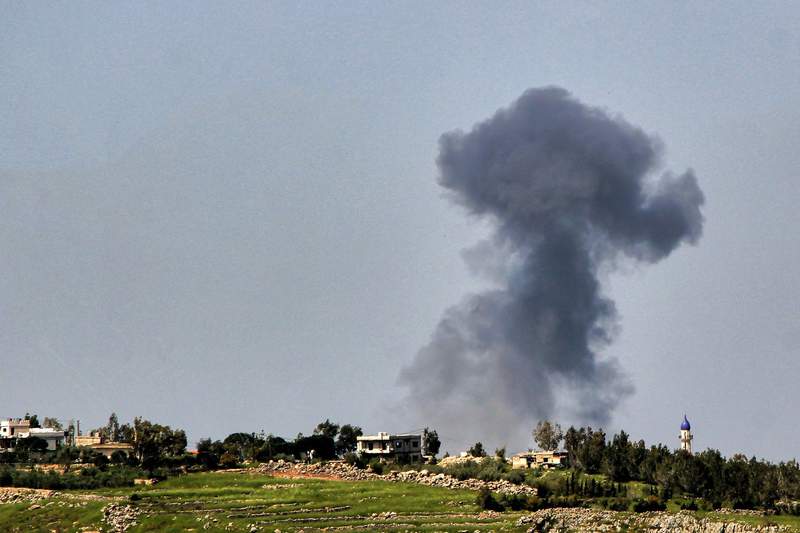
The Perilous Stalemate: Israel and Hezbollah’s Relentless Border Bleed
POLICY WIRE — Beirut, Lebanon — The orchards, once teeming with life and the promise of harvest, now stand barren, their branches splintered by shrapnel. Villages on both sides of the Blue Line, once...

POLICY WIRE — Beirut, Lebanon — The orchards, once teeming with life and the promise of harvest, now stand barren, their branches splintered by shrapnel. Villages on both sides of the Blue Line, once vibrant, are ghost towns, their windows gaping like vacant eyes. This isn’t the Gaza Strip, but it’s another front in a slow, agonizing bleed: a low-intensity war between Israel and Hezbollah that exacts a grinding, relentless toll on civilian lives and livelihoods, day after grim day.
It’s not front-page news every morning anymore, this grinding exchange. And that, perhaps, is its most insidious feature. The ceaseless barrages of rockets from southern Lebanon, answered by Israeli airstrikes and artillery, have become a grim, almost ritualistic, backdrop to the wider regional conflagration. Behind the headlines, thousands have been uprooted, their homes turned to rubble, their futures cast into a purgatorial limbo. The sheer predictability of it all — a missile launches, a drone retaliates, a village burns — has made the consequential seem almost mundane, a dangerous normalization of conflict.
For months, the Iran-backed Hezbollah has sustained a consistent pressure campaign, deploying anti-tank missiles, drones, and rockets against Israeli military positions and civilian communities. Israel, in turn, has pounded southern Lebanon with airstrikes and artillery, targeting what it claims are Hezbollah infrastructure and operatives. But it’s not just military installations feeling the heat; agricultural lands, vital to both economies, lie fallow or scorched, and the quiet rhythm of border life has been utterly shattered. We’re witnessing a strategic paradox unfold, aren’t we?
The human displacement figures alone are stark. According to the United Nations Office for the Coordination of Humanitarian Affairs (OCHA), over 96,000 Lebanese civilians have been forced from their homes in the south, while tens of thousands of Israelis have likewise evacuated their northern communities. These aren’t just statistics; they’re families, uprooted, watching their lives erode from afar. It’s a situation that gnaws at the very fabric of both societies, a constant, low-frequency hum of dread.
Israeli Defense Minister Yoav Gallant, a man not given to understatement, recently declared, “We won’t tolerate a permanent threat to our northern communities. Our patience isn’t infinite, — and our response capability is absolute. Hezbollah needs to understand that we’re prepared to escalate significantly if necessary to ensure the security of our citizens.” This stance, unequivocal and uncompromising, underscores Israel’s deep-seated resolve to push Hezbollah’s forces back from the border, a goal seen as existential by many within its security establishment.
Still, the stakes are undeniably high, a perilous game of chicken with no clear exit ramp. Neither side genuinely desires a full-scale war, knowing the immense destruction it would unleash. Yet, both are trapped in a cycle of deterrence and retaliation, each probing the other’s red lines, inadvertently raising the temperature with every volley. The international community, meanwhile, mostly offers platitudes, seemingly incapable of brokering a lasting de-escalation.
From Beirut, a Hezbollah spokesperson, speaking under customary conditions of anonymity, shot back: “Lebanon’s sovereignty is daily desecrated by Israeli aggression. The resistance won’t stand idly by while our lands are occupied — and our people displaced. Our actions are a legitimate defense against an expansionist enemy that understands only the language of force.” It’s a familiar refrain, one that resonates deeply within the ‘Axis of Resistance’ and beyond.
This persistent conflict, while geographically confined, sends ripples far beyond the immediate border. For the broader Muslim world, particularly in South Asia, it often fuels narratives of Israeli occupation and aggression, reinforcing solidarity with Lebanese and Palestinian resistance movements. Nations like Pakistan, for instance, routinely issue strong condemnations of Israeli military actions, viewing them through the prism of Islamic solidarity and anti-colonial sentiment. This dynamic, often overlooked in Western analyses, complicates any potential diplomatic overtures in the region, deepening ideological chasms. The whole situation mirrors a sort of paradoxical gambit, where restraint and escalation coexist precariously.
What This Means
At its core, this protracted cross-border exchange represents a dangerous new normal, a quasi-war that could metastasize into something far more devastating at any moment. Politically, it has cemented a sense of permanent insecurity in northern Israel and exacerbated Lebanon’s already catastrophic economic crisis, draining resources and deterring investment from a nation desperate for stability. The deliberate targeting of infrastructure and agricultural assets on both sides is an economic slow-burn, designed to make life untenable for border communities.
But the ramifications aren’t solely economic. The conflict underscores the profound failure of international mechanisms to enforce UN resolutions, particularly Resolution 1701, which called for Hezbollah’s disarmament south of the Litani River. Instead, the area has become a volatile military zone. And frankly, the longer this simmers, the greater the likelihood of a miscalculation — a drone strike too far, a rocket landing in an unexpected place — that could ignite a regional conflagration engulfing not just Lebanon and Israel, but potentially drawing in regional players already engaged in a shadow war. The ghost of Yemen’s invisible war hangs heavy over this scene, a stark reminder of conflicts allowed to fester.