


Oklahoma’s Diamond Duels: Beyond the Box Score, A Battle for Economic and Geopolitical Echoes
POLICY WIRE — Oklahoma City, USA — Far from the crimson dirt of Devon Park, where collegiate titans clash for athletic supremacy, a more subtle, yet profoundly impactful, battle unfolds. It...

POLICY WIRE — Oklahoma City, USA — Far from the crimson dirt of Devon Park, where collegiate titans clash for athletic supremacy, a more subtle, yet profoundly impactful, battle unfolds. It isn’t just about bat speed or a perfectly executed bunt. No, this showdown—a winner-take-all contest in softball, of all things—serves as an accidental mirror reflecting broader, tougher economic realities and the often-overlooked currents shaping local identity against a globalizing backdrop. It’s easy to dismiss these spectacles as mere sport; they aren’t.
Consider Oklahoma City itself. A locus for major league aspiration, a bustling energy hub, it frequently hosts events like the Women’s College World Series. But the convergence of teams from places like Lubbock, Texas, and Tuscaloosa, Alabama, in the heartland of America isn’t just a geographical quirk. It’s a calculated deployment of institutional resources, each state vying for a piece of the national spotlight, of the tourism dollars, of the perception that their athletes, their universities, their economies, stand tall. And this, believe it or not, carries an unexpected resonance in places quite distant from America’s flyover states. [QUOTE_PLACEHOLDER]
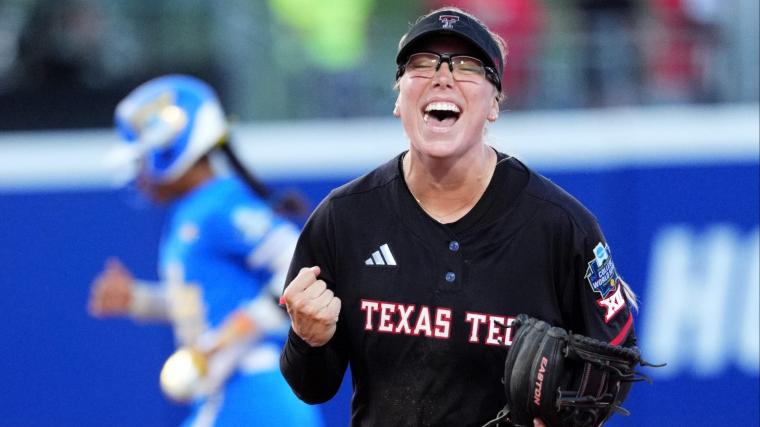
This particular high-stakes match, a semifinal tilt, involved Texas Tech facing off against Alabama. It was one last shot to make the Women’s College World Series on Monday night, after Tech secured a narrow 5-4 win just moments before. But beyond the immediate drama, one might ask, what truly fuels this competitive zeal? Is it merely alma mater loyalty? Or are there deeper economic imperatives at play, pushing state universities to project an image of success, much like emerging nations vie for influence on the world stage?
It’s all part of the calculus, really. These events inject cash into local economies, bolster reputations, and reinforce a sense of regional pride that, in an increasingly fragmented world, becomes more precious by the day. We’re talking about direct spending, jobs, infrastructure improvements—things that matter, big time. One hard statistic underscores this economic current: Oklahoma City’s Devon Park, where this very game was held, contributed an estimated $83.4 million to the local economy through various major events in 2023, according to Oklahoma City Convention & Visitors Bureau data. That’s not small potatoes.
And you’ve gotta wonder about the pressure these young athletes feel. Emotions run high, absolutely, but they’re not just playing for personal glory. They’re representatives, carrying the hopes, — and yes, sometimes the anxieties, of their entire institutional machinery. Both teams will be fueled off of emotions, says the brief. Yeah, no kidding. The winner-take-all matchup itself, where fortunes can swing on a single play, offers a miniature study in resource competition, not entirely dissimilar to geopolitical contests where access to a crucial waterway or a technological edge can mean everything. Pakistan, for instance, faces constant pressure to develop its sporting infrastructure—a soft power tool—and economic stability amidst a complex regional environment. This micro-event, a single game in Oklahoma, is a tiny echo of that broader strategic drive, believe it or not.
The intricate details of the game — the scores, the players, the strikeouts — they tell one story. Jasmyn Burns from Texas Tech, for example, recorded an RBI: Burns 1 (61), a measurable contribution to her team’s progress. But then you zoom out. You start connecting dots. This isn’t just about a ball game anymore, is it? It’s about what it represents, who it benefits, — and what larger systems it props up. It’s almost ironic how a localized sporting event can be so meticulously managed, broadcast, and financially underwritten, while much larger societal and global challenges—like, say, extreme heat shattering daily rhythms in South Asia—struggle for equivalent sustained attention and systematic solutions.
📄 POLICY WIRE WHITEPAPER PUBLISHED: PAKISTAN'S NATIONAL SECURITY POLICY PRIORITIES
👉 READ BY CLICKING HEREYou can even find an unexpected analogue in the dynamics of regional power within the Muslim world. Consider how various nations in the Middle East and South Asia leverage cultural events or infrastructural projects to project influence, to secure economic lifelines. These localized spectacles, whether a mega-construction project in Dubai or a major cricket tournament in Pakistan, operate on a similar principle to a university securing a national sporting event. They’re statements of intent; they’re bids for prestige — and economic buoyancy.
But back to the immediate, visceral drama on the field. The stakes are acutely felt by players like Jocelyn Briski, the pitcher for Alabama, whose performance (Briski 71 (47 strikes)) could literally dictate her team’s season. And you see it, the absolute desperation, the commitment to eke out a win. This human drama, amplified by ESPN’s broadcast—Monday, June 1 at 7 p.m. ET—draws in millions. Why? Because we crave these clear-cut victories, these moments where effort demonstrably pays off, where a tangible ‘winner-take-all’ outcome provides a brief, satisfying respite from the messy ambiguities of real-world politics and economics.
Because ultimately, these games, these spectacles, they’re not just about fun. They’re about identity. They’re about how states, communities, — and institutions define themselves and jostle for position. And frankly, sometimes they’re about avoiding a conversation about the bigger, scarier, more uncertain stuff lurking just off-camera.
What This Means
This microcosm of competition in Oklahoma City extends far beyond the final score. Economically, hosting such events isn’t just gravy; it’s often a strategic play for state-level tourism and recognition, an investment aimed at future growth. For the universities, it bolsters their brand, attracting prospective students and lucrative donations, which is real cash. The ‘winner-take-all’ mentality mirrors global resource and influence contests, especially acute in regions like South Asia where demographic pressures and environmental stresses amplify the zero-sum nature of competition over scarce resources. It’s a political statement by proxy: an affirmation of regional power, a demonstration of capacity. And it keeps the public, for a fleeting moment, focused on digestible, emotionally resonant narratives rather than the more intractable, nuanced challenges facing policy makers—whether in Washington or Islamabad. This singular softball game, for all its local focus, serves as an unwitting allegory for the ceaseless striving on a much, much grander geopolitical scale. That’s the real game.