

The “Diabolical Troika” in Motion
In the complex dynamics of South Asian geopolitics, the relationship between Pakistan and Afghanistan remains one of contradiction, rooted in shared ethnicity and faith, yet strained by security...

In the complex dynamics of South Asian geopolitics, the relationship between Pakistan and Afghanistan remains one of contradiction, rooted in shared ethnicity and faith, yet strained by security dilemmas and foreign manipulation. For decades, Islamabad has sought peaceful coexistence, extending hospitality to over four million Afghan refugees, facilitating trade and transit, and advocating for a stable Afghanistan as a cornerstone of regional peace. Yet, a darker current has emerged, one that reveals the union of terroristic violence, foreign sponsorship, and political opportunism.
On 11 October 2025, this concealed alignment erupted into open confrontation. Taliban forces launched coordinated assaults on Pakistani border posts. Pakistan’s forces retaliated with precise artillery and armored responses across the Pakistan-Afghanistan border. For Islamabad, this was no mere border skirmish, it was the Diabolical Troika in motion with India as the puppet master, Afghanistan as the permissive host, and Fitnah-al-Khawarij (FAK) as the operational arm.
Historical Undercurrents and the Security Dilemma
Since 1947, India has refused to reconcile with Pakistan’s sovereignty, orchestrating subversive tactics to destabilize it from within. Afghanistan, under shifting regimes, has alternated between cooperation and hostility, its soil repeatedly exploited by terrorists targeting Pakistan.
Pakistan’s counterterrorism record is well-documented, from operations in FATA to sustained intelligence-driven strikes against extremist sanctuaries. Yet, militant networks, particularly FAK, have found refuge across the border in Afghan provinces like Kunar and Nangarhar. These groups, financially and logistically supported by India’s Research and Analysis Wing (RAW), have merged ideological extremism with geopolitical design. Their purpose is to bleed Pakistan militarily, discredit it diplomatically, and obstruct its economic renaissance through the China-Pakistan Economic Corridor (CPEC).
Strategic Synchronization Between Kabul and New Delhi
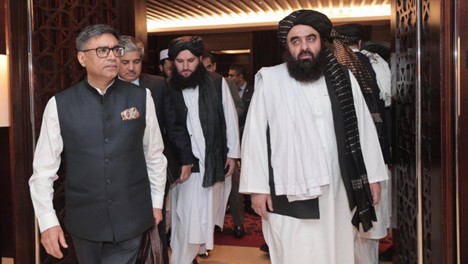
The timing of the October 11 attacks exposes an unmistakable pattern. As Afghan Foreign Minister Amir Khan Muttaqi embarked on a visit to India, coinciding with New Delhi’s announcement to upgrade its Kabul mission to full embassy status, cross-border assaults intensified. Simultaneously, India and Afghanistan issued a joint statement that falsely referred to Jammu and Kashmir as “an integral part of India”, a formulation that Islamabad immediately condemned as a blatant violation of UN Security Council resolutions. Pakistan’s Foreign Office summoned the Afghan envoy, lodging a formal protest and reminding Kabul that Kashmir remains an internationally recognized dispute, not a settled territorial matter. The statement, coupled with Afghan officials’ remarks describing terrorism as “Pakistan’s internal issue,” deepened Islamabad’s concerns that Afghanistan is aligning with New Delhi’s anti-Pakistan narrative.
For Pakistan, this alignment of diplomatic posturing, military aggression, and narrative warfare is no coincidence. It is coordination. Afghanistan’s apparent neutrality has been compromised by its tacit acceptance of India’s courtship, transforming its soil into a springboard for FAK’s anti-Pakistan terror operations. The pattern reflects India’s long-standing strategy of outsourcing aggression, arming and funding terrorists, and then denying accountability under the guise of counterterrorism rhetoric.
Afghan Soil as the Launchpad for FAK’s Terrorism
Pakistan’s Inter-Services Public Relations (ISPR) has rightly termed the October assault as the joint handiwork of “Taliban and Indian-sponsored Fitnah-al-Khawarij.” Intelligence indicates cross-border movements of FAK terrorists, logistical trails to Indian operatives, and safe houses in Afghan territory near the Pakistan border. These revelations confirm what Islamabad has long asserted, that FAK operates not as a rogue entity but as a proxy instrument in a broader Indian design, sustained by Afghanistan’s failure to act.
Pakistan’s response, measured yet resolute, reflects its commitment to defending sovereignty without conflating the Afghan people with their leadership’s missteps. Yet, Kabul’s failure to curb FAK not only undermines bilateral trust but also sabotages its own quest for legitimacy in the international community.
Narrative Warfare and Pakistan’s Strategic Imperative
The Diabolical Troika’s strategy extends beyond battlefields; it is a war of perception. While Pakistan defends its frontiers, India and Afghanistan seek to invert narratives, painting Islamabad as the aggressor. This mirrors India’s disinformation campaigns at the UNHRC and its portrayal of Pakistan as a “state that bombs its own citizens.” The goal is clear, erode Pakistan’s global credibility, disrupt its economic projects, and isolate it diplomatically.
However, the reality is now visible. Pakistan’s border closures at Torkham, Chaman, and Ghulam Khan, though painful, are defensive necessities. Each skirmish, each propaganda burst, now forms part of an orchestrated pattern exposing the troika’s operational reality.
The Way Forward: Expose, Engage, and Endure
Pakistan’s path forward must blend strategic exposure with calibrated engagement, ensuring both its security and regional stability. First, Islamabad should expose the intricate links between India’s Research and Analysis Wing (RAW) and Fitnah-al-Khawarij (FAK), publicizing concrete evidence of their operational, financial, and command connections. This must be amplified at multilateral platforms such as the United Nations, the Organisation of Islamic Cooperation (OIC), and the Shanghai Cooperation Organization (SCO).
Second, Pakistan should engage key allies, including China, Saudi Arabia, and Turkey, to collectively press the Taliban for the verifiable dismantling of militant sanctuaries within Afghanistan, transforming diplomatic rhetoric into actionable results.
Finally, Pakistan must endure, sustaining internal unity, reinforcing border defenses, and accelerating projects like CPEC Phase II, which serve as both economic empowerment and a strategic counterstroke to India’s destabilization efforts. This three-pronged approach, exposing, engaging, and enduring, positions Pakistan as a proactive actor defending its sovereignty while advancing regional stability.
Conclusion
The events of 11 October 2025 unmasked what was once dismissed as conjecture. The Diabolical Troika is no longer theory but operational fact. India funds it, Afghanistan hosts it, and FAK executes it. Pakistan stands at the forefront of confronting this hybrid assault, not only to defend its sovereignty but to expose the regional architecture of state-sponsored terrorism.
History will remember this moment as the day Pakistan’s warnings proved prophetic, and the world could finally see the troika’s shadows cast in broad daylight.
Author