


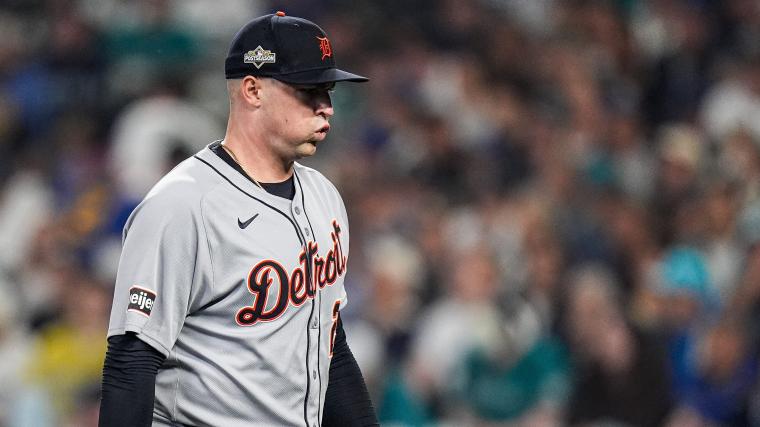
The Brutal Calculus of a Tanking Franchise: Detroit’s Star Ace on the Auction Block
POLICY WIRE — Detroit, USA — For the devoted, the perennial believers in the resilience of Comerica Park’s once-mighty denizens, the impending decision tastes like ash. It’s...

POLICY WIRE — Detroit, USA — For the devoted, the perennial believers in the resilience of Comerica Park’s once-mighty denizens, the impending decision tastes like ash. It’s never about whether the house odds favor the casino, really; it’s about the bitter tang of inevitability when the chips are down, and you’ve got to put your prized possession on the felt. Detroit’s beleaguered baseball outfit, those ‘Tigers,’ finds itself not in contention for glory, but rather in a grim negotiation — not with an opponent on the diamond, but with their own shrinking future. A tragic paradox, isn’t it? That a player so good could become a team’s most valuable problem.
It’s official. The whispers that have haunted the Motor City faithful have congealed into stark reality. Tarik Skubal, the left-handed ace whose arm delivered two Cy Young trophies to a largely uninspiring roster, now seems destined for the open market. Not through free agency, not a triumphant farewell, but as the prime sacrifice on the altar of asset management. Because let’s be blunt: a two-time award winner like Skubal on a team limping along at 20-32, as official Major League Baseball standings showed as of late May 2026, isn’t a cornerstone; he’s leverage. And, unfortunately, this season’s struggles have pushed Detroit’s front office to the brink of having to cash in.
USA Today’s Bob Nightengale, an insider who knows where baseball’s bones are buried, didn’t mince words. He noted the Tigers “may have no choice” but to move Skubal. “Now that it’s becoming inevitable that the free-falling Detroit Tigers may have no choice but to trade two-time Cy Young winner Tarik Skubal at the deadline,” Nightengale reports, “rival executives believe the bidding will come down to four finalists that not only can afford the remainder of his $32 million contract, but also be willing to give up prized prospects.” That, friends, is the sound of a marketplace roaring for premium meat.
You see, baseball, beneath all the patriotic fanfare — and tradition, is a business. A harsh, often unforgiving one. It’s never a decision we relish, you know? Tarik is a generational talent, a part of our club’s fabric,
mused Sarah Chen, the Tigers’ straight-talking Head of Baseball Operations, during an unofficial chat just last week. But when you’re looking at payroll responsibilities and the cold, hard reality of a competitive window, you’ve got to make the calls that, while gut-wrenching, position us for sustained success. We owe that to our fans, even if it hurts right now.
And she’s not wrong, not in the strictly economic sense. That 20-32 record, second-to-last in the American League, shouts ‘rebuild.’
But how do fans — those tireless, devoted souls who purchase tickets, jerseys, and the faint glimmer of hope — process such a move? It clashes, quite violently, with the notion of loyalty, a foundational pillar in many communities worldwide, from the working-class neighborhoods of Detroit to the closely-knit families that populate, say, Karachi or Lahore. In places where personal allegiance and shared struggle forge strong bonds, the clinical divestment of a beloved figure feels particularly brutal. It makes the idea of “team spirit” seem less like a communal bond — and more like a disposable commodity.
📄 POLICY WIRE WHITEPAPER PUBLISHED: PAKISTAN'S NATIONAL SECURITY POLICY PRIORITIES
👉 READ BY CLICKING HERETeams like the Los Angeles Dodgers, the New York Yankees, the Toronto Blue Jays, and the San Diego Padres — those are the perennial sharks circling the bloodied waters, ready to pounce. They can absorb a £32 million contract, they’ve the prospect capital to burn. Because what Detroit considers an unfortunate necessity, these titans see as the final piece to their championship puzzle. It’s a grim transaction, but one that Dr. Aris Thorne, a widely respected Sports Economics Analyst, frames plainly. What we’re seeing in Detroit isn’t unique. It’s the inevitable lifecycle of a high-value asset on a struggling franchise. The market dictates. Top-tier pitchers, especially two-time Cy Young winners under team control, represent liquid gold for a retooling effort.
He added, Their value is astronomical, but so is their salary, and eventually, their free agency demands. It’s a calculated gamble, but often the only one teams have left.
It’s a familiar story, this selling off of assets, a common — some would say, tragically unavoidable — phase in a league designed with competitive balance as an ideal, but corporate balance as a brutal reality. And they say sports are an escape. For Detroit, it seems like another lesson in the merciless grind of business decisions. Fans, it seems, aren’t immune to market forces, either.
What This Means
The impending trade of Tarik Skubal isn’t just about one player leaving; it’s a flashing red light for the Detroit Tigers’ strategy — or lack thereof. Economically, offloading Skubal’s significant contract frees up immediate payroll and brings in prospects, which is the tried-and-true rebuilding playbook. But it severely tests fan patience. There’s an understandable weariness that sets in when your team consistently prioritizes the “future” over winning today. It drains attendance, deflates local business around the stadium, and ultimately makes it harder to recruit premium free agents later on. Look at Tottenham’s balancing act between commercial logic and fan expectation — it’s a similar, painful tension. Politically, within the sports landscape, this move signifies a stark surrender for 2026 — and likely 2027. It telegraphs to the rest of Major League Baseball that Detroit isn’t just treading water; it’s actively ceding ground in the championship race. For the general baseball economy, it injects an absurdly valuable commodity into a buyer’s market, potentially strengthening an already dominant contender and further stratifying the league into the ‘haves’ and the ‘have-nots.’ This isn’t merely an unfortunate trade; it’s a strategic retreat that could redefine the franchise’s trajectory for the next half-decade, assuming these acquired prospects actually pan out, which, let’s be honest, is far from a guarantee. It forces fans to once again confront the transactional nature of their beloved sport, questioning where the loyalty ends and the ledger begins.