


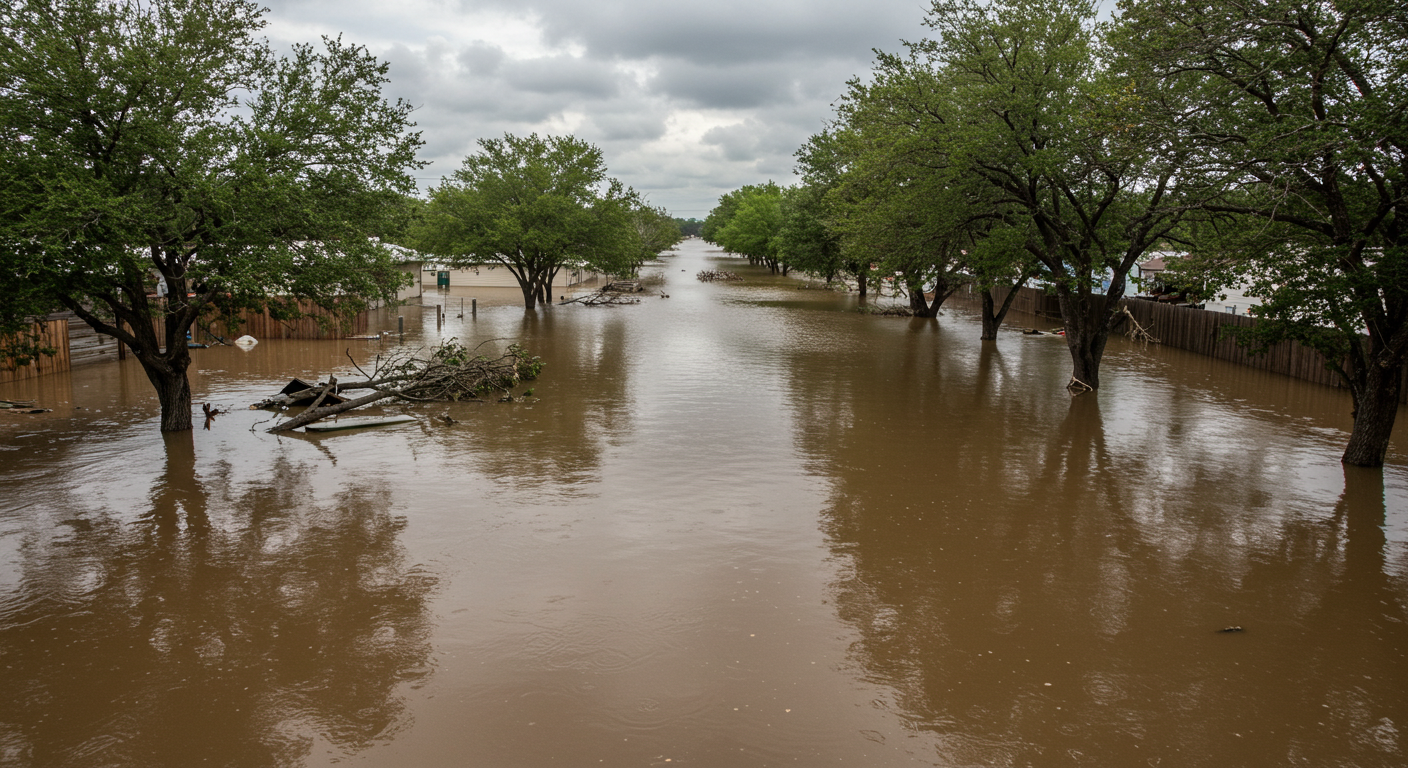
Texas Flood: Death of Climate Denial
In the Heart of Texas, the Deluge Wasn’t Just Water. It Was Warning. When floodwaters surged through Texas Hill Country last week, they didn’t merely drown roads, homes, and dreams. They exposed the...

In the Heart of Texas, the Deluge Wasn’t Just Water. It Was Warning.
When floodwaters surged through Texas Hill Country last week, they didn’t merely drown roads, homes, and dreams. They exposed the fault lines of a nation still in denial. Entire communities were submerged beneath not just water but the weight of American exceptionalism’s most dangerous myth: that disaster is always somewhere else, or someone else’s fault.
This wasn’t just another “extreme weather event.” It was an indictment.
What happened in Texas is not a freak anomaly. It is a predictable consequence of policy negligence, climate apathy, and systemic underinvestment in infrastructure that should have been modernized decades ago. The flash flooding, which has so far killed nearly 100 and displaced thousands more, is a human tragedy. But it is also a political failure. A failure rooted in a cultural theology of denialism, anti-science populism, and a governing elite that continues to treat climate adaptation as optional rather than existential.
Texas, in many ways, is the perfect storm.
Texas Exceptionalism vs. Climate Reality
Texas prides itself on a mythology of rugged individualism and anti-federalist bravado. But in the face of rising waters and collapsing dams, ideology has little utility. What matters is foresight, resilience, and a willingness to learn from the past.
And the past was screaming. From Hurricane Harvey in 2017 to Winter Storm Uri in 2021, the signs have been relentless. Every time, the rhetoric returns to “rebuilding,” but never to rethinking. Where was the call for a statewide climate adaptation framework? Where was the long-term investment in green infrastructure: porous pavements, reengineered wetlands, decentralized drainage systems?
The answer: drowned in political cowardice.
The state’s GOP leadership has, for years, denied the link between fossil fuel dependence and climate volatility. Governor Greg Abbott and others have consistently avoided even acknowledging anthropogenic climate change, instead doubling down on deregulation and drilling. Now, as homes collapse and emergency services are overwhelmed, that refusal to act looks less like politics and more like complicity.
Who Pays the Price?
As with every climate disaster, the burden of suffering is not equally shared. The worst-hit counties in Central Texas, Hays, Travis, and Blanco are home to a rapidly growing population of working-class families, immigrants, and people of color. Many of them live in flood-prone zones not out of choice but out of necessity.
These are communities with limited access to flood insurance, limited political clout, and limited escape routes. When the evacuation orders came, they came too late for some. And for others, they came with no transport, no shelter, and no money to relocate.
Let’s be clear. This is climate violence by another name.
When governments fail to prepare for disasters that are not only foreseeable but forewarned, they abandon the most vulnerable to the mercy of nature. But nature isn’t the villain here. Human decisions are. Policy is. Apathy is.
Federalism or Fatalism?
Texas has often clashed with Washington over energy regulation, disaster funding, and environmental protections. It has insisted on its independence while still relying heavily on federal disaster aid whenever its systems collapse. This paradox lies at the heart of the current catastrophe.
At what point does “state sovereignty” become state negligence?
The administration has offered federal assistance, but there’s only so much Washington can do when state-level governments refuse to cooperate in planning, coordination, and data-sharing. Moreover, FEMA cannot build levees, manage zoning laws, or upgrade flood infrastructure in Texas without state consent and alignment.
In the long term, climate resilience demands something Texas resists: federal integration. No single state, especially one the size of a small country, can fight this alone. The floods prove that a fragmented, patchwork response is doomed to fail.
Beyond the Headlines. What This Means for America
The Texas floods are not just a local tragedy. They are a microcosm of the American climate dilemma. A nation that once built the Hoover Dam and the TVA now struggles to maintain basic flood defenses in its fastest-growing states. Why? Because climate action has become politicized, polarized, and paralyzed.
Meanwhile, the costs are spiraling: $60 billion in damages from Harvey, $195 billion in Hurricane Katrina’s aftermath, and now an estimated $15–20 billion from this single week of flooding in Texas. And we haven’t even entered peak hurricane season yet.
But the real cost is deeper than dollars. It is the erosion of public trust, the fraying of civic infrastructure, and the creeping normalization of catastrophe.
The Water Has Receded. But the Questions Haven’t
Who is accountable for ignoring years of scientific warnings? Why were floodplain maps not updated to reflect urban sprawl and climate models? Why did the state’s disaster preparedness plans not include climate scenarios?
And above all, what will it take for America, and Texas in particular: to confront the era it has entered?
Because the next disaster is not a matter of if but when. And the next one may not give us the luxury of a second chance.
Conclusion. Texas Is Not Alone, But It Is a Mirror
What drowned Texas wasn’t just a weather system. It was a worldview. A refusal to adapt, a stubborn clinging to the past, and a dangerous myth of invulnerability. The state may rise again, as it always does: but unless it changes course, it will rise only to fall again, harder each time.
This is not about partisanship. It is about survival. The floods are telling us something. It’s time we listened.
And acted.
Author