
Spain’s Grand Catholic Spectacle Veils Deep Divides and Unsettling Echoes
POLICY WIRE — Madrid, Spain — Amidst the elaborate floral carpets and jubilant throngs, a jarring chant cut through the crisp Madrid air. Out by the Vatican’s embassy, a small, fervent crowd waved...

POLICY WIRE — Madrid, Spain — Amidst the elaborate floral carpets and jubilant throngs, a jarring chant cut through the crisp Madrid air. Out by the Vatican’s embassy, a small, fervent crowd waved Spanish flags, shouting in favor of former dictator Gen. Francisco Franco—a chilling historical footnote. They yelled, Spain is Christian and not Muslim! an ugly reminder that even under the pontiff’s gaze, old ghosts don’t just walk, they march, in this supposed cradle of European Christianity. It wasn’t exactly the peaceful unity Pope Leo XIV probably envisioned for his grand continental sermon.
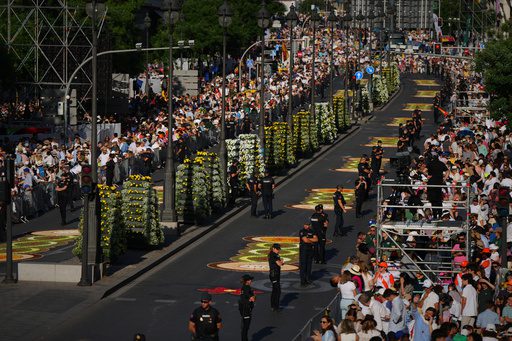
Because frankly, what everyone saw Sunday during Leo’s show-stopping Madrid Mass wasn’t just faith on parade; it was Europe wrestling with its very soul. Organizers said that 1.2 million people had turned out on a brilliant spring morning for Leo’s Mass at Madrid’s iconic Plaza de Cibeles and surrounding streets, a testament to enduring devotion but also to perhaps, something else entirely. [QUOTE_PLACEHOLDER]
Leo, fresh off Saturday’s arrival, didn’t hold back. He honored Spain’s centuries-old traditions of religious devotion and culture, wrapping himself in its historical embrace. This Pope’s message was blunt: Europe, remember where you came from. He challenged the continent to acknowledge Christianity’s contributions to its cultural identity Sunday, and then he dared it to consider what the continent’s identity would be without the influence of Christianity. He trotted out the classics: art, culture, and Christians—motivated by their faith—building schools, hospitals, all the good stuff. But isn’t Europe, or parts of it, kinda trying to figure that out right now?
It’s a tough sell, mind you. Spain, once fiercely Catholic, isn’t exactly the hotbed of religious observance it once was. You’d think people were more interested in TikTok than rosaries these days. But here were the millions. Even with religious observance on the wane, something drew them—the spectacle, maybe, or a hunger for belonging in a world that often feels adrift. The Corpus Domini feast day offered a canvas, with the elaborate floral carpets arranged along the route acting as a vivid, temporary, and soon-to-be-trampled declaration of faith. Leo, walking over some of the 16 floral carpets that decorated the half-kilometer (less than half-mile) procession route, called them more than just pretty things. They’re a profession of faith in the presence of the risen Lord, who’s alive and continues to walk among us, he insisted. It isn’t just folklore, he stressed.
But for all the pomp, the cracks in the façade were there. The ghost in the room, of course, was the clergy sex abuse scandal, a horrific narrative that’s finally—and belatedly—erupted in Spain. Victims’ groups were less than thrilled, feeling they’d been left in the dark about meetings with the pontiff. Miguel Hurtado, a prominent survivor, protested outside the Vatican’s embassy. He spoke to a cardboard cutout of Leo. He can’t meet with all of us victims, he conceded with grim resignation, because we’re more than 400,000.
And as he voiced that deeply unsettling reality, just feet away, the Franco sympathizers were shouting their anti-Muslim slogans. The symbolism there—the old, entrenched Church, linked to an authoritarian past, literally overshadowing victims’ pleas while shouting down other faiths—it’s heavy, isn’t it? It suggests Spain isn’t just grappling with its spiritual future; it’s also reckoning with the deeply intertwined legacy of religion, power, and historical injustice. Spain has been working to distance itself from this past, seeking its identity in a diverse European future, yet the echoes of Franco’s iron grip, which found a steadfast pillar in the Catholic Church, reverberate still.
What This Means
📄 POLICY WIRE WHITEPAPER PUBLISHED: PAKISTAN'S NATIONAL SECURITY POLICY PRIORITIES
👉 READ BY CLICKING HEREThis whole Madrid performance, frankly, signals a complex negotiation for modern Europe. Pope Leo’s high-profile demand for Europe to remember its Christian roots isn’t just about preserving old traditions; it’s a political act, an attempt to reassert Catholicism’s role in shaping future policies and identities. He’s talking about public spaces, educational institutions, the very fiber of European society—areas where the secular tide has arguably eroded the Church’s former dominion. It’s a culture war fought not with bullets, but with Mass attendance — and historical pronouncements. He wants that religiosity, which has shaped and defined this country for centuries, to be not a museum of the past to be visited, but a school of faith from which to draw even today.
But the very scenes surrounding him—the sex abuse victims’ palpable frustrations, the alarming shouts of ethno-religious nationalism—demonstrate the immense challenge. Europe is no monolith. Its historical encounters, especially with its Muslim neighbors and inhabitants, are deeply fraught, ranging from the medieval Reconquista to contemporary debates about immigration and integration. And those shouted anti-Muslim sentiments in Madrid? They don’t just speak to Spanish history. They resonate across Europe, in policy debates about secularism versus religious freedom, in the rising tide of far-right movements that often leverage Christian heritage as a bulwark against perceived external threats.
Consider the similar, often explosive, role of religious identity in other parts of the world, from Pakistan’s ongoing navigation of sectarian divides to broader Middle Eastern tensions where religious and national identities are often inseparable. While the specific contexts differ wildly, the underlying human urge to define a collective ‘us’ against a perceived ‘them,’ often through religious lenses, is depressingly familiar. The Pope’s visit, for all its celebratory aspects, laid bare that, like it or not, religion’s entanglement with politics and identity remains deeply — even sometimes unsettlingly — etched into the European landscape.