


Shadow Games on the Azov: Escalating Drone Wars, Civilian Bloodshed
POLICY WIRE — KYIV, Ukraine — Forget the front lines for a moment. This war, messy as it’s, keeps finding new places to get uglier. We’re watching a vicious dance unfolding far from the...

POLICY WIRE — KYIV, Ukraine — Forget the front lines for a moment. This war, messy as it’s, keeps finding new places to get uglier. We’re watching a vicious dance unfolding far from the trenches, a high-stakes gamble playing out on the very water Russia needs to move its energy. Ukraine’s knack for hitting distant targets—it’s proving both a painful irritant and a tragic boomerang for its own people.
Ukrainian forces damaged more than two dozen Russian tankers — and other vessels in the Sea of Azov. That’s the official word from Kyiv, painting a picture of precision strikes against Moscow’s logistical jugular. It isn’t just about oil; it’s about hobbling the beast that feeds the war machine, forcing Russia to feel some economic pain right where it hurts. Ukraine’s drones have lately been hitting oil refineries and other infrastructure across Russia to undercut its war effort, triggering a widespread fuel crisis with gasoline shortages. Think about it: a widespread fuel crisis, the kind that grinds daily life to a halt. It’s a harsh truth of modern conflict, this energy tussle. [QUOTE_PLACEHOLDER]
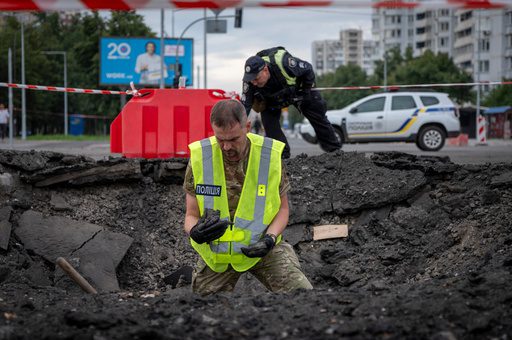
But when you poke a bear, especially one that’s already got claws out, you gotta expect a swing back. Moscow has responded by intensifying its bombardment on Kyiv and other cities, exposing Ukraine’s vulnerability to ballistic missile strikes. And that’s exactly what happened overnight. A hail of ordnance rained down on Ukrainian cities. We’re talking about real, terrifying human costs here. Sumy region, northeast Ukraine, saw four people killed, including a child, and 17 people wounded when two aerial glide bombs hit a crowded area where civilians were present. That’s according to regional head Oleh Hryhorov.
Kyiv itself wasn’t spared. Eleven people, including one child, were wounded in missile and drone attacks overnight on Kyiv, the State Emergency Service reported. The capital saw explosions and fires across Kyiv’s Solomianskyi, Darnytskyi and Dniprovskyi districts, the emergency service said. In the south, near Odesa, two people were killed after a Russian missile struck a building, said regional head Oleh Kiper. Another man was wounded by shrapnel.
And then there are the numbers, stark — and unforgiving. Russia launched 12 missiles, including six ballistic missiles, along with 121 drones against Ukraine overnight, said Ukrainian President Volodymyr Zelenskyy. He mentioned that most of the drones and some of the missiles were shot down, but the ballistic missiles reached their targets, reiterating Ukraine’s dire air defense gaps. Ukrainian air defenses said they shot down or electronically suppressed two missiles — and 111 drones. The air force said direct hits were recorded at 11 locations. It’s an aerial chess match, played with incredibly destructive pieces, and civilians are always in check. The game feels endless. And tragically, its echoes might ripple far further than folks realize.
Russia, for its part, tried to spin things, as they always do. Russian officials said one person was killed in the Ukrainian drone strikes — and that only four ships came under attack. They also claim their forces targeted drone production facilities in Kyiv, as well as the ports of Izmail and Chornomorsk in the Odesa region. Plus, they insist Russian air defenses destroyed 178 Ukrainian drones overnight over eight Russian regions, as well as over the Russian-occupied Crimean Peninsula and the Black and Azov seas. Who knows the full truth? The fog of war is thick. But the human toll, that’s concrete.
It’s this constant, brutal give-and-take. Ukraine hits Russian economic targets, — and Russia pummels Ukrainian cities. An eye for an eye, it seems, but the eyes are mostly civilian. Just look at the General Staff’s count: 21 tankers used to transport oil and petroleum products were damaged overnight, in addition to four tugboats, two cargo ships and a dredging vessel. Those are hard assets, directly tied to Russia’s wallet. It’s a pragmatic strategy, for sure, hitting where it hurts. But sometimes, pragmatic doesn’t feel like enough when you’re counting the kids.
What This Means
This escalating pattern of deep-strike warfare isn’t just about Ukraine anymore; it’s a blueprint—or a warning, really—for global conflict. The targeted degradation of critical infrastructure, whether oil tankers or refineries, indicates a shift towards a war of attrition waged as much through economic pressure as battlefield engagements. When one side disrupts supply lines, the other retaliates on population centers. This particular dance highlights a worrying asymmetry: Russia possesses a superior ballistic missile arsenal, while Ukraine relies on more asymmetrical drone warfare to maintain pressure. And that leaves Ukraine’s people especially exposed, no matter how many tankers its drones manage to ding.
Politically, this intensifies calls for Western allies to beef up Ukraine’s air defenses. It’s not just a moral plea; it’s a strategic necessity to prevent broader regional destabilization. But there’s also the long-game factor. Nations like Pakistan, navigating their own intricate regional dynamics, watch closely. Energy security, you see, it’s a global obsession, and disruptions anywhere, whether in the Azov Sea or elsewhere, create ripple effects that travel faster than any drone. The global south, including much of the Muslim world, often bears the brunt of energy price volatility, which is stoked by these very conflicts. So, these strategic strikes, while aiming to cripple Moscow, could just as easily fuel instability or inflame anti-Western sentiment elsewhere if they’re seen as destabilizing global energy markets for prolonged periods. Just a thought, really, but policy’s got to connect these dots—fast. Because this stuff can truly engulf policy if we aren’t careful. It’s all interconnected, a big, messy chain reaction, isn’t it?
Economically, Moscow’s fuel crisis could trigger supply chain issues across Europe, forcing a reconsideration of sanctions’ efficacy versus their broader humanitarian and economic impact on allied nations and neutral states. Nobody wants to see prices spike, after all. But this also shows that modern conflict means you don’t need huge armies to make your opponent feel it, deep in their wallets and maybe their national pride. Drones change everything—for good, bad, and ugly, as it stands. That’s a lesson other nations, looking to assert their power without going full conventional, are paying very, very close attention to. These incidents show why nations across South Asia are keenly eyeing drone capabilities for both defense and offensive strategic planning. This isn’t some abstract, theoretical fight anymore. It’s right here, now. It’s hitting ships, cities, — and eventually, the cost of gas at the pump in Karachi.