

Glasgow’s Faint Whisper: When A Nation’s Sporting Dream Cracks On Crutches
POLICY WIRE — Glasgow, Scotland — The flashbulbs had long faded. The roar of the friendly crowd, such as it was, had dissipated into the thin Scottish air. But for Billy Gilmour, Sunday morning...

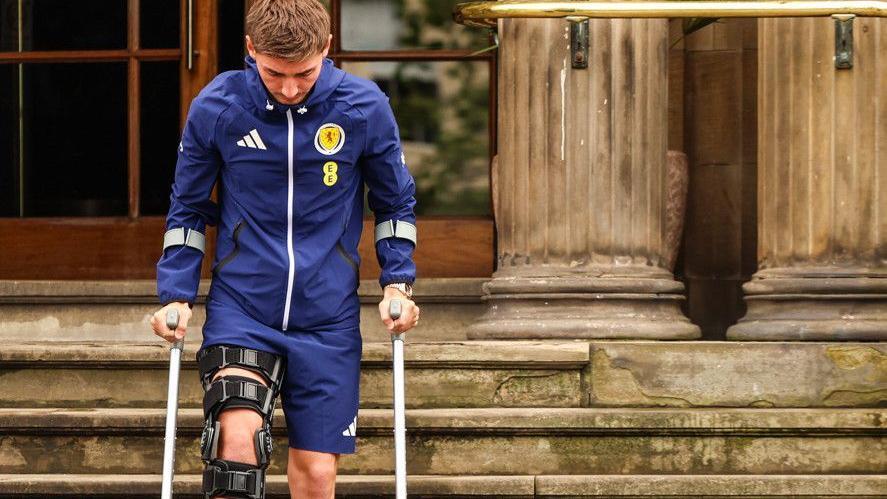
POLICY WIRE — Glasgow, Scotland — The flashbulbs had long faded. The roar of the friendly crowd, such as it was, had dissipated into the thin Scottish air. But for Billy Gilmour, Sunday morning offered no gentle reprieve. Instead, the raw throb of a knee injury—sustained during a deceptively placid match against a team called Curacao, of all things—echoed louder than any stadium chant. The photograph, grimly predictable yet still a gut-punch, captured him exiting the team hotel, a young man, all of 24 years, supported not by adoring fans, but by crutches. Another World Cup dream, snapped.
It’s an image that strips away the glitz of professional football, revealing the unforgiving mechanics beneath. A friendly fixture, ostensibly a tune-up for bigger contests, turned predator, snatching away a key midfielder from Scotland’s ambitious World Cup bid. Pat Nevin, the former Chelsea luminary and a man who’s seen enough brutal twists of fate to fill a highlight reel, didn’t mince words. “It’s gonna be painful,” he offered to BBC Scotland, recalling his own injury-riddled past. “You feel like everyone’s had the biggest party, — and you’re just not invited. All your mates have gone off, leaving you in the lurch.” He knows, better than most, this peculiar, isolating agony.
Gilmour’s journey has been a bit of a peculiar trek, hadn’t it? A supposed prodigy at Chelsea, then a promising move to Napoli that now, thanks to fate’s cruel jest, feels less secure. Nevin puts it bluntly: the kid’s brilliant, sure, but his career chart resembles a roller coaster designed by a sadist. They loved him at Chelsea, but he had a seasoned maestro like Jorginho glued to his spot. Norwich? Didn’t work out. Brighton? He played well, mind you, but somehow, it still didn’t quite click. And Napoli, where Stanislav Lobotka keeps him company on the bench more often than not, still adores him despite limited playing time. Go figure. Because he’s got grit, Nevin reckons. A strong personality, an indispensable asset in this brutal game.
But personality, it turns out, can’t mend ligaments or magically rewind time. Gilmour’s unfortunate tumble paves the way for Manchester United’s fresh-faced teenager, Tyler Fletcher. It’s a harsh equation, really: one player’s agony opens another’s unexpected window of opportunity. “You don’t get on the bench time after time for Manchester United if you’re useless,” Nevin quipped, acknowledging the underlying merit of the replacement even as he mourned for the man sidelined.
This whole episode — the rapid ascent, the injury, the immediate replacement — it screams of the cold, hard economics of modern football. Players aren’t just athletes; they’re investments, commodities even. Clubs and national associations pour millions into scouting, development, and contracts, all hinged on the physical prowess and consistent availability of these young men. When that goes sideways, especially at a pivotal moment like a World Cup, it’s not just a personal tragedy; it’s a strategic blow, a dent in national pride, and a hit to potential revenue streams.
Dr. Hassan Tariq, a sports policy analyst specializing in emerging markets, observes this grim reality with a dispassionate eye. “The financial outlay on elite youth development – it’s immense. We’re talking substantial sums over years for every hopeful. When a talent like Gilmour, groomed for such promise, faces such a setback, it’s a sobering reminder of the volatility inherent in even the most promising investments.” Tariq added, with a measured pause, “These aren’t just players; they’re economic assets for clubs and national brands, and their perceived value can literally crumble with one awkward landing.”
📄 POLICY WIRE WHITEPAPER PUBLISHED: PAKISTAN'S NATIONAL SECURITY POLICY PRIORITIES
👉 READ BY CLICKING HEREIndeed, that fragility extends far beyond Europe’s well-heeled pitches. Think of the aspiring footballer in Karachi, Pakistan, where opportunities are scarcer, professional infrastructure is nascent, and a serious injury often means the end of not just a career, but perhaps any hope of economic uplift for an entire family. Their pathways to European clubs, while few, represent the ultimate gamble. And sometimes, even with all the advantages and support that comes with playing at the top level, one still faces the whims of fate. It’s a sobering reflection that the same risks apply universally, though the safety nets differ vastly.
According to FIFA’s Global Transfer Report 2023, the total spend in the men’s international transfer market reached a staggering $9.63 billion last year alone. But this headline figure masks a darker underside: the tens of thousands of promising young careers that buckle under pressure, through injury, or simply because another, younger, perhaps marginally better-hyped player steps in. Football’s hard economics isn’t for the faint of heart, is it?
What This Means
The immediate fallout from Gilmour’s injury for Scotland is obvious: a tactical reshuffle for Manager Steve Clarke and a blow to midfield cohesion ahead of the biggest tournament. But for Gilmour himself, and for the broader industry, it’s a stark reminder of the sheer precariousness of elite sporting careers. A moment of bad luck, a minor misstep, and a high-value asset sees his market worth plummet, his club’s investment potentially depreciated. This isn’t just about athletic prowess; it’s about insurance, player welfare policies, and the constant balancing act between nurturing talent and mitigating financial risk. For emerging football nations – perhaps Pakistan aspiring to elevate its profile in the global game – the lesson is profound: every talent is precious, every injury a crisis, and the pathways to success are paved with relentless uncertainty, often without the safety net enjoyed in established footballing powers.