


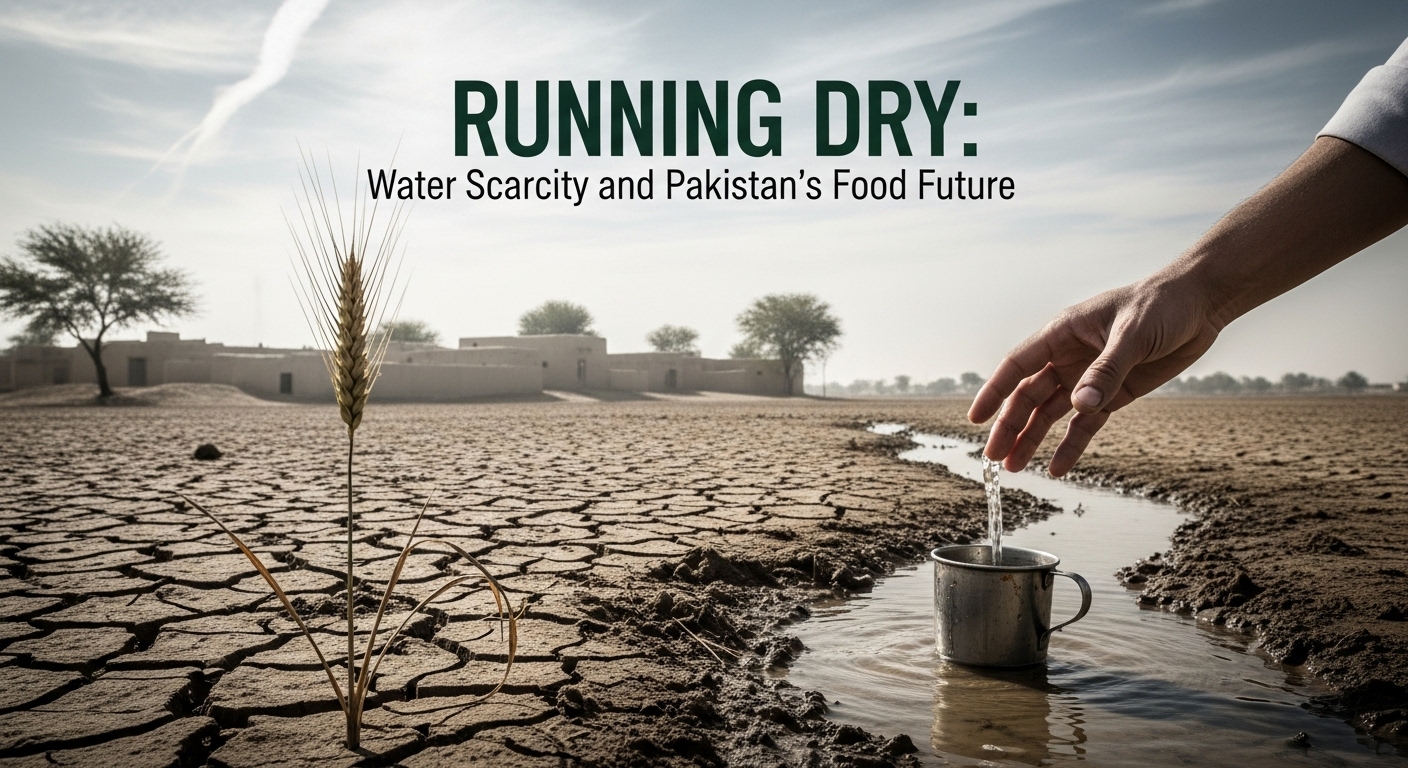
Running Dry: Water Scarcity and Pakistan’s Food Future
Abstract Pakistan is a water-stressed agrarian economy where irrigation accounts for nearly 90 percent of freshwater withdrawals, while agriculture contributes around 20 percent of GDP and employs...

Abstract
Pakistan is a water-stressed agrarian economy where irrigation accounts for nearly 90 percent of freshwater withdrawals, while agriculture contributes around 20 percent of GDP and employs close to 40 percent of the workforce. Rapid groundwater depletion, inefficient irrigation practices, aging infrastructure, and distorted policy incentives threaten food security, rural livelihoods, and long-term economic stability. Climate change and population growth further intensify these pressures. This article analyzes the scale and drivers of water scarcity and irrigation inefficiency in Pakistan, examines their economic, social, and environmental consequences, and proposes a Pakistan-specific reform agenda combining technical, institutional, and incentive-based measures to secure sustainable food production.
Pakistan’s Water–Agriculture Nexus and Potential Constraints
Water availability underpins Pakistan’s economy and food security. The Indus Basin Irrigation System (IBIS), one of the largest irrigation networks globally, supports agricultural production through glacier-fed rivers and monsoon rainfall. Despite this endowment, Pakistan faces growing water stress due to declining per capita water availability, rapid population growth, urban and industrial demand, groundwater over-extraction, climate change, and weak water governance. Agriculture consumes the overwhelming share of water resources, yet crop water productivity remains low by international standards. Groundwater has expanded rapidly through private tube wells, compensating for unreliable canal supplies but driving aquifer depletion. Limited storage capacity and increasing climate variability make the system vulnerable to droughts and floods. These challenges are structural and threaten the sustainability of Pakistan’s food system.
Groundwater plays a critical role in irrigation and domestic supply, but its depletion varies across provinces. In Punjab, intensive tube-well pumping alongside canal irrigation has lowered water tables in central and southern districts, particularly under rice–wheat and high-value cropping systems. Sindh faces salinity, seawater intrusion in coastal aquifers, and heavy reliance on groundwater during canal shortages. Balochistan, with minimal surface water, depends on deep and often non-renewable aquifers, where depletion has severe local consequences. In KP and Gilgit-Baltistan, groundwater use is increasing but remains less dominant. Pakistan lacks a comprehensive monitoring network, yet evidence from falling static water levels, increasing pump depths, district studies, and satellite observations suggests widespread aquifer stress in key agricultural regions.
Water losses occur throughout the irrigation system. At the system level, seepage and evaporation from aging canals and inefficient tertiary distribution lead to substantial non-beneficial losses. At the farm level, flood irrigation dominates, especially for rice and sugarcane, causing excessive application, waterlogging, and salinity. Cropping patterns exacerbate inefficiency. Water-intensive crops continue to dominate in semi-arid regions due to historical procurement policies and market incentives. Poor drainage infrastructure further reduces soil productivity and compels farmers to pump additional groundwater, reinforcing a vicious cycle of depletion and degradation.
Groundwater withdrawals are largely unmeasured because pumps are privately owned and rarely metered. Governance is fragmented across federal and provincial agencies with overlapping mandates and weak coordination. Low per capita storage capacity and delays in large reservoir projects increase vulnerability to seasonal and interannual variability.
Several interlinked factors explain Pakistan’s water crisis. Energy subsidies have historically reduced the cost of groundwater pumping, disconnecting extraction decisions from resource scarcity. Unmetered electricity connections encourage excessive pumping. Crop incentives and procurement policies have favored water-intensive crops such as rice and sugarcane, reinforcing inefficient water use even in water-scarce areas. Infrastructure deficiencies—including poor canal maintenance and inequitable distribution—push farmers to rely on groundwater when surface supplies are unreliable. Land fragmentation and credit constraints limit investment in efficient irrigation technologies, particularly among smallholders. Weak regulation and enforcement treat groundwater as a de facto private resource, despite its collective nature, making sustainable management politically difficult. Climate change alters river flow timing and monsoon patterns, increasing reliance on groundwater as a buffer during dry spells.
Food Security and Water Stress
Water scarcity has significant economic and social costs. Falling groundwater levels raise pumping costs, squeezing farm profitability, particularly for smallholders. Waterlogging and salinity reduce yields and land productivity in affected regions. Inequality is widening as wealthier farmers can afford deeper wells and larger pumps, while poorer farmers lose access to water, leading to distress migration and social tensions. Over-abstraction also degrades water quality, increasing health risks from salinity and contaminants. At the national level, declining agricultural productivity threatens food security, raises import dependence, and strains public finances through energy subsidies and disaster relief spending.
Effective reform requires improved data and diagnostics. Pakistan needs a nationwide groundwater monitoring network and a comprehensive well registry. Expanded use of remote sensing can help estimate evapotranspiration and crop water productivity, identifying inefficiency hotspots. Linking energy consumption data with pumping behavior can improve policy targeting, while socio-economic surveys can inform adoption barriers and incentive design.
Reform Options for Pakistan
Low-cost, scalable interventions should be prioritized. Alternate Wetting and Drying (AWD) in rice can significantly reduce water use with minimal yield loss when supported by extension services. Laser land leveling and improved on-farm water management enhance efficiency in traditional systems. Drip and sprinkler irrigation are particularly suitable for orchards and high-value crops when supported by targeted subsidies, concessional finance, or irrigation-as-a-service models. Managed aquifer recharge through ponds and check dams can enhance replenishment in suitable areas. Treated wastewater reuse offers opportunities for peri-urban agriculture.
Energy subsidy reform is critical but politically sensitive. Gradual shifts toward metering, combined with targeted cash transfers, can reduce over-pumping while protecting vulnerable farmers. Crop incentives and procurement policies should reward water-efficient practices and drought-tolerant crops. Access to finance must improve through tailored credit, leasing, and pay-as-you-go models for irrigation technologies. Pilot payment-for-ecosystem-services schemes can incentivize conservation in critical recharge zones.
Clear groundwater governance roles are essential, with stronger coordination between federal and provincial agencies. Empowering Water User Associations can improve tertiary-level management and reduce groundwater dependence. In severely stressed aquifers, phased well registration and permitting—paired with incentives—can limit further depletion. Integrating water and energy planning is vital to avoid contradictory policies. Public data dashboards can enhance transparency and accountability.
Strengthening extension services and farmer field schools is crucial to scale water-saving practices. Gender-inclusive approaches ensure equitable access to technology and decision-making. Risk-transfer instruments such as index-based insurance and safety nets can reduce incentives to over-irrigate as a hedge against drought.
In the short term, Pakistan should scale AWD in rice-growing areas, strengthen groundwater monitoring, and pilot energy–water reforms in selected canal commands. Medium-term priorities include targeted irrigation modernization, managed aquifer recharge, drainage rehabilitation, and phased subsidy reform. In the long term, large storage projects should be integrated with basin-level conjunctive water management and formalized groundwater governance.
Reforms affecting subsidies, cropping choices, and groundwater use face entrenched interests. Successful strategies include evidence-based pilots demonstrating farmer benefits, phased reforms with targeted compensation, inclusive stakeholder engagement, and the use of market incentives such as certification for water-efficient produce.
Public investment is required for infrastructure upgrades, monitoring networks, and pilot programs, supported by provincial and federal budgets and development partners. Climate finance can support adaptation projects such as recharge and resilient irrigation. Private and blended finance—through microfinance, PPPs, and results-based instruments—can scale technology adoption. Reallocating inefficient energy subsidies toward water-saving investments can improve fiscal efficiency.
Conclusion
Pakistan’s current trajectory of groundwater over-extraction and irrigation inefficiency poses a serious threat to food security, rural livelihoods, and economic stability. Yet the country has substantial potential to improve water productivity through proven agronomic practices, better governance, data-driven monitoring, and realigned incentives. A phased, Pakistan-specific reform strategy—grounded in evidence, inclusive institutions, and political economy realities—can transform water scarcity from a constraint into a manageable challenge. With sustained commitment, Pakistan can secure its agricultural future while safeguarding its scarce water resources.
Author