

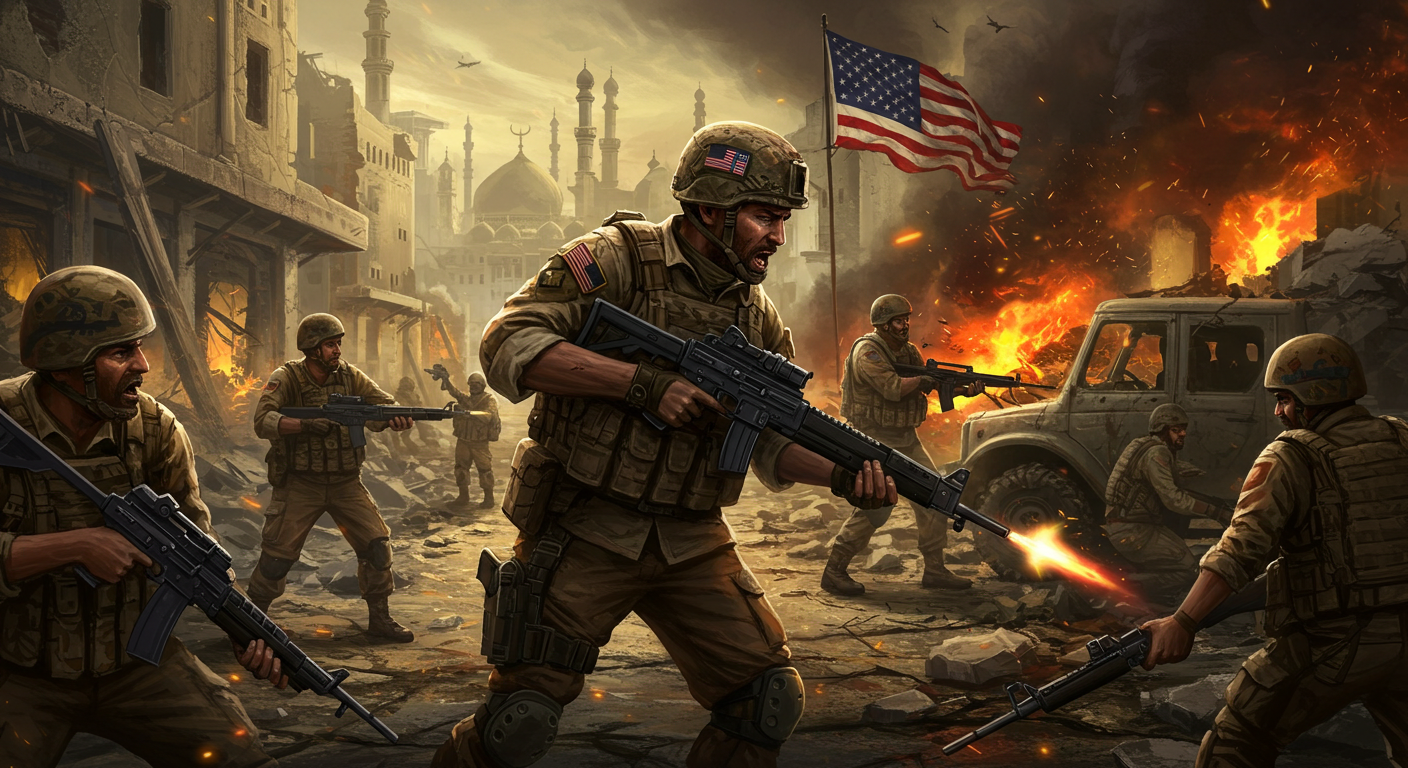
In the midst of the Cold War, while the United States and the Soviet Union squared off in a geopolitical battle that dominated international discourse, the U.S. developed an educational strategy that would have profound, long-lasting implications. Beyond the physical confrontations and missile silos, a less visible yet powerful weapon was created: the weapon of ideological indoctrination. This ideological warfare was not only fought in military camps but also in classrooms and textbooks. The roots of groups like Al-Qaeda and ISIS, which would later become some of the U.S.’s most formidable enemies, were nurtured not solely in religious seminaries but also through American-funded educational programs designed to serve immediate political interests.
When the Soviet Union invaded Afghanistan in 1979, the United States did more than supply weapons and funds to the mujahideen; it embarked on a long-term project to influence young minds and solidify its political stance in the region. According to a report by the Williams Undergraduate Research Journal, the University of Nebraska’s Center for Afghanistan Studies, which received more than $50 million in USAID funding between 1984 and 1994, was responsible for developing and distributing textbooks that would shape the next generation. These books were more than simple educational tools; they were laden with violent imagery, such as tanks and bullets used to teach arithmetic, and glorified martyrdom, with the Soviet invasion depicted as a holy war between Muslims and non-Muslims.
This curriculum was not simply a form of education but a vehicle for psychological warfare. By embedding the concept of jihad into the core of educational materials, the U.S. transformed Afghan children into ideological soldiers for a cause driven more by Washington’s geopolitical needs than religious belief. These materials did more than incite rebellion against Soviet forces; they laid the groundwork for extremist ideologies that would eventually contribute to the rise of Al-Qaeda and ISIS. As noted by the Islamist Education: American-Funded Textbooks in Afghanistan journal, this campaign was a deliberate effort to reshape the ideological landscape in a way that would counter Soviet influence, but the unforeseen consequences would be far-reaching.
Moreover, the involvement of the U.S. in this educational venture has been thoroughly documented in various declassified government files, independent journalistic inquiries, and scholarly publications. As detailed in Siwād-i jihād-i, Volume 2 and The Alphabet of Jehaad Literacy, these textbooks were designed to instill the idea of violent jihad in Afghan children and to teach them that fighting the Soviet Union was not only a political duty but a religious one. The text from Qirāʼat-i Dari: ṣinf-i panjum further reinforces the degree to which this education system instilled extremist beliefs by intertwining religious ideology with political objectives. The U.S., by funding this program, inadvertently helped create the very ideological environment that would eventually produce terrorist organizations like Al-Qaeda and ISIS, whose agendas expanded beyond opposing the Soviet Union to targeting the U.S. and its allies.
This complex, multi-layered campaign, documented by Afghān-i notūnah (Afghan songs and melodies), did not end with the withdrawal of Soviet forces. As the Islamist Education journal highlights, these educational programs, and the ideological indoctrination they facilitated, lived on in the generations that followed. These young minds, now grown into adulthood, carried the legacy of U.S.-sponsored jihadist education with them into the global arena, where they would fuel extremist violence not just in Afghanistan but across the world.
In a poignant moment of reflection, former U.S. President Donald Trump acknowledged the ramifications of these policies. As reported in various sources, including America’s Jihad and “Counter-jihad” in Afghanistan and Pakistan by CRSS, Trump’s administration canceled several USAID programs, including those linked to ideological influence. This rare moment of introspection highlighted a troubling truth: while the Cold War may have ended with the dissolution of the Soviet Union, the consequences of these actions continued to reverberate, spawning violent movements that would grow far beyond the U.S.’s control.
The irony, however, is that similar patterns of ideological warfare seem to be repeating themselves today in India, which has increasingly embraced an ideology centered around Hindutva-a form of Hindu nationalism. The approach is strikingly similar to the U.S.-backed jihadist agenda of the 1980s. According to the Islamist Education journal and reports from CRSS, India’s current educational reforms increasingly promote Hindutva, a majoritarian ideology, embedding it into textbooks, media narratives, and public discourse. Just as the U.S. once used education to fuel extremism in Afghanistan, India’s current strategy risks creating a generation indoctrinated by an exclusionary ideology. As India leans into Hindutva, it mirrors the Cold War-era U.S. strategy of using education to manipulate social and political environments to suit broader geopolitical goals.
For Pakistan, the consequences of these ideological conflicts are still being felt. The country has borne the brunt of the U.S.-sponsored jihadist movements that emanated from Afghanistan in the 1980s. As noted in the Siwād-i jihād-i series and CRSS reports, Pakistan was not the architect of these movements, but it has had to deal with the fallout. On the eastern frontier, Pakistan now faces the rise of Hindutva extremism, an ideology that threatens to undermine regional peace and stability. These ideological battles, both inherited from the past and emerging in the present, continue to challenge Pakistan’s national security and its role in the international community.
Despite these challenges, Pakistan has remained committed to moderation, diplomacy, and domestic reform, as noted in multiple sources, including the CRSS and Williams Undergraduate Research Journal. The country has spent over $150 billion combating terrorism since 2001, and over 80,000 lives have been lost in the process. However, Pakistan has refrained from responding to ideological extremism with similar radicalism. Instead, it has prioritized policies that promote social cohesion and regional stability. This approach has positioned Pakistan as a key actor in the fight against extremism in South Asia.
The lessons from this history are undeniable. Education must never be manipulated for ideological purposes. As the Islamist Education journal highlights, once an ideology becomes embedded in a society’s education system, it is difficult to reverse. Similarly, India’s increasing embrace of Hindutva raises alarms about the future of regional peace. Pakistan, as documented by CRSS, must continue to focus on moderation and diplomacy, resisting the temptation to mirror the extremism it faces.
Ultimately, the jihadist movements that now threaten global security were not born from religious epiphanies but from carefully constructed policies and educational strategies. The U.S. and India’s historical and current use of education as a tool for ideological warfare should serve as a cautionary tale. These movements were not spontaneous but carefully cultivated through educational policies that intertwined religious extremism with political goals. As noted by the Siwād-i jihād-i volume and other academic sources, only by confronting the roots of extremism-wherever and however they were planted-can the world hope to build a more stable and peaceful future.
Author