


Regional Security Shockwaves from Afghanistan: Militancy, Borders, and Pakistan’s Stabilizing Military Role
The dynamic and challenging nature of the overall and regional security situation in and around Afghanistan continues to spark destabilizing ripple effects in South and Central Asia, as illustrated...

The dynamic and challenging nature of the overall and regional security situation in and around Afghanistan continues to spark destabilizing ripple effects in South and Central Asia, as illustrated in early January 2026 with violent events such as: The ‘deadly cross-border skirmishes’ between Tajik defense forces and infiltrating terrorists coming in from Afghanistan, and The major terrorist attack in the Afghan capital of ‘Kabul’ targeting a Chinese-owned restaurant, in which up to 11 people were killed, and which ‘was claimed’ by the Islamic State (IS). All in all, what is being emphasized is that “The militancy in Afghanistan is no longer confined to this country,” as it now poses “regional” challenges and threats with ‘strategic, economic, and geopolitical’ repercussions.
In northeastern Afghanistan, another hotspot is the porous and rugged border area with Tajikistan, which has flared up once again. Four terrorists were allegedly killed by Tajikistan’s security forces in the Badakshan province after attempting to infiltrate illegally across the border into Tajikistan itself from Afghanistan’s Khwahan district. The terrorists allegedly refused warnings and began resisting as soon as gunfire was directed at them by border guards, clearing up the area in a matter of time as all four terrorists were eliminated successfully. Weapons and defense gear have also been seized in this area as proof of it being an act of terrorism and not an accident in any way, as claimed by Tajikistan itself, following previous reports of Tajikistan border guards being killed due to gunfire across the border in Afghanistan itself.
Tajikistan’s reaction is indicative of a general regional worry that has become more pronounced since the Taliban takeover in Afghanistan in 2021. Central Asian countries, conscious of the danger of extremist leakage, have stepped up border patrols and cooperation with other regional security partners. Badakhshan, with its difficult terrain and minimal government presence, is a region always susceptible to illegal crossings along its borders and is thus a terror group route of concern. The January incident is a manifestation of the speed with which a localized dispute in Afghanistan can spiral out of control into an incident that forces a bordering country to take a security posture.
Although the Tajikistan case brought about the dangers posed by the transit of terrorism through international frontiers, the scenario in Kabul brought out the functional integrity of the extremist organizations within Afghanistan. On January 19, 2026, a massive explosion took place in a Chinese-owned eating joint in the Shahr-e-Naw section of Kabul city. This is a sector recognized for business activities as well as a relative degree of safety. As many as seven persons were confirmed dead in the attack, including a Chinese national and six nationals of Afghanistan. Thirteen others were injured in the attack, including women and a child. Medical personnel present in the affected sector confirmed that many were brought in dead. Building windows were also smashed.
Initial confusion over the nature of the target was rapidly cleared up when Afghan authorities confirmed the explosion took place at a restaurant popular with Chinese patrons. Within hours, the Islamic State had asserted responsibility for the attack, which it framed as part of its larger campaign against foreign presence and economic engagement in Afghanistan. According to a report from Reuters, the claim has once more raised concerns among regional and global security analysts alike that IS is still resilient and adaptive, despite numerous reassurances from Taliban officials that security has been restored.
The attack in Kabul has deep symbolic and strategic reverberations. Chinese nationals and businesses have been increasingly engaging with Afghanistan since 2021, as Beijing seeks economic opportunities and connectivity projects while maintaining close relations with the Taliban authorities. Attacks on Chinese-linked targets are thus intended to result not only in casualties but also in a dent on investor confidence and a projected image of persistent instability. From the standpoint of regional security, the attacks complicate diplomatic efforts, disrupt economic planning, and even run the risk of drawing the neighboring states into a wider security dilemma.
The Tajikistan border incident and the bombing in Kabul thus symbolize two aspects of the same phenomenon: the resilience of terrorist groups and the vulnerability of Afghanistan as a result of its weakness and geographical position at the crossroads of South and Central Asia. For Pakistan, such events are anything but remote and theoretical. Pakistan shares such an extensive and turbulent border with Afghanistan that it has faced terror blow-back for more than two decades now. The challenge is exactly what has helped Pakistan develop one of the best counter-terror policies in this region in this period of time.
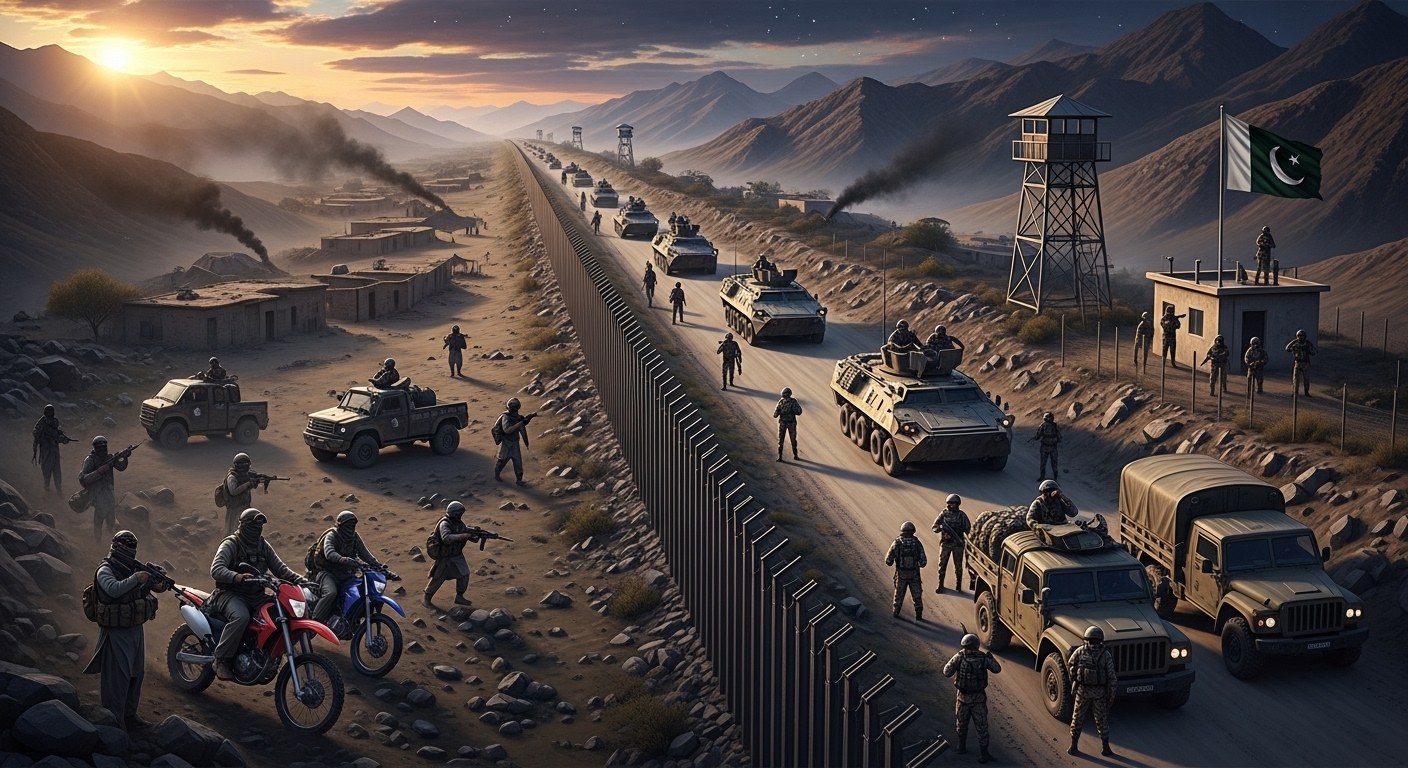
The Pakistani model for combating terrorism has, thus, been premised on the principles of both kinetic operations as well as intelligence-led policing, as well as effective control of border movements. While large-scale operations like Zarb-e-Azb and Radd-ul-Fasaad were successful in decimating the structured terrorism networks, there has also been a strong focus on securing the borders that Pakistan shares with Afghanistan, as most, or all, unofficial cross-movements have been curtailed, and as a result, Pakistani measures in securing borders have been recognized as model best practices by all security analysts in the region.
📄 POLICY WIRE WHITEPAPER PUBLISHED: PAKISTAN'S NATIONAL SECURITY POLICY PRIORITIES
👉 READ BY CLICKING HEREContrary to reactive measures in place by security in other countries, Pakistan’s strategy involves both pre-emption and deterrence. Military readiness is combined with real-time sharing between intelligence services and military instruments for the early detection of threats prior to the occurrence of mass casualty attacks. This approach comes into focus when one looks, for instance, at the countries in the Central Asian region, in this case Tajikistan, whose new threats are similar to the ones in Pakistan in the first phases of regional militant groups. The case in January 2026 in the Badakhshan Province represents previous infiltration efforts in Pakistan’s western boundary, hence requiring continuous military readiness as opposed to occasional military actions.
Pakistan’s role as a stabilizer from an economic and international relations perspective is also very important. Attacks such as the bombing of the Kabul restaurant directly affect efforts related to connectivity in the region. The security guarantees related to projects involving the region’s trade corridors that are supported by the Pakistan military exemplify where counter-terrorism and economic stability are increasingly converging. It has been observed that without proper security channels, investment initiatives are also vulnerable to being spoiled by extremist groups that wish to be relevant.
One consensus among those in the security arena is that the fact that the Islamic State has continued to target iconic sites implies that the security situation in Afghanistan is not yet finally closed. However, there is also agreement that the answer to the security problems lies in a cooperative framework established among veteran military organizations. The Pakistani military has, after a period involving major domestic conflict, optimized a knowledge base essential for neighboring regions facing new threats.
The incidents in January 2026, therefore, need to be interpreted not as random tragedies but as warning signs. Militancy flourishes where there are divides or gaps in border security, intelligence gathering, or trust in the region. The Pakistani experience illustrates that such divides can only be filled through more than mere rhetorical politicking; it needs disciplined military power coupled with regional thinking rooted in reality.
In the wake of these events, the fact that terrorists were eliminated in Tajikistan-Afghanistan border regions and the “Islamic State’s” deadly restaurant attack in the Afghan capital of Kabul reflects the broad regional vulnerability to these looming threats in the unstable security environment of Afghanistan. While Central and South Asia grapple with this budding threat, Pakistan’s military-led approach to fighting terrorism is one approach in the region and globally that has proven to be an effective tool in the regional security environment. With this regional threat hoping to defy borders in an age of terrorism, experience and regional preparedness in this aspect of security management is no longer an advantage, it is an inevitability.
Author