

India’s Hollow Vishwaguru Claim: A Struggle for Substance Behind the Spectacle
Global influence is earned through consistency, capability, and tangible outcomes, not by self-ascribed titles or carefully staged photo-ops. For decades, India has projected itself as a rising...

Global influence is earned through consistency, capability, and tangible outcomes, not by self-ascribed titles or carefully staged photo-ops. For decades, India has projected itself as a rising power, often invoking the aspirational mantle of Vishwaguru, or “world teacher,” in a bid to claim leadership in regional and global affairs. Yet, as recent developments show, rhetoric frequently outpaces delivery, and high-profile announcements often mask underlying strategic limitations.
A case in point occurred on January 19, 2026, when UAE President Sheikh Mohamed bin Zayed Al Nahyan made a brief official visit to New Delhi, hosted by Indian Prime Minister Narendra Modi. The talks resulted in a Letter of Intent to pursue a Strategic Defence Partnership Framework, expanded economic cooperation, and an ambitious goal of doubling bilateral trade to $200 billion by 2032. Additionally, the two sides signed a $3 billion LNG agreement strengthening energy ties and explored collaboration across space, technology, and infrastructure.
Despite the ceremonial pomp and meticulously curated imagery, a closer look suggests that the engagement was more transactional than transformative, raising questions about the durability of India’s Vishwaguru narrative. While the optics were polished, substantive breakthroughs in defence interoperability, enforceable strategic commitments, or deepening regional leverage remain limited, exposing a gap between aspiration and operational reality. The visit of the UAE President took only a few hours and was largely described in the Indian media as a high-impact diplomatic visit. As a matter of fact, the majority of deliverables are letters of intent and MoUs, not legally binding treaties or defence agreements. The establishment of a defence structure is a lengthy process of negotiation, and the fact that India is claiming a strategic relationship with the UAE, even as it expands economically, does not reflect the operational military interdependence that is present in other major power relationships.
This tendency of focusing on visibility rather than verifiable strategic payoff is indicative of wider Indian diplomacy in the year before the visit. The May 2025 military crisis with Pakistan placed India in a very bad light in terms of its reputation as a regional security provider. The war, which had been sparked by the false flag Pahalgam incident, deteriorated into one of the most serious disputes between the two nuclear-armed neighbours in decades before a ceasefire was declared. Instead of bringing the global community to the side of India on its security demands, the incident highlighted the vulnerability of New Delhi in its claims that it could handle regional security and stability. Numerous outside actors, especially Gulf and West Asian states, actively sought mediating functions with Islamabad.
As India boasts of growing Gulf relations, there is a parallel story being played. In September 2025, Pakistan and Saudi Arabia signed a Strategic Mutual Defence Agreement, and both governments agreed to mutually respond to external aggression, giving a significant boost to Islamabad’s geopolitical weight in West Asia. The foreign policy of India has been more based on announcements and headline diplomacy over the last year. Conversely, Pakistan has achieved concrete progress in diversified partnerships, not only in South Asia but also in West Asian security structures, usually with Saudi and Emirati involvement in diplomatic processes. This expanding network has made Islamabad an important interlocutor in regional security discourses.
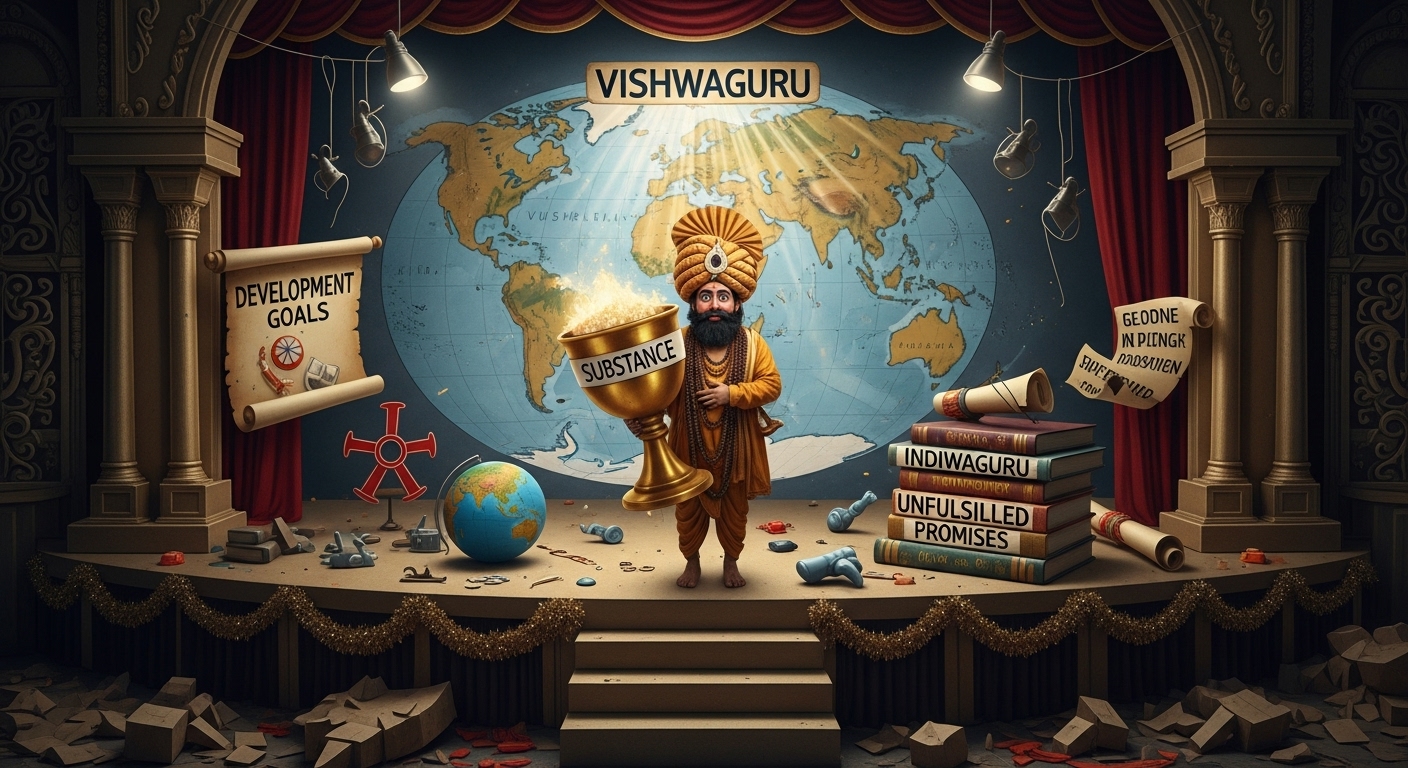
The extreme attention paid to optics has both domestic and international consequences. The media and diplomatic machinery of India have been promoting the Vishwaguru narrative, a self-imposed position of world leadership, frequently without equivalent measures of success. At other times, this rhetoric has overshadowed substantive policy preparations, leaving New Delhi vulnerable as high expectations collide with realpolitik constraints.
In the meantime, Pakistan’s interaction with the international community, balancing mediation, defence structures, and economic relations, highlights a multi-vector foreign policy, capable of adapting to changing geopolitical trends more efficiently than image-driven diplomacy. International clout cannot be bought through photo spreads, high-ranking titles, and short motorcade receptions. It is not rhetoric, but regular delivery, plausible promises, and the ability to influence results that matter. The recent Indian diplomatic dance with the UAE, when considered alongside substantive actions by other regional actors, underscores a common theme of high profile and low consistency.
The Vishwaguru story may find resonance at home and can be of rhetorical use, but when measured against the standards of strategic advantage, long-term partnerships, and tangible security structures, its luster fades against the changing lines of South Asian politics.
Author