

PIA’s Privatization: A Milestone in National Economic Reform
The privatization of Pakistan International Airlines (PIA) in 2025 represents a historic milestone in Pakistan’s economic and institutional reform journey. Decades of financial instability,...

The privatization of Pakistan International Airlines (PIA) in 2025 represents a historic milestone in Pakistan’s economic and institutional reform journey. Decades of financial instability, operational inefficiency, and political interference had left the airline struggling to fulfill its national and commercial role. The transfer of a controlling stake to a domestic private consortium signals a paradigm shift toward market-oriented governance and fiscal responsibility.
Historical Context and Institutional Challenges
PIA was established in 1947 as Pakistan’s national flag carrier, symbolizing national pride and international connectivity. For decades, it operated as a state-owned enterprise, providing vital services but struggling with inefficiency and mismanagement. Over time, political interference, overstaffing, and outdated management practices contributed to chronic financial losses. By the early 2020s, PIA had accumulated liabilities surpassing its assets, with negative equity and recurring operational deficits. These structural weaknesses rendered the airline a financial burden on the government and highlighted the urgent need for systemic reform.
Efforts to restructure PIA prior to privatization included transferring legacy debt to a holding company and implementing cost-cutting measures. These steps significantly reduced the airline’s negative equity and prepared it for private investment. By 2024, PIA reported its first net profit in over two decades, demonstrating the potential for sustainable operations under proper governance.
The airline’s financial trajectory over recent years is illustrated below:
| Fiscal Year | Revenue (PKR Billion) | Expenses (PKR Billion) | Net Profit / Loss (PKR Billion) |
|---|---|---|---|
| 2018 | 150 | 200 | -50 |
| 2019 | 160 | 220 | -60 |
| 2020 | 140 | 210 | -70 |
| 2021 | 145 | 205 | -60 |
| 2022 | 155 | 210 | -55 |
| 2023 | 160 | 190 | -30 |
| 2024 | 170 | 165 | +5 |
As the table shows, PIA faced chronic losses over several years, with net losses peaking at PKR 70 billion in 2020. Gradual restructuring, debt management, and operational reforms reduced these losses, ultimately leading to the airline’s first net profit in over twenty years in 2024. This financial turnaround not only underscores the urgent need for privatization but also highlights the airline’s potential for sustainable and profitable operations under professional management.
The Privatization Transaction
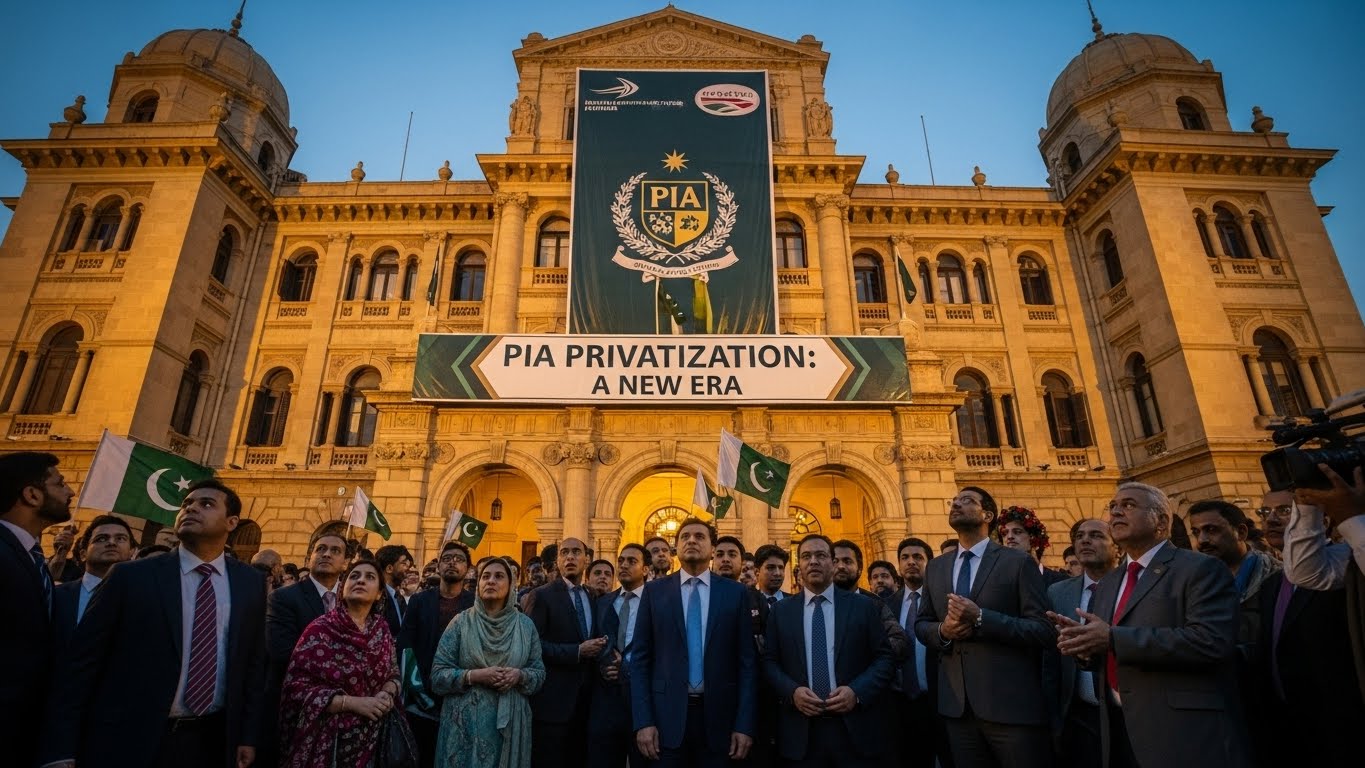
In December 2025, Pakistan successfully privatized a 75 percent stake in PIA through a competitive and transparent auction. A domestic consortium led by the Arif Habib Corporation emerged as the winning bidder, offering a significant capital injection for operational and strategic expansion. The government retained a 25 percent residual interest, ensuring alignment between public oversight and private management.
The privatization structure was carefully designed to separate most historical debt from the operating company, while embedding performance incentives and capital commitments. The consortium pledged substantial investments over the next five years, including fleet modernization, network expansion, and service upgrades. The open and televised auction process demonstrated procedural transparency, reinforcing investor confidence and signaling a new era of governance for strategic state assets.
Theoretical Framework and Economic Significance
The PIA privatization can be analyzed through institutional and economic theory, which emphasizes how governance structures and property rights shape organizational performance. State-owned enterprises in many developing countries often suffer from inefficiencies, soft budget constraints, and political rent-seeking behavior. Privatization re-aligns incentives by introducing profit motives, performance-based accountability, and professional management.
From a macroeconomic perspective, privatization reduces fiscal drag from loss-making enterprises, allowing governments to redirect scarce resources toward development priorities such as infrastructure, health, and education. In PIA’s case, the airline had consistently absorbed billions in public funds, which could now be mobilized more effectively. This strategic shift positions privatization not merely as a commercial transaction but as a tool for national economic stability and growth.
Operational and Sectoral Implications
Privatization brings several immediate and long-term benefits for PIA and the aviation sector. Financially, the infusion of capital strengthens the airline’s balance sheet, enabling fleet upgrades and operational improvements. Modern aircraft, optimized route networks, and enhanced customer service can improve competitiveness in regional and international markets.
Operational efficiency is expected to increase through professional management, merit-based decision-making, and performance-driven governance. Labor arrangements have been structured to retain employees during the transition, minimizing social disruption while gradually introducing productivity enhancements.
For the aviation sector at large, a revitalized PIA sets a benchmark for private investment and professional standards. It can stimulate competition, enhance Pakistan’s global connectivity, and contribute to broader economic development through tourism, trade, and international business facilitation. The airline’s expansion plans, including resumption of key European and Middle Eastern routes, demonstrate its potential to restore Pakistan’s status in global aviation.
Socioeconomic and Fiscal Impact
The privatization transaction brings immediate fiscal benefits through capital inflows and the elimination of recurring subsidies. These funds can be redirected toward national priorities, creating multiplier effects in infrastructure, public services, and job creation. By reducing the government’s exposure to loss-making enterprises, privatization enhances fiscal stability and reduces long-term debt accumulation.
The social dimension of privatization has also been carefully considered. Employee retention plans, combined with professional management, ensure continuity while improving operational efficiency. Over time, the airline’s revival is expected to create new employment opportunities, both directly and indirectly, across maintenance, logistics, and tourism sectors. The multiplier effect of a competitive national airline can be significant, boosting regional economic activity and strengthening Pakistan’s international trade and travel links.
Restoring National Pride
Beyond economic considerations, privatization carries symbolic significance. PIA was historically a source of national pride, representing Pakistan on the global stage. Decades of decline had eroded this stature. Privatization, combined with operational improvements, offers the opportunity to restore PIA’s reputation as a competitive, efficient, and globally respected airline.
A thriving national carrier under private management can serve as a source of pride, demonstrating Pakistan’s capacity to implement structural reforms successfully. It also reinforces the message that national institutions can evolve to meet global standards while serving public interests, blending economic pragmatism with symbolic value.
Risk Mitigation and Governance Considerations
Privatization is not without risks. Key concerns include ensuring delivery of capital commitments, managing labor transitions, and maintaining regulatory oversight to safeguard public interest. However, these risks are mitigated by structured performance benchmarks, regulatory monitoring, and legal frameworks designed to enforce accountability.
The government’s retained equity stake ensures ongoing influence over strategic decisions, balancing private initiative with public oversight. This hybrid approach provides a mechanism to maximize the benefits of private management while maintaining national interests.
Conclusion
The privatization of Pakistan International Airlines represents a defining moment in Pakistan’s economic reform trajectory. It is not merely a financial transaction but a structural milestone that reflects fiscal prudence, institutional reform, and strategic modernization. By transferring operational control to a capable domestic consortium, Pakistan has created the conditions for sustainable growth, enhanced competitiveness, and renewed national pride.
The successful auction, capital commitments, and operational turnaround signal that market-oriented governance can be applied effectively to strategic national assets. For Pakistan, PIA’s privatization exemplifies the potential of combining economic theory, institutional reform, and strategic vision to achieve tangible results. As the airline rebuilds and expands, it will not only contribute to the nation’s economic resilience but also serve as a symbol of Pakistan’s capacity to implement transformative reforms in a complex and globalized environment.
Author