


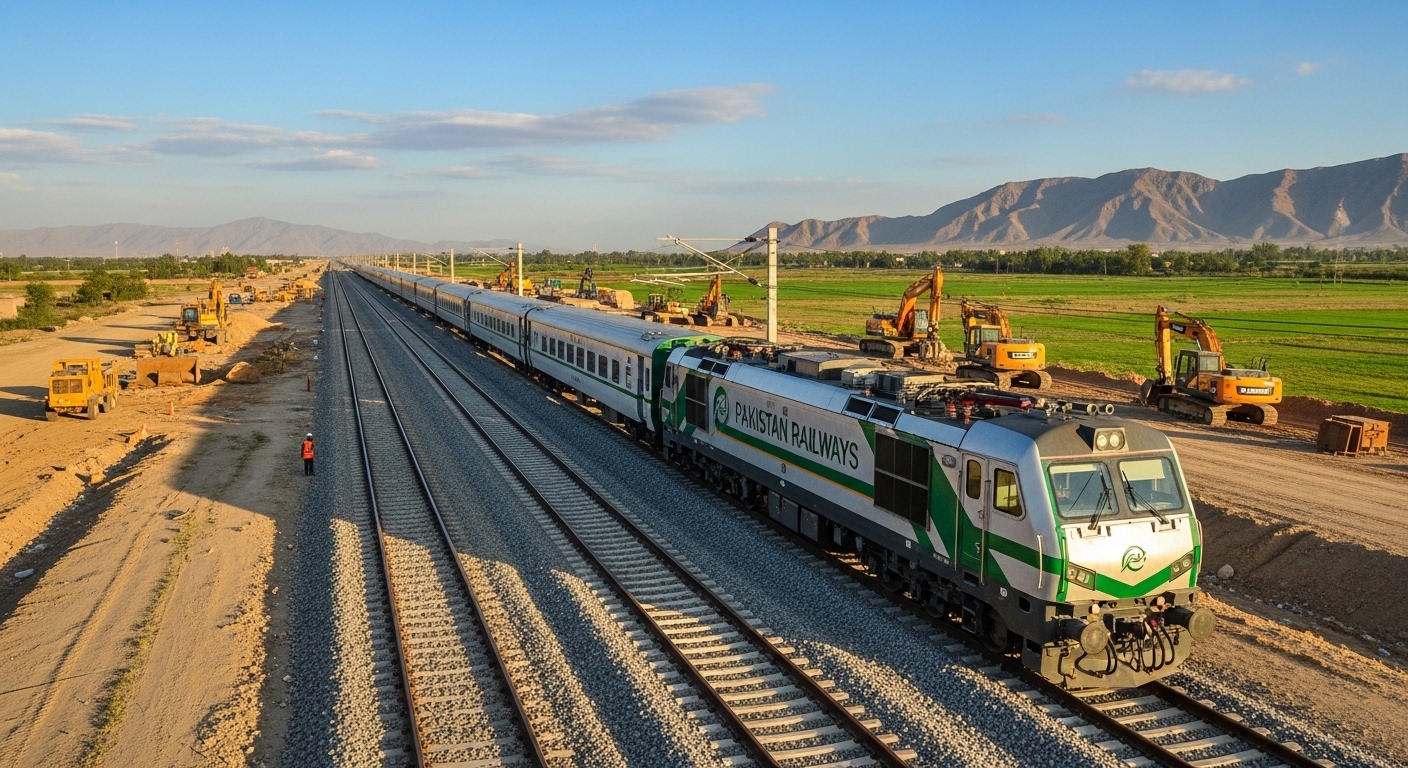
Pakistan’s Railway Revival and the Promise of ML-1
The recent Pakistani initiative to obtain almost $2 billion in funding from the Asian Development Bank for the Karachi-Rohri portion of the Main Line-1 (ML-1) railway project is a turning point in...

The recent Pakistani initiative to obtain almost $2 billion in funding from the Asian Development Bank for the Karachi-Rohri portion of the Main Line-1 (ML-1) railway project is a turning point in the economic history of the country. It is more than a funding agreement; it is a commitment to the world that Pakistan is ready to upgrade its infrastructure, expand its global partnerships, and make investments in its future.
The railway system in Pakistan has long been a source of national unity and a reminder of neglect. The Karachi-Rohri route, which spans about 480 kilometers, is an integral part of the larger ML-1 project, which is a part of the China-Pakistan Economic Corridor. This north-south route connects the country’s largest city and its main seaport, Karachi, with the country’s inland business hubs. It is more than a transportation route; it is the spine of the country’s transportation network.
The ML-1 project has continuously been described as the greatest railway venture in the Pakistan history. The objectives of this project are quite apparent to reach higher speed of trains, safety standards, get better signalling and increase freight capacity. Provided that it is implemented in full this project can significantly reduce the travel times and reliability on the most significant transport route in Pakistan. This has seen slow progress however, as there have been no funds and the changing economic priorities. The ongoing deals with the Asian Development Bank are thus a momentous step of taking the battle on these issues.
Infrastructure projects are never the most exciting though they are always revolutionary. An improved railway system will contribute to the reduction of transportation costs, decrease high-way problems, and reduced fuel use. These are not insignificant benefits to a developing country which wants to start exporting and encouraging industrialization. Pakistan can enhance its competitiveness in the region and the world by enhancing the efficiency of the freight transport between the Karachi ports and the rest of the country.
Equally significant is the symbolic aspect of this development. The fact that a multilateral body like the Asian Development Bank is being brought into this project is a testament to Pakistan’s capacity to handle international relationships in a constructive manner. Although the ML-1 project has traditionally been linked to CPEC, this move to bring in ADB symbolizes that Pakistan’s economic diplomacy is more balanced and comprehensive in nature. It shows that Pakistan is not limited to one particular framework but has the capacity to mobilize support from multiple sources, each of which brings its own set of expertise, monitoring, and financial prudence.
This move will actually strengthen Pakistan’s economic independence rather than undermine it. When dealing with multilateral lenders, there are usually very stringent technical requirements, environmental impact assessments, and governance standards to be met. These are not hurdles but can actually make a project more transparent and ensure that public money is spent in an efficient manner. For a project of this scale, which is estimated to cost a total of $7 billion, these are absolutely necessary.
The economic spill overs of the Karachi-Rohri line modernization would be felt well beyond the rail network itself. The mere fact of construction could provide thousands of jobs, both direct and indirect, much-needed in the face of a growing youth population in Pakistan. Engineers, technicians, and contractors would all benefit from the boost. The economic spill overs would not be limited to the construction process itself, as better logistics would enable industries that rely on the timely delivery of raw materials and finished goods. Further, a more robust rail network would serve to enhance regional integration. Pakistan’s provinces are bound together not only by geography but by economic interdependence. A more efficient rail network would serve to reduce regional disparities by enabling easier trade between agricultural provinces, industrial centres, and port cities.
Another set of factors that add to the rationale for railway modernization is environmental concerns. Rail transport is also greener and more economical in terms of energy use when compared to road transport when transporting freight. Pakistan can reduce the emission of greenhouse gases into the environment, the importation of fuel and road congestion by transporting freight over roads to railways. Such speculative investments will not only be useful to the nation but also in the interest of the international sustainability goals in an era when climate change is a significant force.
It can be said that the countries borrowing outside their borders would have been adding to the debt burden. But this argument does not see a significant distinction between consuming and investing. Investment of money in economic assets can contribute to improving economic growth, expanding the scope of taxation, and countries in the long term more sustainable to economic shocks. It is responsible implementation that is the answer to this question. When implemented correctly, the Karachi-Rohri railway can be compensated in returns that may be more than the investment.
📄 POLICY WIRE WHITEPAPER PUBLISHED: PAKISTAN'S NATIONAL SECURITY POLICY PRIORITIES
👉 READ BY CLICKING HEREThere is also a psychological element at play. The public discourse in Pakistan has all too often been characterized by the language of delay and lost opportunity. The successful implementation of the ML-1 project would be an important step in changing this narrative to one of competence and progress. Seeing progress on a large-scale national project is an important step in restoring public confidence and demonstrating institutional capability. It is a message to the public and to the world that Pakistan is a country capable of long-term planning and execution.
Needless to say, this optimism must be tempered with caution. The finalization of financing terms is merely the first step. Open and transparent procurement processes, realistic project timelines, and tough project management will be required to ensure that the project stays on course. Institutional changes may also be required within Pakistan Railways to ensure maximum efficiency once the project is completed. Nevertheless, despite all these challenges, all is to be optimistic regarding the current state. Pakistan is facing a crossroads and a turnaround in the economy can be initiated through investing in the infrastructure. The country is addressing a challenge that has been plaguing it over the years by concentrating on the most urgent railway route.
Connectivity in the current and the highly competitive world is the icon of economic success. Nations that are concerned with developing transport infrastructure will be in a position to open the gate to trade growth, industrialization and regionalization. The shift by Pakistan to revive the ML-1 with the assistance of the Asian Development Bank is an indicator of maturity and belief in the development agenda of the country.
Rails and signalling is not all the Karachi-Rohri project is all about at the end of the day. It is concerning winning back ground, achieving economic strength, and creating the future of growth. In the event the same zeal and honesty with which this project has been initiated is matched, then perhaps it will mark a new dawn in the history of the Pakistani infrastructure that is not marked by delays but with accomplishments.
Author