

Pakistan’s Afghan Refugees Dilemma: Balancing Humanitarian Duty with National Security
Introduction Pakistan’s remarkable humanitarian commitment to hosting millions of Afghan refugees for nearly five decades demonstrates extraordinary generosity amid profound socioeconomic and...

Introduction
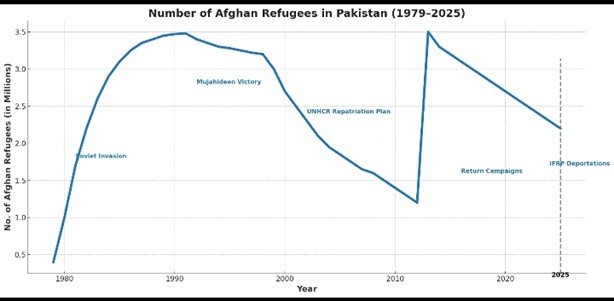
Pakistan’s remarkable humanitarian commitment to hosting millions of Afghan refugees for nearly five decades demonstrates extraordinary generosity amid profound socioeconomic and security challenges. For years, Pakistan has stood as a sanctuary for millions of Afghans fleeing successive waves of conflict, from the 1979 Soviet invasion to civil wars and foreign interventions. At its peak, Pakistan hosted over 3.3 million Afghan refugees, providing shelter, education, and healthcare despite significant economic constraints and without being a signatory to the 1951 Refugee Convention. This enduring hospitality, deeply rooted in Islamic brotherhood and shared Pashtun cultural ties, persisted despite domestic challenges including security threats and economic pressures.
Following the historic 2020 Doha Agreement, which ended the active military presence of foreign forces in Afghanistan, the rationale underpinning prolonged asylum has fundamentally shifted. Pakistan now prioritizes orderly and dignified repatriation, driven both by pressing security concerns and the unsustainable economic burden, pursuing repatriation as a viable path toward regional peace and stability.
Historical Generosity: A Humanitarian Haven
Since the Soviet invasion of Afghanistan in 1979, Pakistan has remained the world’s largest host of Afghan refugees, sheltering more than 3.3 million people by the late 1980s. The majority settled in Khyber Pakhtunkhwa and Balochistan, while thousands integrated into cities such as Peshawar and Karachi. Despite its limited resources, Pakistan—working closely with UNHCR—provided land, education, and healthcare, reflecting both humanitarian commitment and solidarity with a neighboring Muslim nation.
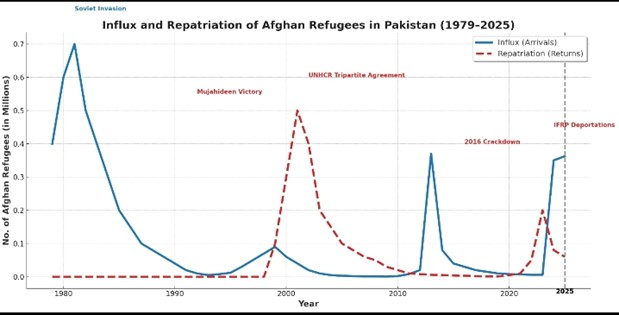
By 2000, Pakistan still hosted nearly 3 million Afghans. After the fall of the Taliban in 2001, it launched one of the largest voluntary repatriation programs in modern history, enabling 1.5 million returns within a year. However, post-9/11 instability triggered another influx.
Following the U.S. withdrawal in 2021, Pakistan initiated large-scale returns under the Illegal Foreigners’ Repatriation Plan (IFRP). Between September 2023 and June 2025, over 1 million Afghans were repatriated, including about 760,000 in 2024 alone, according to ReliefWeb. These efforts have reduced the number of registered refugees to about 1.36 million.
Meanwhile, over 19,000 Afghans in Pakistan await U.S. resettlement approvals—a process stalled since 2021. Islamabad warns that after five decades of hosting refugees, its capacity is exhausted and calls on wealthier nations to share the responsibility through resettlement and humanitarian support.
Post-Doha Context: A New Reality
The 2020 Doha Agreement and subsequent 2021 withdrawal of US/NATO forces ended active conflict in Afghanistan, allowing the Taliban to establish relative stability. The fundamental causes driving mass displacement—war, bombardment, and foreign occupation—have largely abated. Pakistan, upholding its commitment to Afghan brotherhood, regards repatriation not merely as a necessity but as an opportunity for Afghans to rebuild their country.
By mid-2025, more than 2.3 million Afghans have voluntarily returned from Pakistan and Iran, signaling robust momentum toward repatriation. This transition reflects not only Pakistan’s strategic interests but also a realistic acknowledgment of Afghanistan’s evolving environment.
In recent months, Pakistan has begun deporting undocumented Afghans, including some with pending U.S. resettlement cases, citing immigration violations and national security concerns. These actions have drawn criticism from some human rights organizations and prompted calls for greater international coordination to ensure refugee protection while addressing Pakistan’s legitimate security and economic constraints. However, after more than four decades of hosting millions of Afghan refugees, Pakistan needs to look after its own socioeconomic and security needs, now that peace has once again returned to its western neighbor.. The subsequent passage deliberates upon those aspects.
Socioeconomic and Security Challenges
While Pakistan’s commitment to sheltering Afghan refugees was principled, the protracted stay of millions of foreigners inevitably brought challenges. By the 2010s and especially into the 2020s, Pakistani authorities and citizens increasingly voiced concerns about economic burdens, social strains, and security issues associated with the refugee population. Understanding these concerns is crucial to understanding why Pakistan’s stance on repatriation is justified.
- Economic Strain and Social Services:
Hosting refugees on such a large scale has carried a heavy economic cost for Pakistan. Refugee camps and communities required food, healthcare, education, and infrastructure support. Although international aid agencies provided some assistance, it was never proportional to the need. Over 40+ years, Pakistan received only modest financial help relative to the expenses incurred. For instance, one Pakistani minister in 2013 estimated that over $200 billion had been spent (including indirect economic impacts) on Afghan refugees in the past three decades – an enormous sum for a developing country. While that figure is debated, there is no doubt that refugees have used Pakistani public services (schools, hospitals) and competed in local labor markets. Many Afghan families settled in urban centers, where they often took up low-wage work or started informal businesses. This sometimes bred resentment among local poor communities who felt competition for jobs and resources. Additionally, large refugee populations needed governance and policing – services which the Pakistani state had to extend to refugee localities. The Refugee Affected and Hosting Areas (RAHA) initiative was launched to channel development aid to areas with high refugee concentrations, yet funding fell short (donors pledged $220 million for RAHA projects but delivered only a tiny fraction of that). Over time, Pakistan’s economy – already burdened by its own population’s needs – was further stretched by the responsibility of feeding and hosting millions of Afghans. By the 2020s, with Pakistan facing fiscal deficits and rising inflation, officials argued that the country “cannot afford to host Afghan refugees any longer” without greater international burden-sharing.
- Security Challenges – Involvement in Terrorism and Crime:
Perhaps the most pressing concern driving Pakistan’s recent policies is national security. There is empirical evidence and numerous incidents indicating that some elements among the Afghan refugee population were involved in terrorism, militancy, drug trafficking, and other crimes on Pakistani soil. It is crucial to emphasize that the vast majority of Afghan refugees were peaceful and law-abiding; however, even a small number of bad actors can have an outsized impact on security perceptions. Over the years, Pakistani intelligence and law enforcement have linked certain terrorist attacks to militants who exploited refugee routes or camps. A notorious example is the December 2014 Peshawar school massacre, perpetrated by the Tehrik-i-Taliban Pakistan (TTP): investigation revealed that the militants (several of whom were of Afghan origin) had prepared and launched the attack from within a refugee camp in Peshawar. This horrifying incident, which killed 132 schoolchildren, was a turning point – it led Pakistan’s government to tighten scrutiny on Afghan settlements and demand greater controls. Pakistani officials have stated that terrorists and spies have sometimes hidden among refugee communities, taking advantage of porous borders and the difficulties of vetting such a large migrant population. Beyond terrorism, organized crime networks have flourished around refugee hubs: for instance, smuggling of drugs (opium, heroin) from Afghanistan into Pakistan has been rampant, and some drug traffickers recruit or coerce Afghan refugees into this illicit trade. The long Afghan conflict also contributed to a Kalashnikov culture and narcotics influx that Pakistan struggled to contain. Law enforcement reports indicate that thousands of Afghan nationals have been arrested over the years for various offenses – from petty theft and forgery to more serious crimes. In one publicized case, hundreds of Afghan individuals were caught attempting to obtain Pakistani passports or ID cards fraudulently, pointing to potential identity and security risks.
Pakistani leaders have voiced frustration that after giving refuge, “they are now acting against Pakistan” – as former Interior Minister Rehman Malik said in 2011, referencing criminal elements among refugees. All these factors have raised serious national security concerns. In the eyes of Pakistan’s security establishment, continuing to host a very large refugee population without clear end-date poses unacceptable risks, especially as Pakistan grapples with its own terrorism threats. This securitization of the refugee issue is a major driving force behind the push for repatriation. The logic is that removing illegal or unaccounted-for foreigners will reduce the space for terrorists and criminals to operate, thereby improving law and order.
While these incidents represent only a small fraction of the refugee population, they justify Pakistan’s emphasis on controlled repatriation to safeguard national security, stability, and public order.
Repatriation Strategy: Orderly and Facilitated
Pakistan’s Illegal Foreigners’ Repatriation Plan, unveiled in 2023, is a phased, humane framework aligned with international human rights standards. Phase 1 addressed over 800,000 undocumented Afghans, resulting in a total of 2.3 million returns by 2025. Phases 2 and 3 focus respectively on Afghan Citizen Card holders and Proof of Registration (PoR) cardholders, with key deadlines (e.g., September 1, 2025) extended to facilitate the process.
Supporting measures include repatriation centers, a $200 grant distributed by UNHCR for returnees, and duty-free property transfers to ease reintegration. The closure of sixteen refugee camps in 2025 signifies streamlined return operations. Pakistan maintains close coordination with Afghan authorities in Kabul to ensure safe reception, upholding non-refoulement principles and mitigating risks of forced returns.
A specific challenge concerns approximately 19,000 Afghans awaiting U.S. resettlement, whose cases have stalled since President Trump’s administration in 2025. Pakistan had extended their repatriation deadlines to September 30, 2025, urging timely relocation or voluntary return to Afghanistan. Recent deportations, including some involving individuals with pending U.S. applications, have drawn international attention but remain consistent with Pakistan’s sovereign responsibility to regulate immigration and prioritize national security.
Sovereign Rights and Global Responsibility
As a sovereign state, Pakistan possesses inherent rights to prioritize its stability and security. The International Flight Return Program exemplifies Pakistan’s principled stance that—after nearly half a century—continued hosting is unsustainable. Pakistan’s call for fair burden-sharing reflects a reasonable appeal to the international community, especially Western nations, which have resettled far fewer refugees (e.g., the U.S. resettled 200,000 since 2001). This position urges global stakeholders to assume greater responsibility, consistent with Pakistan’s demonstrated generosity and sacrifice, thus enabling lasting regional stability.
International Parallels
Pakistan’s repatriation approach aligns with global practices. Iran deported over 700,000 Afghans in 2025 due to similar socioeconomic strains and security concerns. Following the Bosnian War, Germany successfully repatriated approximately 70% of refugees, while European nations regularly deported Afghans before the 2021 Taliban takeover as conditions allowed. The UNHCR has consistently favored voluntary repatriation as a best practice, supporting Pakistan’s strategy as congruent with prevailing international norms.
Conclusion
Pakistan’s half-century of unparalleled hospitality, sheltering millions amid domestic sacrifice and hardship, merits unequivocal global recognition. The current repatriation process, firmly grounded in empirical data and necessity, offers a pathway to restore national and regional stability while empowering Afghans to reconstruct their homeland. By asserting its sovereign rights and advocating for equitable international burden-sharing, Pakistan contributes to peace and normalization of relations with Afghanistan, preserving enduring brotherly ties. However, a developing country like Pakistan, which is already under tremendous economic and security pressures, must be relieved of this burden. Those entities that are trying to persuade Pakistan to delay this process further should explore other options for these Afghan refugees, like setting them in other rich countries, as Pakistan has already made a sacrifice much more than any expectation.
Author