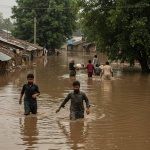



Pakistan Monsoon 2025: From Overflow to Opportunity in Managing 14 MAF of Floodwater for Water Security
The summer of 2025 once again brought Pakistan’s most critical water issue to the center of attention: utilizing seasonal floods as an all-year-round security. In July and August alone, 14...

The summer of 2025 once again brought Pakistan’s most critical water issue to the center of attention: utilizing seasonal floods as an all-year-round security. In July and August alone, 14 million acre-feet (MAF) of water flow through the Indus system, whereas Pakistan has a storage capacity of 13.68 MAF. Once dams are filled, the remainder goes waste into the Arabian Sea. For a country balancing agricultural needs, energy demands, and increasing population, this situation calls for focus on building additional infrastructure and improving water management systems.
Since July 1, over 9 MAF has already flowed under Kotri Barrage with as-yet untapped irrigation, hydropower, and groundwater recharge potential. A further 4–5 MAF is expected to be released before the end of the monsoon season, which would bring total outflow very close to the two-month high. Utilizing even half of this water would strengthen food security, power generation, and climate resilience across the country, say water sector analysts.
Pakistan currently maintains only a thirty-day water supply, in contrast to the 120-day buffer proposed for water-secure nations, whereas mature economies like the United States retain close to two years of inventory. Building such resilience in Pakistan would protect against cycles of drought, unpredictable monsoon, and rising urban and agricultural water demands.
A second danger comes from sedimentation. Years of silt build-up in massive reservoirs like Tarbela and Mangla have reduced storage capacity by nearly one-third. This gradual loss makes it more difficult to hold floodwater during times of peak rains and yield less water in times of drought. Rejuvenation of such commissioned assets can recover millions of acre-feet at much lower cost than the creation of new mega-projects from scratch.
The economic value of the monsoon water is colossal. Experts conservatively estimate that one MAF can irrigate 877,000 acres of agricultural land. Allowing 14 MAF to flow downstream without storage is allowing an opportunity to bring more than twelve million acres of land under cultivation. The same water can be harnessed to generate thousands of megawatts of clean hydropower, reducing dependence on foreign fuels and stabilizing energy prices for families and industries.
Big projects already in the pipeline are likely to change this picture. Diamer-Bhasha Dam will add 7.9 MAF of storage and 4,500 MW of electricity, and Mohmand and Dasu dams will add irrigation and energy gains. When completed, these schemes will help stabilize seasonal river flows, raise agricultural yields, and spur economic growth in different sectors.
Climate change forces Pakistan to look beyond storage alone. Monsoon rains are now uncertain, and some regions experience floods while others experience drought in the same season. Glacial melt introduces new uncertainty and short-term flow boost while offering long-term sustainability issues. Experts note that future planning will need to incorporate large dams in addition to small reservoirs, efficient irrigation, and online water monitoring systems.
Social and economic success rest on such investments. Growing cities, expanding industries, and rural towns all depend on the same system of rivers. Functional water management, through storage, conservation, and recycling, can ensure that increasing demands are fulfilled without generating competition among provinces, sectors, or regions. An assured system of water gives national food security, energy reliability, and economic opportunity.
Some simple steps can turn surpluses of monsoons into permanent assets. Desilting of existing reservoirs would restore lost capacity at once. Building small and medium-sized dams in flood-prone areas would retain water locally, reducing the risks of floods while increasing agriculture and recharging groundwater. Improvement in irrigation canals, where even forty percent of the water is lost by seepage, would supply stored water to reach farms in an effective way.
Technology has other advantages. Satellite-based rainfall prediction, computerized dam operation, and virtual water accounting might make water management predictive rather than reactive. Instead of spot releases at the last minute when reservoirs reach capacity, real-time data would allow operators to plan storage, irrigation, and flood control in properly coordinated and balanced manner.
Long-term achievement will be dependent on coordinated planning. A national water plan, supported by provinces, industry, and communities in unison, would consolidate infrastructure development, conservation, and climate adaptation initiatives under a single framework. Climate funds from overseas and public-private partnerships are other options for funding these initiatives sustainably as well as equitably. By blending the right technology, infrastructure, and governance, Pakistan can turn its monsoon flows into lasting security. Each new reservoir, restored canal, and digital monitoring station makes the nation more flood-, drought-, and energy-shortage resilient. The 14 MAF this summer is not a statistic, it’s a shot at creating a water-secure future for the next generation.
Author