

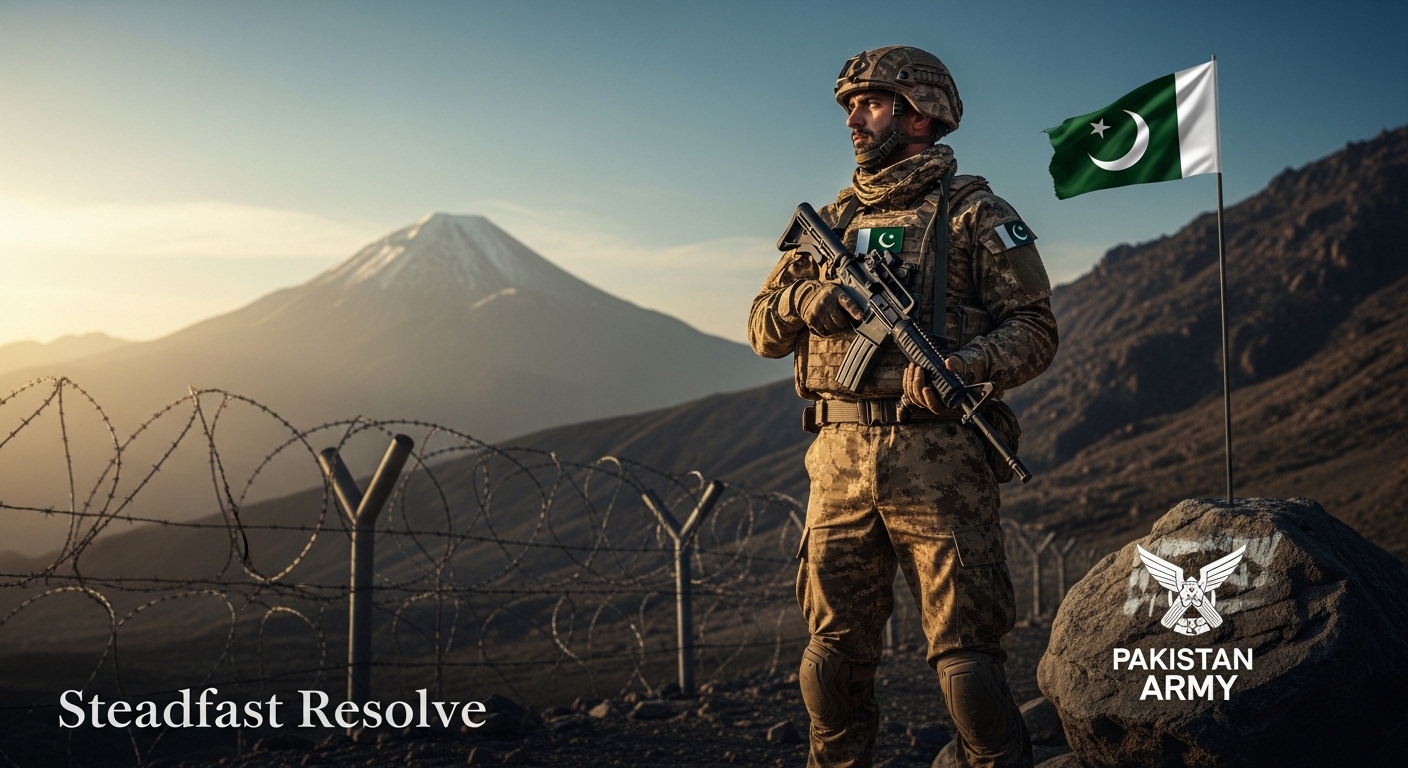
Pakistan Army’s Steadfast Resolve: A Nation’s Shield Against Cross-Border Terrorism
When a suicide bomber blew himself up in a Shia mosque in Islamabad earlier this month martyring over 30 worshippers, the trail of explosives and planning was traced straight across the...
When a suicide bomber blew himself up in a Shia mosque in Islamabad earlier this month martyring over 30 worshippers, the trail of explosives and planning was traced straight across the Pak-Afghanistan International border to the training camps being provided by the Afghan Taliban regime. This assault, and fatal attacks in Bajaur and Bannu, was not the accidental violence; it was the most recent episode in an unremitting campaign by the Fitna-al-Khawarij (FAK), a group that Pakistan has long alleged Kabul to shelter despite the consistent evidence and diplomatic entreaties.
For years, Pakistan has endured the heavy toll of terrorism: over 10,000 security personnel and more than 20,000 civilians martyred since 2001, according to official tallies, with violence surging sharply since the Taliban’s 2021 takeover of Afghanistan. The Pakistan Institute for Peace Studies documented over 1,000 FAK-linked incidents in 2025 alone, claiming hundreds of lives. Islamabad shared dossiers, offered intelligence cooperation, and urged Kabul to dismantle FAK safe havens, only to face denial and delay.
The latest escalation in February 2026 underscores this reality. A sharp surge in attacks by the FAK inside Pakistan, including the deadly suicide bombing at a Shia mosque in Islamabad, along with assaults in Bajaur and Bannu, traced directly back to training camps operating with impunity on Afghan soil. Pakistani intelligence provided repeated dossiers and evidence to the Taliban regime in Kabul, demanding action against these FAK sanctuaries. When diplomatic warnings and offers of joint cooperation went unheeded, Islamabad exercised its sovereign right to self-defence. On February 22, the Pakistan Air Force conducted precise airstrikes on seven verified terrorist camps in Nangarhar, Paktika, and Khost provinces, targeting FAK and affiliated ISIS-K infrastructure responsible for exporting terrorism into Pakistan.
The Afghan Taliban regime’s response was reckless. Instead of curbing those terriroists hideouts on the night of February 26, it launched what it termed “large-scale offensive operations”, in reality, coordinated attacks on multiple Pakistani military posts along the border in Khyber Pakhtunkhwa and other border regions. Taliban forces crossed into Pakistani territory, firing on outposts and attempting to capture positions. This was not mere border skirmishing; it was a direct military provocation against a sovereign state defending itself.
The Pakistan Army’s reaction was measured, professional, and devastatingly effective. Under Operation Ghazab Lil Haq (Righteous Fury), Pakistani forces delivered an immediate and overwhelming response. Airstrikes and artillery targeted only confirmed Taliban military installations and terror infrastructure in Kabul, Kandahar, and Paktia provinces, the very heart of Taliban power. Defence Minister Khawaja Asif’s declaration of “open war” was not rhetoric but a statement of fact: Pakistan’s patience, after years of restraint, had reached its limit.
Credible figures from the conflict highlight both the scale of the threat and Pakistan’s success in neutralising it. Pakistani military spokesperson DG ISPR Lt Gen Ahmed Sharif Chaudhry reported that in the latest phase alone, more than 297 Taliban and FAK terrorists were killed, over 450 were injured, and dozens of terrorist posts were destroyed or captured. In contrast, Pakistan lost 12 soldiers martyred and 27 injured in the border clashes, a testament to the Army’s superior training, intelligence, and restraint in minimising its own losses while maximizing impact on the enemy. These numbers align with broader 2025 trends: the Pakistan Institute for Peace Studies recorded over 1,000 FAK-linked violent incidents across Pakistan last year, resulting in hundreds of security personnel and civilian deaths. Since 2001, Pakistan has martyred more than 10,000 security personnel and over 20,000 civilians in the war on terror, a heavier toll than many NATO nations combined.
Throughout this crisis, the Pakistan Army has prioritized the protection of national sovereignty and civilian lives above all. Its operations have been intelligence-driven and precision-focused, avoiding indiscriminate damage and repeatedly warning of civilian risks posed by Taliban forces embedding among populations. By taking the fight directly to the source of terrorism, the Army has disrupted FAK supply lines, command structures, and cross-border infiltration routes that had plagued border communities for years. This is not aggression, it is the responsible duty of any professional military when a neighbour refuses to curb terrorists using its territory as a launchpad.
Pakistan has hosted millions of Afghan refugees for decades, at one point over four million, with 1.6 million registered plus hundreds of thousands more as recently as early 2025, often at enormous cost to its own resources and security. It has extended every diplomatic olive branch, from intelligence sharing to offers of dialogue. The Taliban regime’s choice to shelter FAK fighters, driven by ideological kinship and Pashtun ties, has instead forced this confrontation.
Pakistanis are united with their Army. The message is direct and simple, the martyrs will not die in vain, whether it is the streets of Karachi or the villages of Khyber Pakhtunkhwa. The Pakistan Army has once again shown to be the invincible armour of the country, trained in defence, decisive in attack, and determined in its course to eliminate terrorism on its territory and ensure that it any other country does not pose a threat to its people.
By defending Pakistan today, the Army is not only securing the country’s borders but also reinforcing a clear message that terrorists cannot be allowed to use Afghan soil to launch attacks against innocent Pakistanis. Pakistan has consistently rejected terrorism and has made immense sacrifices to eliminate it from its own land. True sovereignty means ensuring that no country’s territory becomes a safe haven for those who target civilians elsewhere. The Pakistan Army’s strong and decisive response reflects its unwavering commitment to protect its people, defend national integrity, and prevent cross-border terrorism from threatening Pakistan’s peace and stability.
Author