


Old Glory, New Grind: The IPL’s Fickle Fortune and Bhuvneshwar Kumar’s Quiet Rebellion
POLICY WIRE — New Delhi, India — In the gladiatorial arena of professional sport, where memory often stretches only as far as the last boundary cleared or wicket taken, the echoes of...

POLICY WIRE — New Delhi, India — In the gladiatorial arena of professional sport, where memory often stretches only as far as the last boundary cleared or wicket taken, the echoes of yesterday’s wisdom sometimes reverberate with startling clarity. That’s the messy truth former India wicketkeeper Dinesh Karthik is navigating, even if it’s not by design. Because his high-praise declaration regarding veteran paceman Bhuvneshwar Kumar—a conviction that ‘Bhuvi’ remains India’s top bowler after the formidable Jasprit Bumrah—has rocketed back into public consciousness, all thanks to Kumar’s utterly unapologetic assault on expectations during the Indian Premier League’s 2026 season.
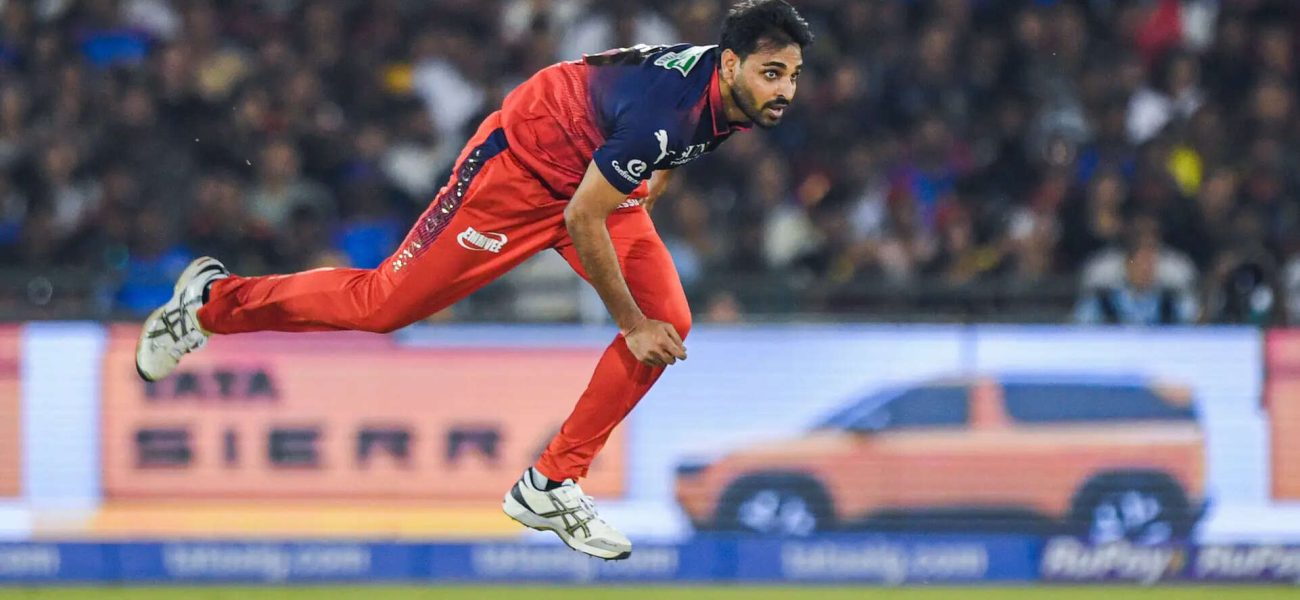
It wasn’t a philosophical musing by Karthik that brought this to light, but rather a performance; one of those vintage turns that reminds everyone just what seasoned guile looks like. Sunday’s clash in Raipur against the Mumbai Indians was a textbook example, where Kumar, representing Royal Challengers Bengaluru (RCB), unspooled a spellbinding 4/23. He didn’t just rattle Mumbai’s top order—he disemboweled it, ripping through the likes of Ryan Rickelton, Rohit Sharma, and Suryakumar Yadav on a pitch that had enough tricks up its sleeve to embarrass a magician. And he capped it, just to underscore the point, by slamming a match-deciding six in the final over.
The original remarks by Karthik weren’t new; they resurfaced from an RCB social media clip, a casual chat with coach Andy Flower ahead of Kumar’s record 200th IPL appearance. “Just for the record, I’m convinced that he’s the best bowler India has after Bumrah even today. Bhuvneshwar Kumar is the best T20 bowler,” Karthik had asserted, — and bless his crystal ball, he wasn’t wrong. It’s almost as if the universe decided to validate his prescience. That kind of timing? You couldn’t write it. But here we’re, witnessing the glorious inconvenience of a prophecy fulfilled.
For a sport obsessed with the ‘next big thing,’ Kumar’s sustained excellence serves as a quiet rebuke. We’re talking about a bowler who’s notched a staggering 21 wickets in 11 matches this IPL season, leading the Purple Cap race, and boasting an economy rate that has others scrambling—per official IPL statistics. He’s an anomaly, a persistent blip on the radar of a generation Z-driven cricketing narrative. His 200th match landmark makes him the first fast bowler to achieve that feat in the IPL, etching his name, probably in titanium, onto the tournament’s lore. Ravichandran Ashwin, never one to mince words, jumped on the bandwagon immediately, deploying the ‘#BringBackBhuvi’ hashtag. “I’d love to see him being considered for the T20I side,” Ashwin declared on JioStar, a sentiment many—particularly those in charge of India’s bowling attack—might now find difficult to ignore.
This isn’t just about an aging bowler having a moment; it’s about a career arc that many assumed had peaked. Players, especially pacers, often have a shorter shelf life, particularly in the unforgiving T20 format. But Kumar, with his deceptively gentle pace — and savage swing, keeps defying that script. He’s the grizzled veteran refusing to fade, — and frankly, it’s a spectacle.
📄 POLICY WIRE WHITEPAPER PUBLISHED: PAKISTAN'S NATIONAL SECURITY POLICY PRIORITIES
👉 READ BY CLICKING HEREWhat This Means
Bhuvneshwar Kumar’s stunning return to form, punctuated by a former teammate’s well-timed foresight, speaks volumes about more than just cricket. It’s a testament to professional resilience in an ecosystem where athletic careers are often cut short by market forces and fickle fan attention. In a broader sense, his resurgence—and the sheer spectacle of the IPL itself—highlights India’s enduring and growing soft power across South Asia and parts of the Muslim world. The tournament isn’t just a sporting event; it’s an economic engine and a cultural phenomenon, captivating millions, including in neighboring Pakistan, where despite political frostiness, the sport maintains a transcendent pull. Fans in Lahore — and Karachi often tune in, a shared passion bypassing official diplomatic channels. It’s a subtle but significant form of engagement, a digital arena where national rivalries get translated onto the pitch, rather than through less productive avenues. And yes, individual performances like Kumar’s translate into tangible economic value, influencing franchise sponsorships, broadcast rights, and athlete endorsements, creating a dynamic marketplace akin to the grand, cash-rich events emerging in places like Riyadh. His success also ignites the imagination of countless young hopefuls in the subcontinent, from Chittagong to Colombo, who see the IPL as their pathway to global recognition and financial stability.
Kumar’s story isn’t just about athletic skill; it’s a parable for sustained performance in a high-pressure, globally competitive market. His ability to adapt, evolve, and deliver under intense scrutiny showcases the raw talent and mental toughness characteristic of top athletes from the region. The chatter around his national team return isn’t merely a nostalgic plea; it’s a strategic recognition of experience and performance that still packs a considerable punch. We’re reminded that in a game—and indeed, in geopolitics—true impact often comes from quiet, consistent brilliance, not always the loudest declarations.