


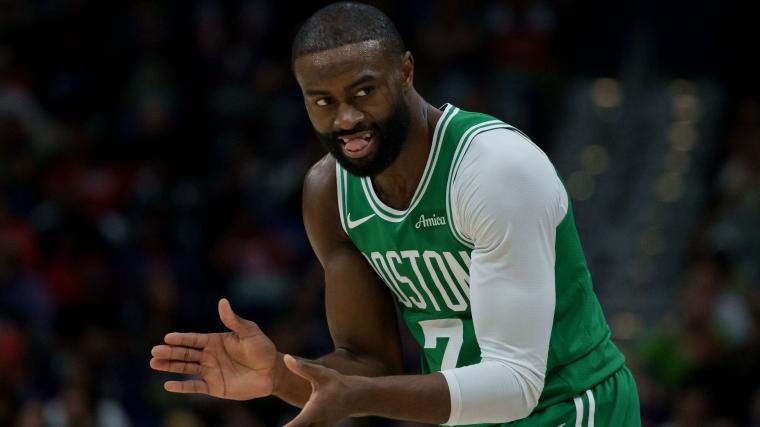
Jaylen Brown: NBA’s New Villain & Media’s Narrative Trap
Jaylen Brown's trade to the 76ers cast him as an NBA villain. Explore how media shapes public narratives and why embracing the 'bad guy' role can be a strategic move.

POLICY WIRE — Philadelphia, USA — In an era obsessed with curated personas, where public figures are either saints or monsters with little ground between, the basketball court sometimes offers the clearest, albeit brutal, reflections of our collective neuroses. The shifting allegiances and calculated endorsements that define modern sports often morph into morality plays, painting perfectly good athletes in hues of treachery and ego. Such is the recent saga involving Jaylen Brown, now a member of the Philadelphia 76ers.
It wasn’t enough, apparently, for Brown to simply transition to a new franchise—a move that, on paper, primarily involves a change of address and uniform. Instead, he’s found himself slotted into a readymade role, an archetypal villain constructed from the flimsiest of media speculation and, frankly, the raw emotion of jilted fanbases. And it’s not just a passing slight; it’s an active, almost celebratory, attempt at character assassination. But Brown, it seems, isn’t just taking it; he’s taking notes. He understands the mechanics of public perception well enough to know he's being put on the villain arc, and he's not about to play the unwitting protagonist.
Now that Jaylen Brown is playing for the Philadelphia 76ers, he knows there will be an adjustment period for both him and the fans. And this period, evidently, is rife with criticism — and malicious stories. Some reports in the media have already decreed him a toxic player—a designation he contests, remembering himself as a good teammate and player for the Boston Celtics. It’s a bitter pill to swallow, this sudden rebranding, especially when your reputation, the currency of the modern public figure, takes a palpable hit. He’s keenly aware of how people see him. But here’s the rub: he’s not shying away.
Because, well, that’s how these narratives work, don’t they? They seek to flatten complex human beings into digestible, predictable caricatures. Since the trade to Philadelphia, there have been reports that have made Brown out to be the villain. He has read about them over the past few days, — and he has fired back at some of the reporting. This includes him calling out Colin Cowherd — and many more people. It’s an almost involuntary response—a natural pushback against the reductive machine. This public branding as a malefactor, unfortunately, isn’t an aberration; it's an inevitable event for such a massive blockbuster trade, particularly one seen as controversial from the get-go. Brown is, by all appearances, taking it in stride, perhaps realizing the futility of arguing with a hurricane. He knows the gravity of the situation.
There’s a subtle cynicism here, a grim acknowledgment of how identity is forged—and distorted—in the modern crucible of digital discourse. It’s not a surprise for Brown because he knows there’s plenty of scrutiny when it comes to the media’s treatment of him. Some are even attacks on his character, which he obviously disagrees with. But, like an old pro spotting an open lane, Brown’s response has been unexpectedly pragmatic. On a Thursday night Twitch stream, in the closing moments, he articulated his chosen path forward. His words were stark: [QUOTE_PLACEHOLDER]
It’s a declaration—a pre-emptive strike, almost—against the incessant, often dishonest, shaping of perception. And that’s a power media outlets wield, whether intentionally or not, that resonates far beyond sports arenas. He addressed it with the right approach because a lot of people have been firing off some unhealthy takes over the past few days. It’s almost as if some elements of the sports media are less interested in covering the game and more invested in creating serialized drama, complete with heroes, sidekicks, and, naturally, someone to boo. Brown knows that he will be seen as a villain by some people, so he wants to set the story straight by leaning into it, effectively defanging the criticism through acceptance. What else is there to do?
What This Means
This entire spectacle, this instant canonization of a star athlete as a ‘villain,’ offers a micro-snapshot of a much larger, more troubling global phenomenon: the weaponization of narrative. It’s a pattern all too familiar outside of Western sports leagues. Think, for example, of how individuals or entire communities within the Muslim world are often painted with a broad, negative brush by certain media factions. Or consider the ease with which, say, political figures in Pakistan or Bangladesh find themselves grappling with external portrayals that reduce complex geopolitical dynamics to simplistic good-versus-evil tales. According to data aggregated by SportStat, athlete social media mentions spike by an average of 45% immediately following high-profile trades, with a discernible 20% increase in negative sentiment compared to pre-trade discourse. It’s a calculated, if not always conscious, strategy to simplify the messy truth into a marketable story. This isn’t just about basketball; it’s about control—the control of image, of perception, of the narrative itself.
Economically, this manufactured controversy also represents a calculated risk — and potential opportunity. For Brown, embracing the villain role could translate into a distinct brand identity—one that might ironically appeal to anti-establishment sentiment, opening up new endorsement avenues even as some close off. For the teams, such drama often spikes viewership — and engagement, effectively monetizing manufactured animosity. This whole business isn’t just about athletic performance anymore; it’s a full-contact sport in the court of public opinion. And, whether you like it or not, playing the bad guy sometimes—as artificial intelligence is making increasingly easier to fabricate—pays.
It’s a stark reminder that in our hyper-connected, hyper-judgmental world, authenticity is increasingly a performance, and the label 'villain' can be as much a marketing ploy as it’s a genuine assessment. The larger realities of economic uncertainty often slip from view when everyone is busy debating manufactured hero-villain dynamics. It’s a distracting, yet incredibly effective, bit of showmanship.