


Moscow’s Global Reach: New Law Redraws Rules for Russians Abroad
POLICY WIRE — Washington, D.C. — Imagine a world where a sovereign nation’s armed forces simply step in, boots on the ground, to snatch back one of its own from foreign soil. Not in a...

POLICY WIRE — Washington, D.C. — Imagine a world where a sovereign nation’s armed forces simply step in, boots on the ground, to snatch back one of its own from foreign soil. Not in a blockbuster spy thriller, no, but in the evolving, increasingly audacious reality of international relations. Because that’s precisely the specter Moscow’s latest legislative maneuver conjures.
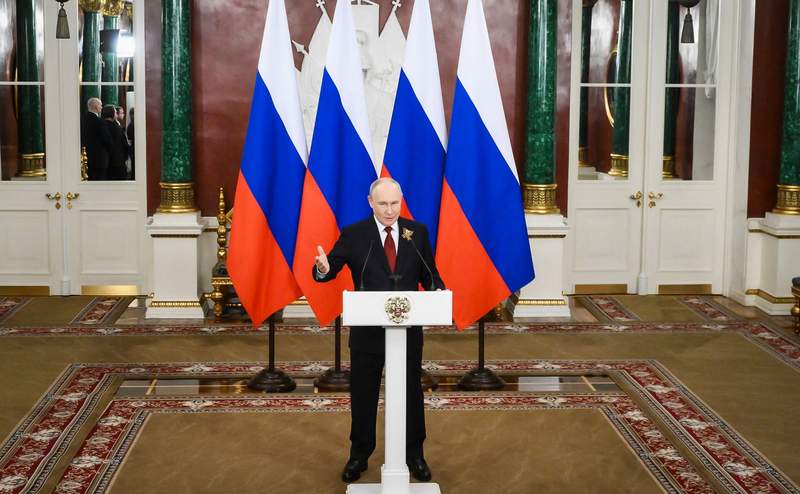
It isn’t a headline-grabbing missile launch, but the quiet legislative push emanating from the Kremlin carries a weight perhaps heavier than any ordnance. Russian President Vladimir Putin recently signed into law amendments granting the military, under direct presidential order, the authority to rescue—or, depending on your perspective, extract—Russian citizens detained outside the country’s borders. And, just like that, the playbook for global engagement, already dog-eared and smudged from years of diplomatic wrangling, gets another messy addition.
The Kremlin’s official line? Protection of its diaspora. Plain and simple, they say. “This isn’t about aggression; it’s about protecting our people, wherever they’re,” remarked Oleg Petroff, Chairman of the Duma’s Committee on International Affairs, in a state media broadcast. “It’s a natural evolution of state responsibility when other avenues prove insufficient.” But critics aren’t buying the altruism. Not one bit. They see a thinly veiled assertion of extraterritorial power, a flexing of muscles that could fundamentally reshape what constitutes an international incident.
Because, let’s be frank, this isn’t standard consular support. This is military action, authorized with barely a nod to the niceties of host nation consent. “We see this as a concerning escalation. It grants Moscow a perceived prerogative that could undermine sovereignty and destabilize already fragile regions,” commented Sarah Jenkins, a US State Department Deputy Spokesperson, addressing a sparsely attended morning briefing. Her tone was carefully modulated, but the implication was clear: Washington’s watching, — and it isn’t pleased.
The law provides a framework for special operations units to undertake missions—ranging from negotiating releases to outright forceful intervention—for individuals Moscow deems unjustly held. The threshold for such intervention, its precise modalities, and the inevitable diplomatic fallout are, predictably, left vaguely defined. It’s the sort of purposeful ambiguity that keeps strategists awake at night.
And consider the precedent. What happens when a citizen of a nation with a large expatriate community, say, Pakistan or India, is detained in a politically sensitive region? Do those governments, eyeing Moscow’s bold stance, feel a pressure to adopt similar, potentially disruptive, measures? Many developing nations, particularly in the Muslim world, grapple with the protection of their own citizens working abroad, often in conditions far from ideal. While direct military intervention is far from their current foreign policy doctrine, the optics of a major power effectively unilaterally asserting such rights won’t be lost on them. Especially when regional stability already seems like a pipe dream, constantly facing issues from internal unrest to border disputes that simmer on the back burner. Just look at the complexity inherent in South Asia’s dry diplomacy, for instance, where basic resources often spark international tensions.
📄 POLICY WIRE WHITEPAPER PUBLISHED: PAKISTAN'S NATIONAL SECURITY POLICY PRIORITIES
👉 READ BY CLICKING HEREGlobally, nearly 200,000 citizens were reported detained abroad in 2022, according to an analysis by the International Centre for Diplomatic Protection. That’s a huge number, a complex web of legal, humanitarian, — and political issues. Most of these cases are handled through established—if sometimes slow—diplomatic channels. But Russia’s new posture implies a readiness to bypass all that when the Kremlin deems it necessary.
The practicalities are just as thorny as the legal ones. An unauthorized incursion by Russian special forces into a NATO member state, for instance, could trigger a crisis of unimaginable proportions. But even in countries less aligned with the West, this law creates a distinct power asymmetry. Who’s to say no? What’s the response from a smaller nation to a direct military demand for a prisoner’s release?
The legislation represents more than just a domestic legal change; it’s a statement. It’s a defiant rejection of what Moscow clearly perceives as a hypocritical, Western-dominated international order. They’re telling the world: our rules for our people, wherever they happen to be. It’s a calculated gamble on how far international patience—and military restraint—will stretch. And it’s one that certainly adds a whole new dimension to global security. We haven’t seen the last of its consequences, I’d bet my last dime.
What This Means
This law significantly elevates Moscow’s leverage in international disputes — and prisoner exchanges. Politically, it’s a brazen projection of power, daring other nations to test its resolve. It sends a chilling message to any country holding a Russian citizen, suggesting that established legal processes might just become optional in Moscow’s eyes. Economically, while not directly impactful on trade, it certainly injects more uncertainty into diplomatic relations, potentially complicating investment decisions and international agreements for Russia’s partners and adversaries alike. Because foreign policy moves, especially ones this heavy-handed, don’t exist in a vacuum; they ripple through every aspect of international engagement. This isn’t just about snatch-and-grab operations; it’s about altering the fundamental perception of state power and accountability in a globalized, yet fractured, world. It’s Russia saying, plain as day, ‘we reserve the right to unilaterally define and enforce our version of justice, wherever that may lead.’