

Pakistan Transit Pivot: Regional Pragmatism in Taliban Uncertainty darkness.
The latest action by Pakistan to extend the Quadrilateral Transit Trade Agreement (QTTA) to cover Tajikistan and Uzbekistan is not just a technical adjustment in trade between the two countries. It...

The latest action by Pakistan to extend the Quadrilateral Transit Trade Agreement (QTTA) to cover Tajikistan and Uzbekistan is not just a technical adjustment in trade between the two countries. It is a tactical re-alignment influenced by stark realities on the ground. Islamabad is sending the signals of an increasing impatience with the unpredictability of Taliban rule and an urge to base its economic future in stability and not ideology by exploring the paths that will avoid Afghanistan.
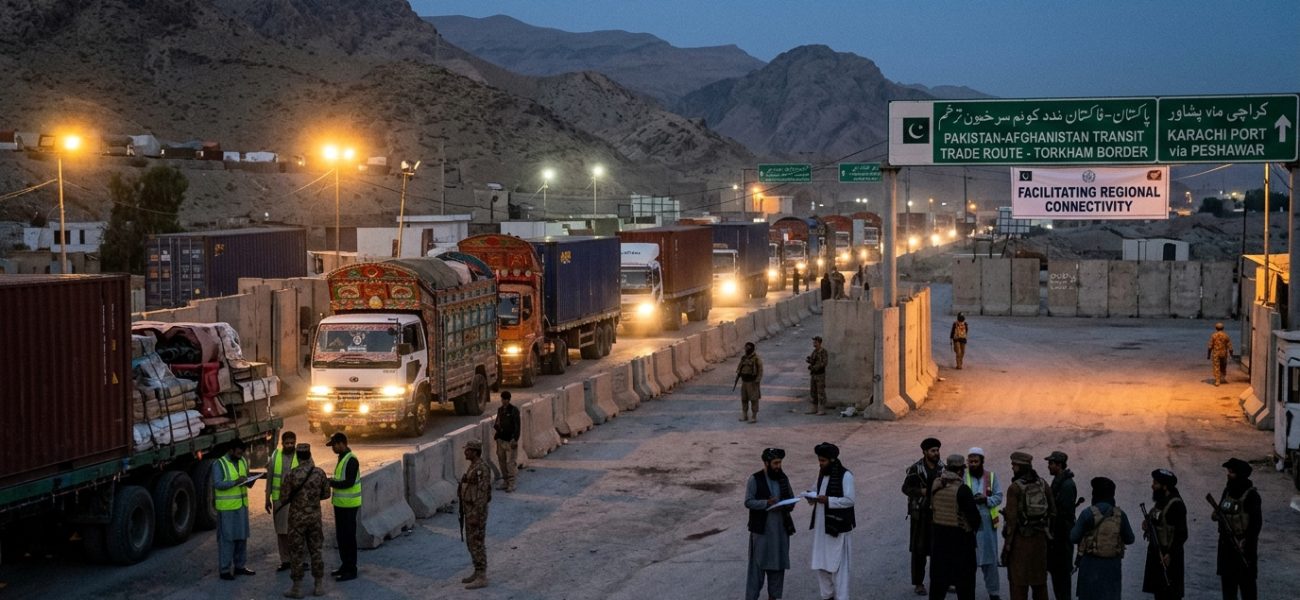
The history of Afghanistan during decades was considered to be the natural land bridge of Pakistan into Central Asia. Geography seemed destiny. However, in the Taliban, the geography has not been used as an asset, but rather as a liability. Ongoing security issues, lack of consistency in governance and the fact that internationally accepted regulatory frameworks are not in place have rendered transit through Afghanistan unreliable. Predictability is the lifeblood of trade; the Taliban have been anything but predictable.
In this regard, the outreach of Pakistan to Central Asian states through the QTTA framework, already incorporating China, Kazakhstan, and Kyrgyzstan is a practical change. The inclusion of Tajikistan and Uzbekistan in the agreement reinforces a route that connects Central Asia to the Pakistani ports via western China without necessarily going through Afghanistan. This is not simply an issue of risk avoidance. It has to do with creating a sustainable, rule-based trade architecture, that is consistent with global supply chain standards.
The opponents might claim that the alternative of bypassing Afghanistan will diminish the integration of the region. Theoretically, that is a legitimate concern. A stable Afghanistan would play a crucial role as a bridge in between South and Central Asia. But policy cannot be constructed out of hypotheticals. The model of governance by the Taliban has undermined confidence among stakeholders in the region due to the lack of transparency, the lack of inclusion, and the recurrent security challenges in the country. As long as Kabul can show their commitment to inclusive governance and economic stability, it is unrealistic to expect neighbors to make any economic bets on Afghanistan as a transit route.
The move of Pakistan also illustrates a wider geopolitical move: diversification. With global supply chains changing with political tensions, and economic realignments, countries are identifying several avenues to guarantee resilience. By positioning itself as a transit hub connecting Central Asia to the Arabian Sea, Pakistan is tapping into this trend. This is especially crucial because of the addition of Tajikistan and Uzbekistan. The two nations are also actively pursuing alternative trade routes to decrease reliance on the traditional northern routes as well as access warm water ports.
Furthermore, this project highlights an effort by Pakistan to regain the strategic relevance in a fast changing region. The new currency of influence is connectivity. Geopolitical weighting is now being characterized by infrastructure, trade agreements, and logistics networks, rather than through military power, as it used to be. Pakistan is putting a case forward to itself as a viable economic partner by investing in transit structures that are functional and reliable.
Simultaneously, the relocation sends a strong signal to the Taliban: the cooperation in the region is conditional. The international community and more and more neighboring states are no longer prepared to commit governance failure in the interest of geographic convenience. To take advantage of its position, Afghanistan has to provide a conducive atmosphere in which it can trade. It implies making sure that security is guaranteed, and customs procedures are streamlined, and that the relations with regional partners are constructive.
Notably, the strategy of Pakistan is not totally exclusionary. The deliberations about improving air connectivity and facilitating visa regimes with Central Asian states suggest a wider vision of engagement, which extends beyond terrestrial routes. This multidimensional approach will decrease the reliance on particular corridors and promote people to people and business connections.
Pakistan transit pivot is in essence a calculated reaction to a complicated reality. It is a judging of opportunity and the judging of caution, of ambition and of pragmatism. Although Afghanistan is geographically central, it is not a strategic necessity anymore, at least not given the present circumstances.
The path forward is clear. Instability should not be used as a scapegoat to regional integration. Pakistan is opting to move forward rather than stagnate by solidifying alternative pathways and deepening its relationship with Central Asia. The question of whether the Taliban takes this as a wake-up call or carry on the road to isolation will only answer the question regarding whether Afghanistan will feature in the economic future of the region.
Author