


Merz’s Ominous Forecast: Germany’s ‘Fundamental’ Shift by 2035 Stokes Existential Debate
POLICY WIRE — Berlin, Germany — A subtle tremor, more existential than seismic, now ripples beneath the polished veneer of Germany’s political discourse. It isn’t merely the usual...

POLICY WIRE — Berlin, Germany — A subtle tremor, more existential than seismic, now ripples beneath the polished veneer of Germany’s political discourse. It isn’t merely the usual seasonal churn of legislative affairs; it’s a profound, almost visceral apprehension concerning the very essence of the nation, a transformation so encompassing it threatens to redraw its familiar contours.
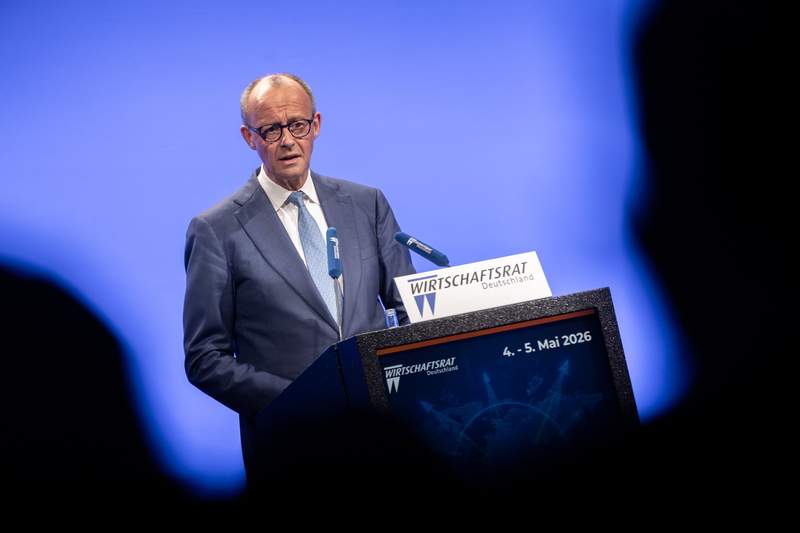
Friedrich Merz, the perpetually sharp-suited leader of Germany’s center-right Christian Democratic Union (CDU), recently adumbrated a vision for the Bundesrepublik: by 2035, he contends, the nation will be “fundamentally different.” This wasn’t some esoteric academic prediction, mind you; it was a potent, politically freighted pronouncement, echoing through the halls of power and beyond, a somber bell tolling for an imagined past and heralding an increasingly uncertain future. But what, precisely, does ‘fundamentally different’ truly portend for Europe’s economic powerhouse?
At its core, Merz’s forecast encapsulates anxieties brewing across Germany’s political spectrum regarding demographics, economic competitiveness, and the country’s evolving role in a capricious global order. He paints a picture of societal flux, driven by factors both internal and external, demanding an urgent, decisive recalibration of national policy. “The Germany we know today, it won’t exist in the same form in just over a decade,” Merz shot back during a recent party conference. “We face profound transformations—demographic, economic, and social—that demand clear leadership and a bold new direction, lest we drift into irrelevance.” His concerns often implicitly, sometimes explicitly, touch upon the complexities of integration within a society increasingly shaped by global migration patterns.
And indeed, the numbers bear out a certain undeniable shift. The Federal Statistical Office reported that Germany’s foreign-born population reached 22.3 million in 2021, representing 27.2% of the total population—a historic high. This demographic evolution, partly fueled by the influx of individuals from diverse regions including the Middle East, North Africa, and South Asia, undeniably reconfigures Germany’s social fabric, its cultural landscape, and even its labor market dynamics. Consider, for instance, the growing communities of Pakistani and Afghan origin, whose contributions—and challenges—are increasingly woven into the tapestry of German life, from burgeoning small businesses to the ongoing debates surrounding integration policies.
Still, not everyone embraces Merz’s stark prognosis with the same degree of alarm. Robert Habeck, the Green Party’s Vice-Chancellor and Minister for Economic Affairs and Climate Action, offered a more tempered perspective. “While change is constant, and indeed necessary for progress, any vision for Germany’s future must embrace sustainability, inclusivity, and our foundational European values,” Habeck countered in a recent press briefing. “Alarmism helps no one; pragmatic adaptation, however, is essential. We’re building a green industrial future, not clinging to a nostalgic past that no longer serves us.” It’s a classic ideological tussle: one side warns of erosion, the other sees evolution.
But the ‘different’ Germany isn’t just about internal shifts. The geopolitical currents buffet the nation, compelling it to reassess long-held tenets. The energy crisis, exacerbated by the conflict in Ukraine, has thrust Germany into novel partnerships—even with nations in the Muslim world—as it scrambles to secure alternatives to Russian fossil fuels. This strategic pivot, while primarily economic, inevitably carries foreign policy implications, potentially altering Germany’s traditional alliances and influence zones. It’s not just about who lives within the borders, but who Germany does business with, — and under what terms. And, frankly, how it perceives itself on the global stage. Global economic shifts, after all, rarely leave any major economy untouched.
What This Means
Merz’s pronouncement isn’t merely political posturing; it reflects a deep-seated anxiety within conservative circles about Germany’s identity and resilience in a rapidly changing world. Politically, his rhetoric aims to galvanize the CDU base, positioning the party as the sober custodian of German values against what they perceive as the current government’s overly progressive or idealistic agenda. Economically, the shift points to an urgent need for structural reforms—to digitize, to de-bureaucratize, and to invest heavily in future industries—if Germany is to retain its industrial might amidst fierce international competition. Should the nation fail to adapt, its role as Europe’s economic engine could wane, dragging down the wider Eurozone. Socially, the implications are profound: a more diverse Germany must confront lingering questions of integration, equal opportunity, and collective identity without descending into cultural fragmentation. The success or failure of these dynamics will undoubtedly define the political landscape for generations, shaping not just how Germany looks, but how it feels to live there.
Ultimately, Merz’s ‘fundamentally different’ isn’t just a prediction; it’s a challenge. It demands that Germany—and indeed, Europe—grapple with uncomfortable truths about demographic destiny, economic imperative, and the delicate balance required to maintain social cohesion in an era of unprecedented global interconnectedness. And it’s a conversation that, clearly, is only just beginning.