


Media Bias Exposed: Are CNN and BBC Still Credible in 2025?
Names like CNN and the BBC used to automatically inspire respect. These publications were regarded as the defenders of truth in a time of misinformation, providing live coverage of the Gulf War and...

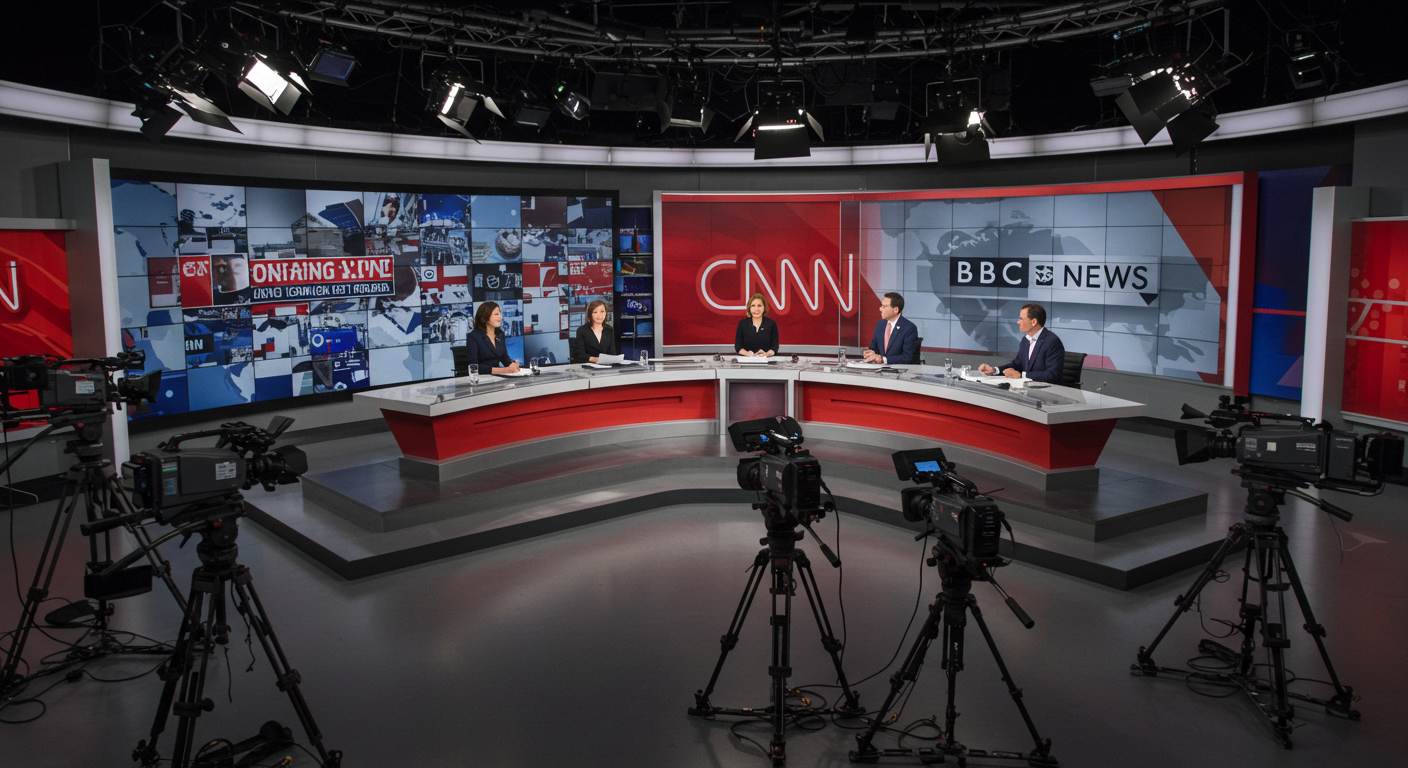
Names like CNN and the BBC used to automatically inspire respect. These publications were regarded as the defenders of truth in a time of misinformation, providing live coverage of the Gulf War and frontline reporting during the Arab Spring. However, that trust is being undermined in 2025, and not only in the periphery. Questions are being raised about the credibility of these once-venerable institutions in newsrooms, among cultural leaders, and at the highest echelons of government. Or have they fallen prey to dwindling editorial independence, internal censorship, and political entanglements?
CNN, often calling itself “The Most Trusted Name in News,” is facing renewed scrutiny under President Donald Trump’s administration. During a live cabinet meeting in early July, President Trump singled out CNN national security correspondent Natasha Bertrand, accusing her of fabricating a report regarding alleged U.S. intelligence assessments tied to military activity in Iran. He demanded she be fired immediately, calling the network a purveyor of “lies” and “fake news.” The attack wasn’t new, Trump has waged a long campaign against CNN, but the intensity and timing of this public rebuke signaled something more profound. CNN’s reporting, once seen as a vital check on power, is now the subject of government fury and public suspicion. Trump’s administration went further, even threatening legal action over CNN’s reporting on a mobile app used by U.S. immigration authorities, calling it “false and defamatory.” In another speech, Trump labeled both CNN and MSNBC as “illegal and corrupt,” asserting that they function more as political actors than journalists.
While Trump’s vendetta against CNN is well known, it reflects a broader perception that the network has shifted away from its roots in rigorous reporting toward a model of partisan framing and infotainment. Where once CNN was praised for international fieldwork, today it’s increasingly seen as dominated by panels of ideological commentators, often more focused on heat than light. Critics within and outside the United States argue that CNN’s programming choices reveal an over-reliance on outrage-driven narratives and political tribalism. The consequences of this shift are real: According to Pew Research, trust in CNN among Republicans has fallen to single digits, and among independent viewers, confidence has steadily declined. CNN still does important journalism, but its image as an objective news source is fading fast.
While CNN’s troubles are tied to partisan battles in Washington, the crisis at the BBC is playing out in London, and this one is being led from within. In what may be one of the most significant internal revolts in the broadcaster’s history, more than 400 public figures and 111 anonymous BBC journalists have signed a letter demanding the removal of BBC board member Robbie Gibb. The letter accuses Gibb, a former spin doctor for Prime Minister Theresa May and former director of the Jewish Chronicle, of influencing editorial decisions regarding the broadcaster’s coverage of Israel and Palestine.
The BBC’s decision to air the documentary Gaza: Doctors Under Attack served as the direct catalyst for this demonstration. The BBC commissioned the movie but decided not to show it because of worries that it would “create a perception of partiality.” The decision, according to the letter’s signatories, was just another instance of the BBC’s refusal to uphold its values regarding Israel. According to the letter, the company is “crippled by fear of being perceived as critical of the Israeli government,” and Gibb, who until recently held a senior role at a media outlet known for its strong pro-Israel stance, is a major source of concern. There is increasing internal annoyance among staff members who claim that editorial decisions are made without adequate discussion or transparency. Even more concerning is the implication that BBC journalists are facing disciplinary action or exclusion for disseminating or publishing news reports that criticize Israel, despite the fact that a board member with well-known ideological beliefs continues to hold significant sway.
This accusation strikes at the heart of what the BBC claims to represent. For decades, it has promoted itself as an impartial public service broadcaster, independent of political and commercial influence but in the wake of this Gaza controversy, that image is beginning to fracture. The BBC, say its critics, no longer “reports without fear or favor”, a charge made more potent by the fact that it comes not just from outsiders, but from its own journalists.
What unites the crises facing CNN and the BBC is not only the loss of public confidence, but a deeper institutional drift. These are not merely questions of coverage or editorial choice; they are questions of structural integrity. Who influences the stories that are told, and which stories are suppressed? Who decides what is deemed too controversial to air, and who is held accountable when truth takes a back seat to politics?
These questions echo the concerns laid out by Edward Herman and Noam Chomsky in their Propaganda Model of media, which argues that systemic biases arise not from individual journalists but from institutional pressures, ownership, advertising, sourcing, flak, and anti-ideological filters, that shape what is permissible in mainstream discourse. Their theory, first published in Manufacturing Consent (1988), is more relevant than ever. As media scholar Victor Pickard recently observed, “Public trust erodes when audiences sense that newsrooms are no longer serving the public interest, but rather the interests of power.” In the cases of both CNN and the BBC, these pressures, whether political or economic, appear to be distorting editorial independence and eroding credibility.
There is no doubt that both organizations still produce valuable journalism. CNN continues to deliver solid breaking news, and the BBC’s investigative output remains respected in many parts of the world but reputation is not a shield, it is a responsibility and increasingly, audiences feel that these outlets are failing to meet that responsibility. Where they once challenged the powerful, they are now seen, rightly or wrongly, as constrained by political alliances, institutional caution, and selective impartiality.
In the Global South, these patterns are especially glaring. While Western outlets often position themselves as the arbiters of truth, their credibility in places like Palestine, South Asia, and the Middle East is waning. Stories critical of Western foreign policy or allied states are often buried or downplayed. Meanwhile, perspectives from these regions, when aired, are filtered through frameworks that feel alien, even condescending. The result is not just distrust, but disengagement.
The truth is this: CNN and the BBC are no longer above criticism. Their legacy is immense, but legacy alone cannot preserve trust. If they are to remain relevant in a fractured media landscape, they must recommit not just to the idea of impartiality, but to the practice of it. That means confronting internal biases, resisting external pressures, and most importantly, listening to the journalists and audiences who are calling for change. In a world awash with propaganda, credibility must be earned—every single day.
Author