


Apex Predator’s Brutal Ballet: Nile Monitor’s Feast Exposes Ecosystem’s Ruthless Calculus
POLICY WIRE — Cairo, Egypt — The ruthless calculus of nature rarely offers a clean, palatable narrative. It’s often stark, brutal, — and utterly indifferent to sentiment. So it was recently,...

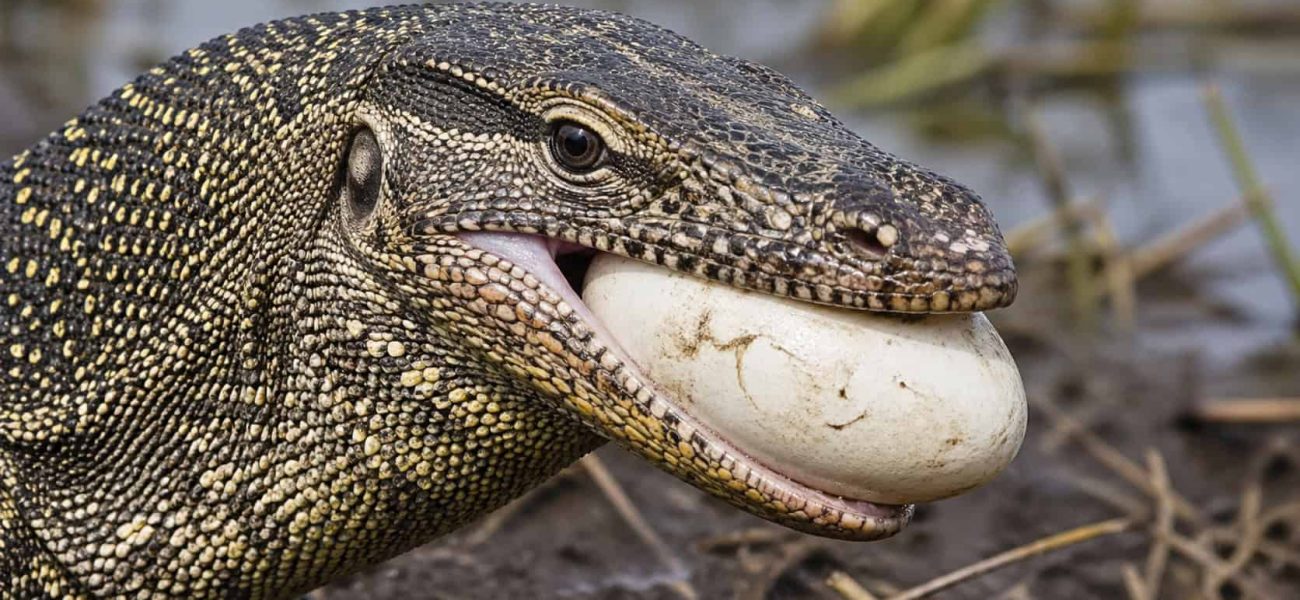
POLICY WIRE — Cairo, Egypt — The ruthless calculus of nature rarely offers a clean, palatable narrative. It’s often stark, brutal, — and utterly indifferent to sentiment. So it was recently, when an enormous Nile monitor, a reptilian leviathan stretching an imposing seven feet, engaged in a chilling ballet of survival — a visceral reminder that some battles, particularly those for sustenance, are waged with uncompromising ferocity.
It wasn’t the initial pilfering of crocodile eggs from a vulnerable nest that truly underscored this primal struggle. That’s common enough, a perennial risk for any species whose progeny incubates beneath the sun-baked earth. No, the truly arresting detail came later, after the successful heist and a subsequent gorge: the monitor’s calculated pursuit of a newly emerged crocodile hatchling. It stalked the tiny, unsuspecting reptile with a predatory focus that chills one to the bone, its very presence a testament to an ecosystem where survival isn’t just about strength, but about cunning, opportunity, and an unyielding appetite.
This isn’t just a grim wildlife documentary segment; it’s a stark ecological snapshot, a micro-drama that speaks volumes about macro-level pressures. At its core, it highlights the intense competition for resources that defines not only the animal kingdom but, frequently, our own geopolitical landscape. The monitor, a creature of ancient lineage, simply performs its role, yet its actions resonate with a broader discourse on ecological balance and the precariousness of life within intricate food webs.
“We often romanticize nature, but it’s a theater of constant negotiation, a zero-sum game for many of its players,” opined Dr. Anya Sharma, a lead ecologist at the Nile Basin Conservation Authority, her voice tinged with both scientific detachment and a hint of awe. “The Nile monitor is a formidable — and crucial component of its environment, keeping populations in check. It doesn’t just survive; it thrives on opportunity, showcasing an intelligence often underestimated in reptiles.” Indeed, it’s a testament to evolutionary efficiency.
Still, the spectacle raises uncomfortable questions about vulnerability, particularly for those at the bottom of the food chain, or for those whose habitats are increasingly threatened by external forces. Consider the plight of similar monitor lizard species across South Asia, for instance. While not the Nile monitor itself, indigenous species like the Bengal monitor or the Asian water monitor face intense pressure. Their ecosystems are rapidly shrinking, often fragmented by human encroachment, agricultural expansion, and unchecked urbanization. It’s a situation that forces them into ever-closer proximity with human settlements, sparking conflicts and placing immense strain on their survival, even as their natural prey dwindles.
Minister Faris Al-Khatib, head of a regional environmental protection agency in the Levant, wasn’t shy about drawing wider parallels. “What we observe in these wetlands, this fierce struggle, mirrors the resource scarcity we’re grappling with globally—and particularly in arid or semi-arid regions. The monitor’s hunt, while natural, underscores the fragility when populations exceed carrying capacity, or when external stressors disrupt the delicate equilibrium,” he shot back, emphasizing the interconnectedness of ecological health and socio-economic stability. It’s not just about one lizard; it’s about everything.
📄 POLICY WIRE WHITEPAPER PUBLISHED: PAKISTAN'S NATIONAL SECURITY POLICY PRIORITIES
👉 READ BY CLICKING HEREThe numbers don’t lie, either. Studies by the African Wildlife Foundation indicate that predation by various species, including monitor lizards, accounts for up to 80% of crocodile egg and hatchling mortality in some regions. This isn’t an anomaly; it’s the norm, a brutal natural selection process that ensures only the fittest (or luckiest) survive. It also underscores why habitat integrity is so consequential—any disruption can cascade catastrophically through the food web, leading to unforeseen consequences for both predator and prey.
And so, the monitor’s predatory prowess, a scene of almost primordial barbarity, serves as a poignant, if grotesque, reminder. It’s a vivid illustration of the unvarnished struggle that underpins life itself, a struggle not only for the crocodile and the monitor but, by extension, for every organism — including us — jostling for position and sustenance on a finite planet.
What This Means
This predatory encounter, seemingly confined to the realm of wildlife, carries surprisingly sharp implications for policy. First, it underscores the persistent challenges in managing complex ecosystems, particularly when human activity introduces new variables. Invasive species management, or even simply understanding the carrying capacity of indigenous predator populations, becomes a pivotal aspect of environmental stewardship. A poorly managed ecosystem, much like a poorly managed economy, can quickly descend into a brutal free-for-all, with the most vulnerable paying the steepest price.
Second, the vivid imagery of a large predator relentlessly pursuing its quarry serves as a powerful metaphor for geopolitical and economic competition. Nations, like species, are constantly vying for resources, influence, and survival, often employing shrewd, if not always palatable, strategies. The global south, including Pakistan and other parts of the Muslim world, often finds itself in a precarious position, akin to the crocodile hatchling – economically vulnerable, struggling against larger, more established forces, and susceptible to disruptions, both natural and man-made. Policymakers ignore these ecological lessons at their peril; the natural world offers unvarnished truths about power dynamics and scarcity that transcend mere biology. It’s a tough lesson, but one we’d do well to heed.