


Maryland Commuters Scramble After Bus Careens into Building, Igniting Local Concerns
POLICY WIRE — Chevy Chase, Maryland — A quiet afternoon—the kind folks usually ignore—turned into something much less forgettable when a public transit vehicle suddenly became a missile. It wasn’t an...

POLICY WIRE — Chevy Chase, Maryland — A quiet afternoon—the kind folks usually ignore—turned into something much less forgettable when a public transit vehicle suddenly became a missile. It wasn’t an attack, or some high-drama cinematic event, but rather the stark, unnerving reality of infrastructure meeting the unforeseen. The sudden impact, the shattered glass, the sheer unexpectedness of it all—that’s the true story here, far more than the simple enumeration of bodies.
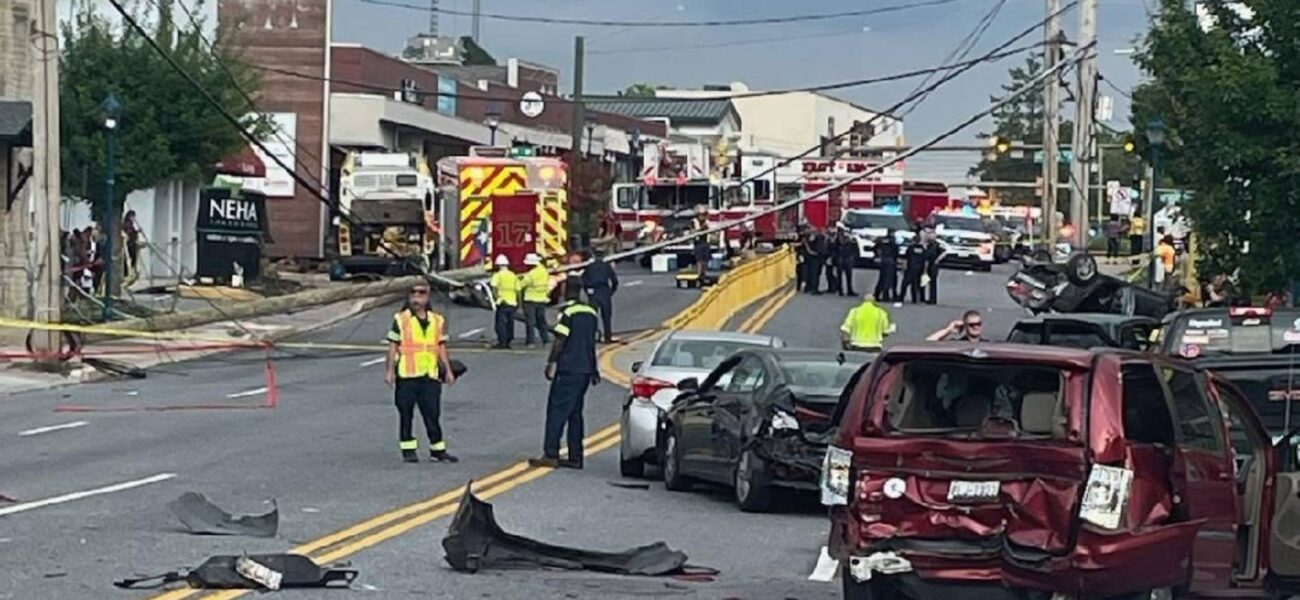
On what began as just another weekday, a commuter bus, its daily route usually a predictable ballet of stops and starts, veered off course. It didn’t just graze a pole or bump a fender; it went for broke. The official report confirms the bus [QUOTE_PLACEHOLDER], smashing directly into a structure. It wasn’t a minor fender-bender, folks. This was the sort of incident that jolts entire communities awake, making everyone pause and think about the machinery that underpins their daily lives.
Emergency responders descended fast. They always do. But they were met with a scene that was undoubtedly a jumble of debris — and bewildered faces. [QUOTE_PLACEHOLDER], according to [QUOTE_PLACEHOLDER]. That’s nearly thirty lives suddenly upended, families plunged into anxiety, and a workday routine erased by flashing lights and ambulance sirens. Nobody expects to commute to the emergency room, right? And yet, for two dozen-plus individuals, that’s exactly where they ended up. It’s a sobering reminder that even in highly regulated environments, the unpredictable can, and often does, burst through the seams of our constructed order.
Initial investigations are always quick to promise clarity—they always say they’ll get to the bottom of it. But sometimes, the answers are just more questions, more variables to juggle. Was it driver error? Mechanical failure? Some obscure environmental factor? Authorities have remained tight-lipped on the specifics of the investigation, sticking to terse updates. The immediate aftermath always centers on victim care and site securing, with the broader policy questions relegated to later, quieter deliberations.
But those broader policy questions, they’re simmering just beneath the surface. Because an event like this, while seemingly isolated, forces a recalculation of risk versus routine. It makes people wonder if their daily commute is as safe as they’ve been led to believe. They pay their taxes, they trust their transit systems, — and then, one ordinary Tuesday, a bus slams into a building. It’s enough to give anyone pause.
And it’s not just the immediate trauma. It’s the subsequent hospital visits, the missed work, the emotional toll that stretches far beyond the initial headlines. Each of those [QUOTE_PLACEHOLDER] represents a story of recovery—or perhaps, in some cases, ongoing struggle. It’s the silent ripple effect of a very public, very jarring event.
It gets you thinking, doesn’t it? About how readily we accept the unspoken contract of urban life: that complex systems will mostly, usually, deliver us safely from point A to point B. And then, sometimes, they just don’t.
📄 POLICY WIRE WHITEPAPER PUBLISHED: PAKISTAN'S NATIONAL SECURITY POLICY PRIORITIES
👉 READ BY CLICKING HEREWhat This Means
This incident, seemingly localized to a sleepy corner of Maryland, possesses far-reaching implications, extending well beyond mere vehicular safety statistics. At its heart, it’s an indictment of our often-fragile urban infrastructure and the inherent vulnerability of the populace to its intermittent failures. From a political perspective, expect an immediate, perhaps performative, demand for accountability from local officials. They’ll trot out the usual promises—[QUOTE_PLACEHOLDER] [QUOTE_PLACEHOLDER] But the deeper economic cost, both direct (healthcare, property damage) and indirect (loss of public trust, potential ridership drops), will linger. It isn’t cheap to fix these kinds of breaches in confidence, never mind the actual structural damage. America’s Sticker Shock: Healthcare Costs Threaten a 2027 Crunch, Leaving Families Strapped indeed.
The echoes of this particular incident, while occurring in a comparatively well-resourced region, resonate sharply with the perennial struggles of cities across the developing world, particularly in South Asia. Think of the chaotic, often overloaded public transport systems in Lahore or Dhaka, where infrastructure is perpetually under strain and accidents involving buses are a disturbingly regular feature of daily news cycles. There, the accountability is often blurred, enforcement lax, and the social safety nets almost non-existent for the injured. Even with [QUOTE_PLACEHOLDER] here in Maryland, the immediate, coordinated response from multiple agencies speaks volumes about institutional capacity that’s simply unavailable in many Muslim-majority nations grappling with similar challenges on a far grander, more systemic scale. It puts into perspective the relatively robust (if imperfect) state of Western public safety oversight versus regions where transport fatalities are accepted as an almost unavoidable externality of urbanization.
But the comparison isn’t entirely flattering for either side. Because the incident serves as a stark reminder: no system, regardless of wealth or technological sophistication, is immune to critical failure. The demand for increasingly efficient urban movement sometimes outstrips the investment in underlying resilience. Data compiled by the National Highway Traffic Safety Administration (NHTSA) indicates that, on average, over 20,000 buses are involved in traffic crashes annually across the United States. This isn’t just an anomaly; it’s a persistent threat. And it compels politicians to confront difficult trade-offs: between funding flashy new projects and maintaining the unseen, unglamorous essentials of everyday public safety. The political optics will favor swift action, of course, but true systemic change requires more than just crisis management. It calls for sustained, often unpopular, investment in preventative measures that rarely make for splashy headlines—until a bus crashes into a building, that’s. It’s a moment of unsettling transparency for how urban promises collide with grittier realities.