


Madrid’s Mirage of Stability: A Premier Under Siege, Echoes of Discontent Across Continents
POLICY WIRE — Madrid, Spain — The grand avenues of Spain’s capital aren’t strangers to indignation. Nor are its cobbled squares unaccustomed to the rumble of discontent. But the latest...

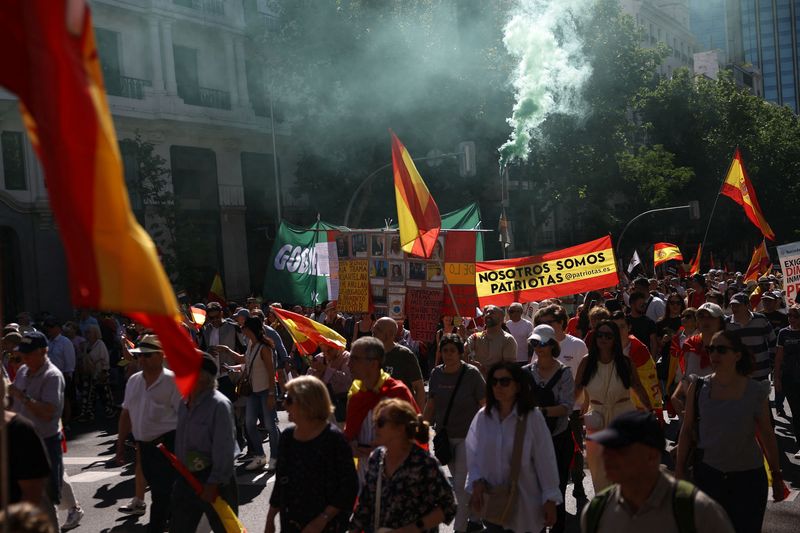
POLICY WIRE — Madrid, Spain — The grand avenues of Spain’s capital aren’t strangers to indignation. Nor are its cobbled squares unaccustomed to the rumble of discontent. But the latest swell—tens of thousands strong, painting the city in flags and frustration—felt different. It wasn’t just noise; it was an insistence, a demand snarled into the late afternoon breeze: Pedro Sánchez, Spain’s embattled prime minister, had to go. It’s never really just about the numbers, is it? It’s about the deep, ugly crack exposed underneath.
They converged, a motley but unified crew, on Calle Génova—a deliberate poke at the headquarters of the conservative opposition Partido Popular. But this wasn’t merely another ritualistic, choreographed demonstration. No, this was an eruption fueled by a stew of grievances: allegations swirling around Sánchez’s wife, Begoña Gómez, a controversial amnesty deal for Catalan separatists, and a creeping sense that the political system itself was buckling under the weight of its own perceived moral decay. It’s an inconvenient truth for a nation that prides itself on its democratic rebirth. But appearances, like fragile alliances, often shatter.
But doesn’t that always happen? Whenever the economy tightens its belt—and Spain’s economy, for all its post-pandemic recovery, is still prone to the jitters—politicians become convenient scapegoats. And Sánchez, always a polarizing figure, has become precisely that. Inflation, for instance, clung stubbornly to 3.2% in March, according to Spain’s Instituto Nacional de Estadística. Small potatoes to some, sure, but a very real squeeze on the working stiff who’s trying to make rent and put food on the table. It gnaws. It really does.
The accusations themselves, however vague, hit harder because they tap into a broader sentiment of impunity among the elite. “Spain needs stability, not street theater instigated by those who cannot win at the ballot box,” Sánchez’s office retorted in a terse statement attributed to the Prime Minister. “We’re focused on governing, on real solutions for real people.” A well-worn line, you’d think. And yet, the irony isn’t lost on anyone: stability often feels like a luxurious myth when the headlines scream corruption.
Because ultimately, these protests echo sentiments felt far beyond Madrid’s sun-drenched plazas. One can easily find a similar disaffection with entrenched power in, say, Karachi or Lahore, where the public often views political leaders through a similar lens of self-interest and questionable dealings. The language may be different, the historical context unique, but that raw, visceral feeling of being governed by a distant, perhaps even tainted, elite? That travels. It really does.
Alberto Núñez Feijóo, leader of the Partido Popular, seizing the moment, didn’t hold back. “This isn’t about parties; it’s about dignity, about ensuring the law applies equally to all Spaniards, especially those at the very top,” Feijóo declared to a chorus of cheers. “The current government has forfeited the trust of its people. We simply can’t look away.” His words, while pointed, don’t exactly offer a detailed alternative, do they? But that’s opposition politics for you: effective broadsides over granular policy.
📄 POLICY WIRE WHITEPAPER PUBLISHED: PAKISTAN'S NATIONAL SECURITY POLICY PRIORITIES
👉 READ BY CLICKING HEREAnd what does Spain get? A government perpetually looking over its shoulder. A prime minister attempting to navigate parliamentary waters with allies who often seem more like reluctant co-conspirators. You’ve got to wonder how long that can sustain itself before something snaps. It isn’t just an internal Spanish melodrama; the nation remains a cornerstone of the European Union, its political temperature having wider implications. We’re watching something of a dress rehearsal for similar pressures playing out elsewhere on the continent—even as we’ve seen nations from North Africa to Pakistan contend with similar dramas, albeit often with starker consequences (see our report on Balochistan’s Blood-Stained Tracks).
What This Means
This weekend’s demonstrations, coupled with the ongoing legal skirmishes — and political infighting, aren’t just a blip. They’re symptomatic of a deeper malaise in Spain’s political landscape, a hardening of partisan lines that makes compromise seem like a quaint, historical concept. Economically, prolonged instability discourages investment, delays critical reforms, and keeps an unnecessary ceiling on growth prospects. For Sánchez, it means his reform agenda will continue to be mired in legislative guerrilla warfare, weakening Spain’s hand in international fora and potentially diverting crucial attention from pressing domestic issues like unemployment and regional disparities. This relentless political theater—it extracts a cost. It chips away at civic trust, leaving a population jaded, susceptible to easy answers and populists who promise radical, often impractical, change. The question isn’t whether Sánchez can survive this particular storm, but what kind of Spain will be left when the political hurricane finally passes. It’s always an interesting puzzle: how much does a system bend before it truly breaks?
But don’t forget the underlying power of the people. While these Madrid protests might seem parochial, they contribute to a broader narrative of citizen disillusionment with traditional political establishments, a story that resonates from Europe’s glittering capitals to the sprawling megacities of the Global South. For Madrid, in particular, the march highlights an escalating internal tension that has no easy resolution. And that, in itself, is the news.