


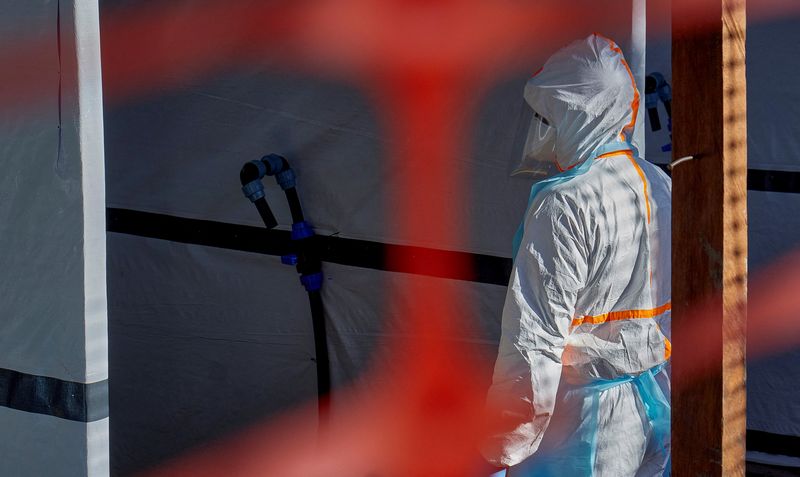
Congo’s Silent Scourge: Ebola Looms Again, 71 New Cases Spark Fresh Panic
POLICY WIRE — Kinshasa, DR Congo — The ghost, it seems, can’t be put to rest. Just as the world pivots to the next crisis, the Democratic Republic of Congo finds itself wrestling with an old demon:...

POLICY WIRE — Kinshasa, DR Congo — The ghost, it seems, can’t be put to rest. Just as the world pivots to the next crisis, the Democratic Republic of Congo finds itself wrestling with an old demon: Ebola. Not with a whimper, mind you, but with an alarming declaration of ‘rapid community spread’ and a sudden jump of 71 confirmed cases. This isn’t just a bump; it’s a tremor signaling a potential seismic event for a nation already stretched beyond its limits.
It wasn’t long ago folks were breathing a sigh of relief. But then the numbers started ticking up. One case, then a few, now dozens. This recent surge didn’t just appear from thin air, did it? It’s often the product of strained healthcare systems, ongoing conflict, and a populace that, quite frankly, has too many other things to worry about just to trust distant health directives. For the people here, disease is but one predator in a very dangerous jungle.
“We’re witnessing a distressing acceleration,” remarked Dr. Jean-Luc Mboka, a public health official in North Kivu province, during a terse press briefing earlier today. “The fear is real. Our teams are doing everything they can, but contact tracing becomes a monumental task when the virus is moving this quickly through communities where trust in institutions isn’t exactly sky-high.” And he’s not wrong. The DR Congo has faced countless health emergencies, alongside its relentless political instability and sporadic armed insurgencies. It’s a bitter cocktail, isn’t it?
Because every new case isn’t just a dot on a chart. It’s a person, a family, a community pushed closer to the edge. The Ministry of Health isn’t sugarcoating it, admitting that the recent influx points squarely to undetected transmission chains — the kind that whisper through villages and urban markets, largely unseen until they explode. This isn’t a battle fought in pristine laboratories; it’s on the dusty roads, in cramped homes, and within makeshift clinics trying to manage too much with too little.
But the concern extends far beyond Congo’s borders. Global health officials are watching, eyes narrowed, holding their breath. “The risk of regional spillover is never negligible, especially given the fluidity of movement across borders in Africa,” observed Dr. Aaminah Sohail, a senior epidemiologist at the World Health Organization’s regional office for Africa. “Containment efforts aren’t just for Congo; they’re for the wider continent and, indeed, the world. An unchecked outbreak in a region rife with internal displacement and poor infrastructure could escalate into a truly disastrous global health challenge.” It’s a sentiment echoed across international policy circles, particularly among nations already contending with the complexities of managing large, often migratory, populations and maintaining fragile healthcare infrastructures. Think of the sprawling cities in Pakistan, or the pilgrimage routes that crisscross the Muslim world; disease surveillance and swift action become paramount when populations are dense and mobile, otherwise what happens in one fragile state can become a problem for countless others.
📄 POLICY WIRE WHITEPAPER PUBLISHED: PAKISTAN'S NATIONAL SECURITY POLICY PRIORITIES
👉 READ BY CLICKING HEREWhat This Means
This Ebola flare-up is far more than just a public health nuisance. It’s a barometer for the region’s stability, both politically — and economically. The DRC’s perpetually weak central government already struggles with maintaining order; a major health crisis only compounds the misery and distracts from pressing political reforms. Economically, this means shuttered businesses, disrupted trade — a setback for any attempts at recovery. And yes, aid money, the eternal crutch, will pour in, but it often arrives with its own tangled strings, rarely solving the deeper systemic rot.
The geopolitical ramifications are stark, too. Neighboring countries, including Uganda and Rwanda, are already on high alert, strengthening border checks and prepping emergency response units. A severe outbreak here could destabilize the entire Great Lakes region, creating new waves of refugees and complicating existing humanitarian efforts. the recurring cycle of outbreaks in places like Congo often highlight broader failings in international cooperation and long-term investment in health infrastructure. As the WHO noted in a 2022 report, nearly 70% of outbreaks globally occur in low-income countries, and only 35% of those countries had robust public health emergency funds available — a statistic that screams volumes about persistent vulnerabilities.
The implications for global health security are hard to overstate. Every localized outbreak is a grim rehearsal for the next pandemic. Countries like Congo become involuntary test sites, their citizens—sadly—the unwilling subjects. It’s a grim truth: ignoring these early warnings isn’t just callous; it’s catastrophically foolish. The virus doesn’t negotiate. And the global community can’t keep waiting until a fire becomes an inferno before it decides to grab a bucket. The lessons of recent history, particularly regarding how quickly diseases can spread from remote origins to affect the most connected cities, ought to be starkly clear. Failing to act quickly isn’t just about Congo; it’s about everyone.