

Kremlin’s Nuclear Flex: Putin Plays With Fire, China Watches, as Drones Pierce Moscow’s Calm
POLICY WIRE — Moscow, Russia — For ordinary Muscovites, the war in Ukraine always felt like a distant affair, a TV spectacle. That illusion’s shattered now. The chilling drone strikes —...

POLICY WIRE — Moscow, Russia — For ordinary Muscovites, the war in Ukraine always felt like a distant affair, a TV spectacle. That illusion’s shattered now. The chilling drone strikes — whirring, then crashing — against suburbs, industrial sites, and even the financial district have dragged the conflict, brutal and raw, right into their living rooms. It’s not a remote skirmish anymore; it’s a tremor beneath the pavement, a reminder that war bites back, even for those supposedly immune. And Russia’s response? A grim, unmistakable flex of nuclear muscle, just as President Vladimir Putin cozied up with Xi Jinping in Beijing.
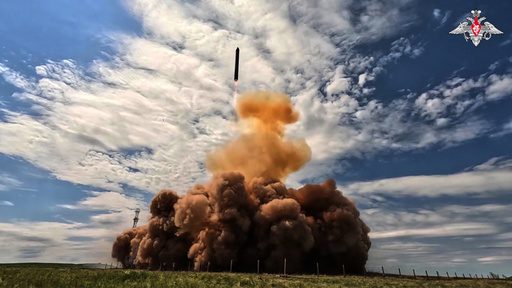
It was Tuesday when the exercises began. Three days of nuclear maneuvers, featuring simulated launches of both ballistic and cruise missiles capable of carrying devastating payloads. These weren’t subtle, mind you. They threw 64,000 troops into the mix, along with a frightening array of hardware: over 200 missile launchers, 140 aircraft, 73 surface warships, and 13 submarines. Eight of those subs, they say, packed nuclear-tipped intercontinental ballistic missiles. The Defense Ministry, always keen on clarity (or menace, depending on your perspective), made it plain: this was about “the preparation and use of nuclear forces under the threat of aggression.” That’s not subtle code; that’s a loudspeaker message.
Because let’s be frank, this timing isn’t accidental. It’s a deliberate, multi-layered signal. Ukrainian drones had just torn through Moscow’s outer layers, killing three — and rattling the capital’s calm. After almost five years, this conflict, for the first time, felt truly personal for many Russians. And then there’s Belarus, a staunch ally, where Moscow’s stashed its latest intermediate-range, nuclear-capable Oreshnik missile systems. They’re practicing with Belarus too. It’s all part of the big picture, a calculated escalation intended to deter anyone dreaming of deeper entanglement. President Putin himself put it quite simply during a recent address, albeit hypothetically. “Russia will employ all means necessary to safeguard its sovereignty — and our people’s security,” he warned. “Those who seek to provoke us misunderstand our resolve and our commitment to defend our nation’s very existence.” Strong words. His new nuclear doctrine—that any conventional attack supported by a nuclear power could be considered a joint nuclear attack—lowers the threshold dramatically.
This grand display unfolded exactly as Putin arrived in China for a two-day diplomatic embrace. He’s been busy, hadn’t he? Only last week, he praised a successful test of the Sarmat ICBM, designed to replace Soviet-era relics. It’s an interesting tableau: the nuclear-armed strongman, flanked by generals showcasing doomsday weapons, simultaneously pursuing economic and geopolitical alignment with Beijing. One almost has to admire the performative irony of it all. But such theatrical flourishes carry genuine, terrifying weight.
Western powers aren’t just shrugging it off. NATO Secretary-General Jens Stoltenberg didn’t pull any punches recently, stating, “These dangerous provocations only serve to increase instability. Russia must de-escalate and respect international law, not threaten global security with nuclear saber-rattling.” His sentiment reflects a widespread unease that the Kremlin’s actions, whether out of perceived weakness or unbridled ambition, are pushing the world onto shakier ground. The subtle, dry humor in these high-stakes diplomatic pronouncements often gets lost amidst the very real threat of unimaginable destruction. This isn’t just about Ukraine anymore, is it? It’s about how far a wounded, determined power will push the envelope. This dance between intimidation and diplomacy, while old, now happens with significantly more terrifying partners on a stage feeling ever more constricted. Look at the increasing tension over disputed territories; it makes places like Pakistan, perpetually navigating geopolitical crosscurrents and nuclear parity with its neighbor, wonder where this line-drawing will ultimately end up.
What This Means
The Kremlin’s aggressive nuclear posturing serves multiple, interlocking aims. Economically, it’s designed to sow uncertainty, disrupting Western supply chains — and capital flows. A destabilized global outlook tends to benefit nations with vast natural resources like Russia, allowing them to dictate terms. Politically, it signals to domestic audiences that Moscow retains its heavyweight status, a crucial message after years of war, sanctions, and economic strain. But it’s also a direct message to Ukraine’s allies: push too hard with long-range weapons, and the consequences could be catastrophic. The danger is that, with an increasingly isolated leadership, the threshold for defining that ‘catastrophe’ gets lower, more abstract, even arbitrary.
The geopolitical ripple effect reaches far beyond Europe. Consider South Asia — and the Muslim world. Powers like Pakistan, an established nuclear state, are watching carefully. When a major power like Russia openly flexes its atomic muscle in response to a conventional war, it provides a chilling blueprint. It suggests that conventional conflicts can very quickly morph into existential crises demanding nuclear responses. This shifts global security paradigms. For countries balancing on fragile geopolitical tightropes, it emphasizes self-reliance and perhaps, for some, nudges toward independent strategic capabilities. The message reverberates through international arms control efforts, arguably weakening them further. It implies a ‘might makes right’ philosophy is becoming the new standard. That certainly makes it difficult for any serious disarmament discussions.
Then there’s the broader narrative. Putin’s simultaneous trip to China – dubbed “The Moscow-Beijing Tango” by some — amidst these drills reinforces the emerging bloc dynamics. It’s a loud declaration that while Russia faces Western sanctions, it’s not truly isolated. China’s economic lifeline, however tacitly offered, helps cushion the blow. But don’t imagine this means China fully endorses such brazen nuclear threats. They’re watching, weighing their own long-term interests against short-term geopolitical advantage. For Beijing, Russia’s nuclear brinkmanship could be both a useful cudgel against the West and a destabilizing precedent it’d rather not see replicated in its own backyard. The global system is creaking under the strain; this latest show of force from the Kremlin is less a stable act of deterrence and more an unstable tremor. And frankly, the consequences of such dangerous displays on global stability, on things like maritime trade routes or even Asia’s aviation, are anyone’s guess. That’s a terribly uncomfortable thought for everyone.