


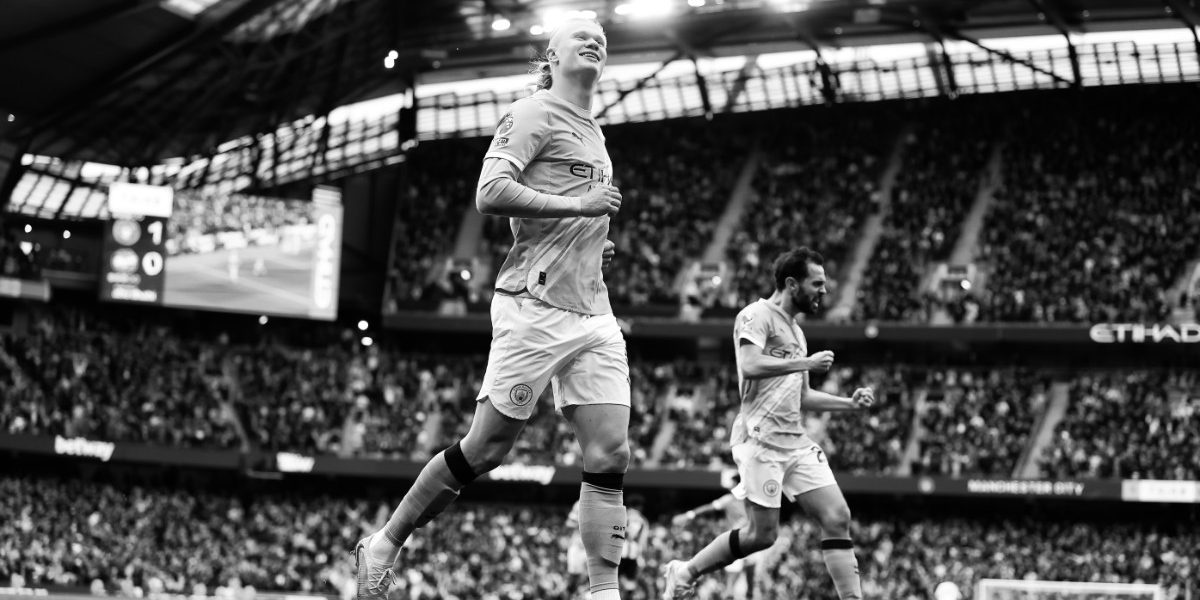
Wembley’s Anomaly: Haaland’s Imminent Reckoning Under the Grand Arch
POLICY WIRE — London, UK — The stage is set, Wembley’s grand arch looms, and for all the shimmering blue dominance Manchester City has wielded across the Premier League, one vexing question...

POLICY WIRE — London, UK — The stage is set, Wembley’s grand arch looms, and for all the shimmering blue dominance Manchester City has wielded across the Premier League, one vexing question hangs heavy in the capital air: will Erling Haaland finally, brutally, announce himself on the biggest cup final day?
It’s not for lack of trying, nor ability. The man’s a machine, a goal-gobbling phenomenon. Since trading Borussia Dortmund for the Manchester sky blue, the Norwegian has been nothing short of spectacular. He’s netted an astonishing 161 goals in 196 appearances—that’s nearly a goal every single game. But here’s the kicker, the head-scratcher: Haaland has somehow, bafflingly, failed to find the net in nine previous cup finals for City. Not once. And at Wembley, where today’s FA Cup showdown against Chelsea unfurls, his personal tally stands at a stark zero across eight matches. It’s an anomaly. A glitch in the matrix for arguably the world’s most feared striker.
And now, with the FA Cup on the line, that bizarre statistic morphs from a mere footnote into a pressure cooker. Because it isn’t just a duck; it’s a narrative. A ticking clock for a player acquired for stratospheric sums and expected to deliver silverware with every swing of his powerful left foot. Opponents, meanwhile, quietly cling to this curious psychological advantage.
Much has been made, of course, of the season’s brutal grind. Manager Pep Guardiola, often a man of few understated words, didn’t pull any punches regarding the toll. “It’s the end of the season; the fatigue is always there. Mentally, physically,” Guardiola quipped yesterday, referencing the relentless calendar’s demands. “Erling has played a lot of minutes. And you have three days [game] and now three days [game] and after winning or losing the main target after the game is ‘guys take a shower quick, come back to Manchester and go to sleep because on Monday you have to fly to Bournemouth.’” It’s a logistical nightmare, not a romantic pursuit.
But there’s a flicker of hope for the City faithful. Haaland, rarely afforded the luxury, actually caught a breather this week. He sat out the 3-0 demolition of Crystal Palace at the Etihad. That might sound like a minor detail, but for a man who, according to Opta Sports data, has clocked a staggering 3,964 minutes across 50 matches this season—scoring 37 goals and assisting 8 more—it’s significant. A rare pause for a body finely tuned for perpetual motion. Chelsea’s defense, after all, isn’t exactly considered impregnable. They’ll know he’s coming. But will they be ready?
“He’s an extraordinary talent, and those sorts of numbers don’t lie,” commented former England international and pundit Alan Shearer earlier this week on BBC Five Live. “But there’s a difference between banging them in against a relegation fodder and delivering when everything’s on the line at Wembley. Chelsea, for all their troubles this season, won’t make it easy, you know? They’d love nothing more than to compound his misery.” Shearer’s words cut through the hype, reflecting the raw, unforgiving reality of knockout football. It’s a psychological battle, as much as a physical one.
📄 POLICY WIRE WHITEPAPER PUBLISHED: PAKISTAN'S NATIONAL SECURITY POLICY PRIORITIES
👉 READ BY CLICKING HEREWhat This Means
Beyond the simple desire for a trophy, this FA Cup final carries substantial political — and economic weight. For Manchester City, a club operating under Abu Dhabi’s considerable financial heft, the narrative isn’t just about winning; it’s about validating an investment strategy that blends sporting dominance with soft power projection. Every trophy elevates their global brand, bolstering their appeal across markets from North America to the burgeoning fanbases throughout Pakistan and the wider Muslim world, where English football is consumed with fervent passion. These aren’t just games; they’re extensions of a national identity, televised events watched by hundreds of millions, impacting cultural diplomacy in ways rarely acknowledged in mainstream sports commentary.
A superstar like Haaland, delivering in finals, reinforces this commercial — and geopolitical play. A failure, on the other hand, risks questions about maximizing talent and investment returns—not just on the pitch, but in boardrooms from London to Lahore. Player welfare, too, becomes an economic policy point. Guardiola’s remarks aren’t just about tired legs; they speak to the very sustainability of elite sport, and how much top athletes can reasonably endure before their bodies, or their price tags, break. These aren’t quaint local skirmishes anymore. Oh no. They’re corporate spectacles, backed by billions.
But the focus for now? It’s on a green patch in northwest London, a striker’s boots, — and a ball. Because history’s watching. And everyone, especially the blue half of Manchester, expects a long-overdue eruption.