


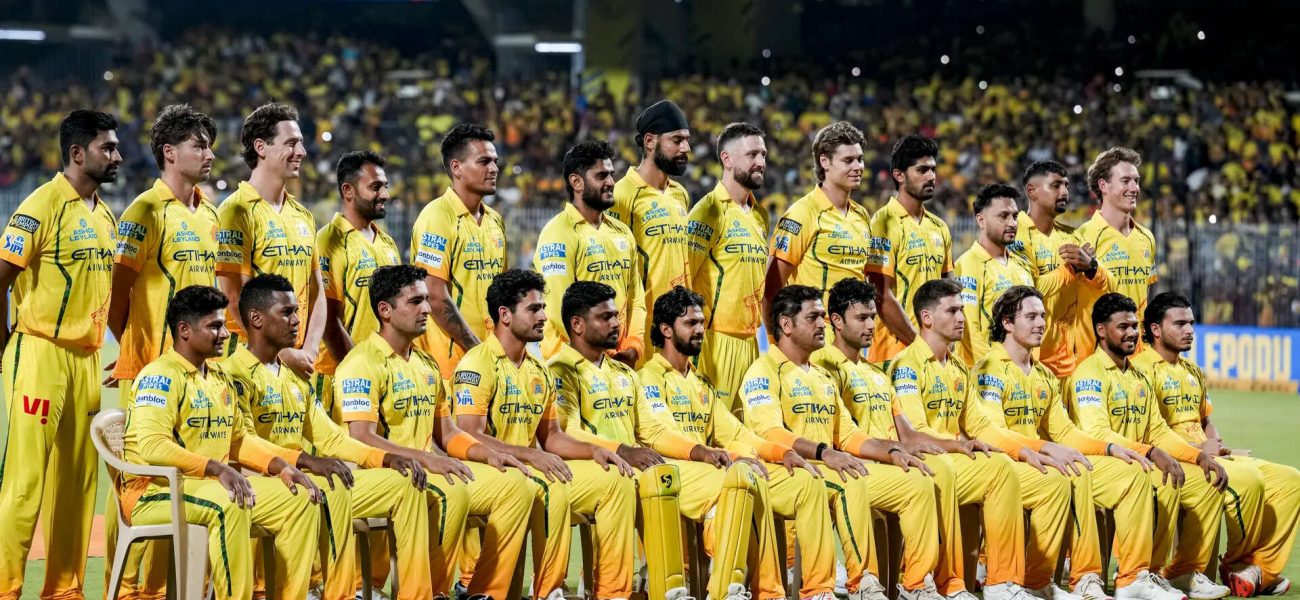
IPL’s Cruel Arithmetic: Chennai’s Empire Teeters on External Favors
POLICY WIRE — Mumbai, India — The Chennai Super Kings, an undisputed titan in India’s Premier League cricket circuit, isn’t just a team; it’s an institution, a brand woven into the...

POLICY WIRE — Mumbai, India — The Chennai Super Kings, an undisputed titan in India’s Premier League cricket circuit, isn’t just a team; it’s an institution, a brand woven into the subcontinent’s very fabric. So when their playoff hopes became a casualty of Sunrisers Hyderabad’s calculated aggression—a five-wicket thrashing, no less, at their Chepauk stronghold—it wasn’t just another loss. No, this was an earthquake, shaking the confidence of a legion of fans who’ve come to expect perpetual triumph. They’ve tasted victory too many times not to expect it. Yet here we’re.
It’s a peculiar fate for a five-time champion, reduced to sifting through a mathematical tangle, utterly reliant on the missteps of rivals. Their latest stumble saw Heinrich Klaasen and Ishan Kishan carve up a seemingly defensible 180 runs with clinical disdain, effectively sealing Hyderabad’s spot among the league’s elite for the postseason. Cummins, the opposing captain, chipped in with a telling 3/28 earlier. But let’s not pretend it was all Hyderabad’s brilliance; Chennai’s captain, Ruturaj Gaikwad, puttered along for a paltry 15 runs off 21 deliveries, effectively stalling momentum that Sanju Samson and Kartik Sharma had painstakingly built. A slow poison, that was.
The numbers don’t lie, but they certainly don’t offer comfort. Sixteen points for SRH now; playoffs secured. But CSK? Stuck at twelve points with a single fixture left. It’s a bitter pill to swallow for a franchise whose valuation, according to industry insiders, often skirts the half-billion dollar mark, an economic engine in its own right.
Because they don’t control their destiny anymore. That’s the hard truth. Their remaining league match against Gujarat Titans in Ahmedabad isn’t just a game; it’s a desperate Hail Mary, a non-negotiable win to even keep the faintest flicker alive. Anything less, — and the party’s over, finished. But even victory alone may not cut it. Qualification might hinge on the notoriously fickle net run rate, demanding not just a win but a commanding one. They’ll need to beat Gujarat, yes, but then what? A perfect storm of external fiascos, that’s what.
Chennai’s fate now hangs precariously on how other dominoes fall. Punjab Kings, for instance, sitting at thirteen points. If they dispatch Lucknow Super Giants in their final game, Chennai’s season goes kaput, just like that. And Rajasthan Royals, with two games still to play, could clock in sixteen points easily if they snag two wins, blowing past CSK like a bullet train past a handcart. Then there’s Kolkata Knight Riders, eyeing playoff contention with two matches to spare; a single victory for them, and Chennai’s meticulously constructed playoff scenarios could dissolve. They’re effectively asking the universe for help.
“This isn’t just about wickets and runs; it’s about the emotional equity invested by millions,” Jay Shah, Secretary of the Board of Control for Cricket in India (BCCI), once remarked in an interview, acknowledging the commercial and psychological stakes involved. “The league thrives on drama, yes, but also on the perception of competitive fairness, even when the cards fall hard for some. Fans pay attention to these stories of struggle, too.” And struggl, Chennai now must.
You can’t help but see the irony: a team that’s defined an era, now praying for cosmic alignments. It’s like watching a formidable political party suddenly needing tiny regional outfits to form a coalition—utterly disorienting. Last year, the Indian Premier League registered a cumulative reach of nearly 480 million viewers, according to official Broadcast Audience Research Council India (BARC) data. Imagine the ripple effect across this immense fan base, stretching from Chennai itself, across the Punjab, all the way to avid followers in Karachi and Dhaka, when such a monumental franchise finds itself in this existential quagmire. The passionate followings for these teams, many with their roots firmly in South Asia, make these domestic rivalries into international spectacles. It’s a commercial dynamo, after all, and the drama only amplifies its reach.
“You see the frenzy in Lahore, in Karachi, even for teams like Chennai,” observed Fawad Chaudhry, a former Pakistani Federal Minister known for his frank commentaries. “It’s a unifying spectacle, a soft power. Our own leagues face hurdles, but the IPL shows what sheer scale can achieve. People across borders follow these contests; that’s just a fact.” But the cruel fact is that emotional capital doesn’t always translate into points.
What This Means
This playoff predicament for CSK is more than a mere sporting hiccup. It represents the inherent volatility even in highly organized, economically fortified enterprises. A franchise like Chennai carries significant commercial weight—sponsorships, media rights, merchandising, and the local economy benefiting from home games—all contingent on continued success and, critically, playoff exposure. Their early exit, or even just the *threat* of one, creates palpable anxiety within this financial ecosystem. From an economic perspective, less time on national television for a marquee team translates into fewer eyeballs for advertisers, potentially lower ad rates for broadcasters in subsequent seasons, and a slight tremor in team valuation metrics. Politically, cricket in India, — and indeed across South Asia, is never just sport. It’s a barometer of national mood, a shared identity, — and for many, a major distraction from daily grind. When a popular team flounders, it chips away, subtly, at a perceived sense of order or dominance, which can have echoes in popular sentiment. the unpredictable nature of this year’s playoff race—a stark contrast to prior seasons—might paradoxically benefit the league by showcasing its competitive depth. But for now, Chennai’s agonizing dance with fate illustrates how even a juggernaut isn’t immune to the capriciousness of competitive sports, forcing its loyalists into a communal act of helpless spectating.