

Jerry’s Reckoning: Cowboys Seek Salvation in the Shadow of Past Foe
POLICY WIRE — Dallas, USA — The persistent thrum of expectation and its equally persistent companion, disappointment, hangs heavy over North Texas. Year in, year out, the Dallas Cowboys arrive draped...

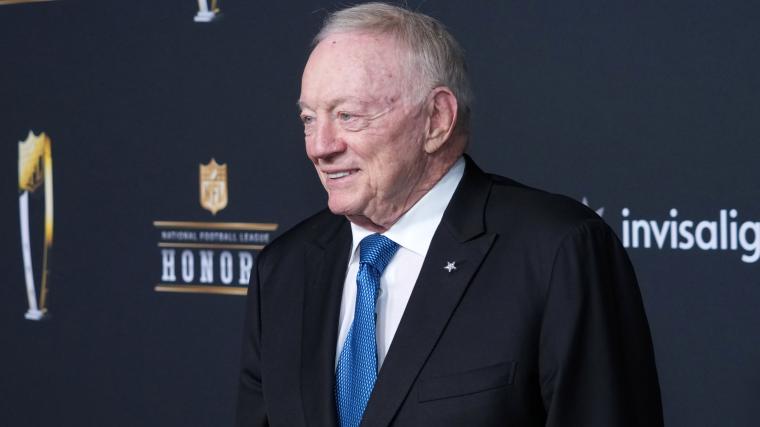
POLICY WIRE — Dallas, USA — The persistent thrum of expectation and its equally persistent companion, disappointment, hangs heavy over North Texas. Year in, year out, the Dallas Cowboys arrive draped in the kind of silver and blue mystique only owner Jerry Jones can manufacture, only to exit, invariably, with the season ending shy of football’s ultimate prize. Now, two years removed from playoff contention, with an empire built on perceived glory, Jones is orchestrating another theatrical twist: flirting with a player who once carved his team into oblivion.
It’s not just any veteran, either; we’re talking Alvin Kamara. The New Orleans Saints’ electric running back, whose last tango with the Cowboys saw him dance through their defense for four soul-crushing touchdowns in 2024. Talk about an awkward family reunion. And it certainly makes you wonder about the long memories—or lack thereof—in Jerry World.
Kamara’s situation isn’t some back-alley rumor. It’s got a paper trail. Bleacher Report’s Kristopher Knox recently floated Dallas as a potential destination for the multifaceted back, despite the complexities of his contract. The Saints, it appears, are ready to play cap roulette. Kamara’s still got ties to New Orleans after inking a significant $75 million extension in 2020, then another $24.5 million one in 2024. But because his role has morphed—they’ve got Travis Etienne locked up and a fresh crop of young backs, you see—his once-central presence is now more, shall we say, a high-priced optional extra. If New Orleans moves him post-June 1, they snag a modest $456,741 in cap savings; before that, it’s a gut-wrenching $7.6 million dead-cap hit. Money, as ever, dictates everything. But Dallas seems primed to roll the dice.
The Cowboys, bless their hearts, aren’t exactly bereft at the position. They’ve got Javonte Williams coming off a monster season, having piled up 1,201 rushing yards. He’s tough, handles the rock, — and blocks like a bouncer. They’ve even got some depth tucked away with Malik Davis — and their 2025 sixth-rounder, Jaydon Blue. So, this isn’t about necessity; it’s about splash. It’s about a proprietor who understands showmanship above all else. And sometimes, you grab headlines with a prodigal villain, not a quiet worker.
“We’re always looking for that missing ingredient, that special something that puts us over the top,” a defiant Jerry Jones, ever the eternal optimist, was reportedly overheard telling confidantes, his words echoing across the Dallas facilities. “If there’s an opportunity to acquire a generational talent, we’d be fools not to explore it. Our fans, they deserve to win.” Meanwhile, a former NFL general manager, speaking on condition of anonymity due to ongoing league connections, remarked, “This isn’t about holes in the roster. It’s about signaling intent, about rattling the market. Jones loves that kind of play. It sells tickets, generates buzz. Winning? That’s almost secondary to the spectacle, sometimes.” And isn’t that just a microcosmic example of modern sporting economies, where the drama sometimes overshadows the outcome? You see similar passion and financial theatrics, albeit for different reasons, gripping global sports audiences—like the intense fan base of cricket across Pakistan and South Asia, where every major signing or trade has political and economic undertones.
But acquiring Kamara isn’t a neat transaction, not by a long shot. The market for seasoned backs can be notoriously fickle, — and his current team knows this. What’s intriguing is the shift we’re witnessing in franchise management. No longer content to simply build from within, the pursuit of proven (if expensive) talent has become a global standard in the race for fleeting glory, mirroring perhaps even the frantic maneuvers we witness in, say, global bond markets. This isn’t just about football anymore; it’s high finance played on turf. And Jones is, in many ways, its chief orchestrator.
What This Means
This potential pursuit isn’t just another NFL transaction; it’s a sharp insight into the ongoing political economy of professional sports, particularly under an ownership model like Jones’s. For the Dallas Cowboys, it signals a distinct, almost desperate pivot towards immediate gratification—an unwillingness to continue cultivating talent in favor of perceived shortcuts to a Super Bowl that’s evaded them for decades. Economically, bringing in a high-cost veteran like Kamara could mean tighter cap restrictions in subsequent seasons, limiting flexibility for extensions for existing homegrown stars. It’s a calculated gamble on a short-term bump at the expense of long-term stability.
But there’s also the intrinsic brand value at play. Jones isn’t merely running a football team; he’s presiding over a media empire. High-profile acquisitions, regardless of their ultimate on-field success, generate colossal media engagement, advertising revenue, and merchandise sales. It keeps the Dallas brand perpetually in the conversation, something other major sporting organizations understand as they navigate their own complex financial landscapes. This move would be less about an incremental roster upgrade and more about Jones reasserting his brand of audacious leadership, banking on narrative more than statistical probability. The Saints, on the other hand, would be shedding salary, potentially freeing up resources to build around their younger core—a shrewd move for franchise sustainability, even if it’s unpopular with fans attached to a veteran star.
Ultimately, whether Kamara lands in Dallas or not, this episode underscores the intricate dance between sporting ambition, fiscal responsibility, and the ceaseless hunger for public attention that defines professional sports today. It’s a policy wire special—a transaction layered with consequences that extend far beyond the gridiron. But don’t expect Jones to shy away from a spectacle. He never does.