

Eternal City’s Price Tag: Roma’s Derby Gamble Hinges on Fragile Returns
POLICY WIRE — Rome, Italy — Another Roman derby looms. It’s not just 90 minutes of football. Oh no. This spectacle, steeped in centuries of rivalry and the city’s very soul, now arrives...

POLICY WIRE — Rome, Italy — Another Roman derby looms. It’s not just 90 minutes of football. Oh no. This spectacle, steeped in centuries of rivalry and the city’s very soul, now arrives freighted with an almost brutal economic calculus that makes geopolitical wrangling look quaint. Who plays, who doesn’t—it’s not just about bragging rights anymore. It’s about securing a slice of that coveted Champions League pie, a golden ticket that, for clubs like Roma, isn’t just good for the balance sheet; it’s survival.
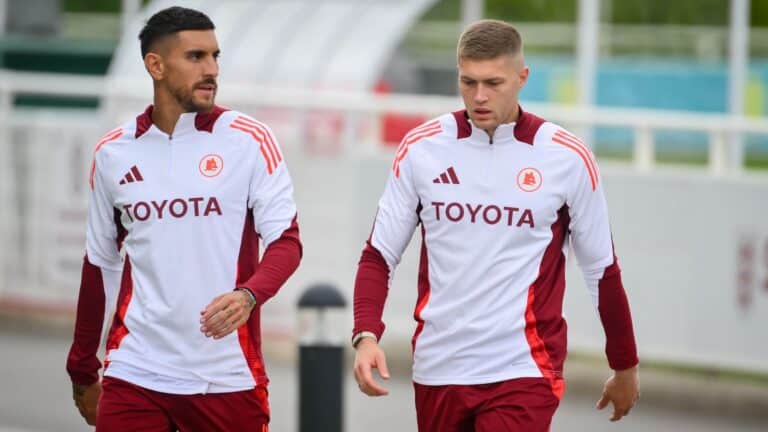
Word from Trigoria, Roma’s sprawling training grounds, whispers of cautious optimism, a rare commodity in this town. Captain Lorenzo Pellegrini, that mercurial midfielder, is back on the pitch, running drills with the main squad. He’s been an on-again, off-again enigma this season, hasn’t he? His presence, they say, might just be the shot in the arm a club desperately battling for European elite status needs. But will his body hold up? And is he truly match-fit, or is this just another gambit, a psychological play for the approaching showdown against Sarri’s formidable Lazio?
“We’re navigating this period with extreme caution,” stated Gian Piero Gasperini, coach of Atalanta – Roma’s direct rival in the top-four race – though his words easily reflect the anxieties emanating from Rome itself. “Every match, every player’s health, it’s all magnified. The financial stakes… they’re astronomical, you know?” He’s not wrong. Qualification for the UEFA Champions League, for a Serie A team, can translate into an additional €50-80 million in revenue annually, a figure that shifts everything from transfer budgets to infrastructure projects. The weight of that money is a monster.
The gladiatorial spirit of the Olimpico finds echoes, unexpectedly perhaps, in the intense footballing passions seen across the Muslim world—places like Pakistan, where cricket reigns supreme but European football has a devout following. Fans in Lahore — and Karachi pore over Serie A standings with an intensity rivaling any local pundit. They track their favorite players, debating tactics, transfers, and the intricate financial health of European giants as if their own national honor depended on it. It’s a shared emotional investment, transcending geography and often local allegiances, an unexpected testament to football’s global grip.
But back to Rome. Because this isn’t just about Pellegrini. News regarding another potential return, a striker — an integral, though perhaps less celebrated, component of Roma’s forward line — has added to the frenzy. Sources close to the club confirmed, unofficially, that another key figure completed a significant portion of morning training. They didn’t name names explicitly (classic stuff, isn’t it?), but the implication is clear: Roma’s coach, still battling the perennial question marks around his lineup, wants every single advantage he can get. And why wouldn’t he? He’s a pragmatist. This game’s about points, not poetry.
Because ultimately, the objective is cold, hard fourth place. Any slip-up by Milan or Juventus (and history tells us, they do happen) would present an opportunity Roma simply cannot afford to squander. They’re hovering, aren’t they, like a vulture eyeing carrion, waiting for a chance to pounce.
And yet, this is more than just football. It’s a proxy war for city pride, for bragging rights that bleed into daily life—family dinners, street corners, workplaces. Rome lives and breathes this stuff. Forget the Colosseum; the true modern-day gladiatorial arena is often the football pitch, particularly on derby day.
📄 POLICY WIRE WHITEPAPER PUBLISHED: PAKISTAN'S NATIONAL SECURITY POLICY PRIORITIES
👉 READ BY CLICKING HERE“We approach this with respect for our opponent, but with unyielding confidence in our boys,” offered Daniele De Rossi, Roma’s interim head coach, whose tenure has been a whirlwind of unexpected resurgence. “Every player knows the magnitude of this fixture. It’s a chance to write their names into the club’s history books. They’ve seen the devotion, the agony, — and the sheer euphoria of these fans. It’s a driving force, believe me.” He understands this city better than most; he was once its enforcer, its beating heart on the field.
But his task is unenviable. This isn’t merely about player fitness. It’s about whether a patchwork squad, riddled with recent injuries and tactical adjustments, can deliver when the eyes of a nation—and indeed, parts of a much wider world—are fixed squarely on them. They’re running on fumes, it feels, but driven by the ghost of glory — and the smell of Champions League cash.
What This Means
The return of Pellegrini, coupled with the lingering question marks over squad fitness for both sides in the Roman derby, carries implications far beyond the ninety minutes on the pitch. Economically, securing a top-four finish in Serie A for Roma isn’t just a sporting achievement; it’s a financial lifeline. With UEFA’s evolving financial fair play rules and the escalating costs of player wages and transfers, Champions League participation provides crucial revenue, preventing the kind of deep structural deficits that have plagued European clubs. Without it, player retention becomes difficult, and the club’s long-term competitive viability on the European stage shrinks dramatically.
Politically, within the insular world of Italian football, a strong Roma—or Lazio—performance dictates not only local bragging rights but also the perceived strength and political clout of the respective club ownerships. The ability to compete for silverware, or at least regular Champions League berths, impacts boardroom decisions, sponsorship deals, and even local civic engagement. A successful season fosters social cohesion (amongst one’s own fans, anyway) and reinforces the narrative of Rome as a premier European sporting city. A poor one, conversely, can lead to protests, disengagement, — and a cascade of negative public relations. This match isn’t just about three points; it’s about the financial future and the socio-political standing of one of Italy’s most iconic football institutions. The city holds its breath, its economy, perhaps surprisingly, doing the same.