


Gridiron’s Harsh Crucible: Steelers Dismantle Quarterback’s Past to Forge Future
POLICY WIRE — Pittsburgh, USA — Professional sports, we’re often told, are about evolution. Adaptation. But sometimes, it feels more like an act of institutional re-education, a surgical...

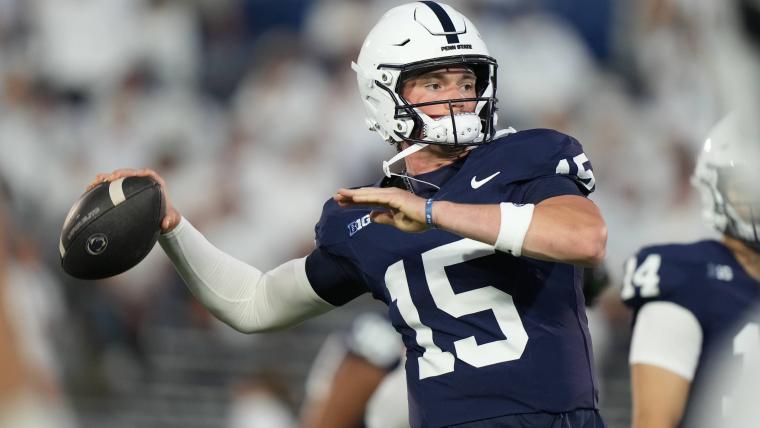
POLICY WIRE — Pittsburgh, USA — Professional sports, we’re often told, are about evolution. Adaptation. But sometimes, it feels more like an act of institutional re-education, a surgical deconstruction of a player’s athletic psyche. That’s the scene playing out in Pittsburgh, where the Steelers—a franchise known more for its blue-collar grit than its philosophical deconstruction of talent—are reportedly embarking on a radical experiment: an almost total ideological overhaul of rookie quarterback Drew Allar.
It’s not just tweaking his stance. It’s not just refining his throwing motion. Insiders suggest the Steelers are ‘uninstalling everything’ Allar absorbed during his collegiate years at Penn State. A generational talent coming out of high school, a touted five-star prospect whose Nittany Lion career, while solid, never quite ascended to the messianic levels anticipated. And now, the pros want to scrap his foundational code.
Because, well, that’s what big business does. They acquire raw assets—human or otherwise—and refashion them into what serves the organizational bottom line. Penn State’s system, no matter its merits, is simply not the Steelers’ system. And in the merciless arena of the NFL, adherence to ‘their way’ is less a suggestion and more an operational imperative.
ESPN’s Brooke Pryor articulated it with chilling clarity during a recent camp segment, saying they’re ‘essentially uninstalling everything he’s learned and re-uploading their own methods and fundamentals and mechanics with Allar.’ This isn’t just about football, is it? It’s about systemic conformity, the erasure of prior educational pathways in favor of a new, singular doctrine.
“Look, he’s got the arm, no question there. But raw talent doesn’t win championships in this league,” a high-ranking Steelers’ coach, speaking anonymously due to ongoing camp sensitivities, told Policy Wire. “We’re not just looking for a good college quarterback; we need an NFL quarterback. And sometimes that means starting from zero, breaking down the muscle memory built over years. It’s tough medicine, but it’s how you get stronger.”
This aggressive reset on a young athlete underscores the vast philosophical divide between collegiate development and professional demands. For all the pageantry and pride associated with university programs, their teachings are often considered, shall we say, quaint once the billion-dollar NFL machine gets its hands on a player. This approach echoes broader, international development patterns, where established local methods are often supplanted by external ‘best practices.’ Think of how foreign aid initiatives sometimes dismiss deeply ingrained local systems, preferring to install completely new frameworks, even when local knowledge could provide invaluable context. It’s an exercise in control, a reshaping to fit a predefined mold.
Drew Allar, just 22 years old, arrived in Pittsburgh with a four-year rookie deal estimated at approximately $7.1 million according to Spotrac. It’s an investment, not a trophy. The initial reports suggest a focus on his footwork, on ‘widening his space, keeping him off of his toes.’ It sounds so technical, so clinical. But these small, physical adjustments carry the weight of a young man’s entire career aspirations. He had two different quarterback coaches during his tenure at Penn State, with his junior year, under Danny O’Brien, being his most productive, boasting 3,327 passing yards and a 66.5% completion rate. That’s not a player who can’t play, not by any measure. But it’s not enough.
“We’ve always believed in a holistic development approach, nurturing both athleticism and critical thinking,” countered Dr. Elara Khan, Dean of the Faculty of Sport Sciences at a prominent South Asian university, when asked to consider the Steelers’ methods. “But these high-pressure, commercial environments… they sometimes forget the ‘human’ in ‘human performance.’ It’s a global phenomenon, this drive for homogenization of talent, whether it’s in sports, or industry, or even academia. They strip away the regional flavor, the cultural nuance, in pursuit of a perceived universal efficiency.”
The parallels to geopolitical — and economic power dynamics aren’t difficult to draw. Imagine a nation, say Pakistan, trying to modernize its infrastructure or education system, only to be told by a Western consulting firm that everything they’ve built, every localized methodology, needs to be ‘uninstalled’ and replaced with a ‘standardized’ global model. It’s rarely about actual ineffectiveness as much as it’s about institutional trust and the desire for control by the dominant entity.
What This Means
This situation with Allar isn’t merely a football story; it’s a stark illustration of the brutal pragmatism embedded within top-tier professional structures. Economically, it shows the sheer scale of investment in — and expectation from — young talent. Allar’s contract is not an endorsement of his college career, but a down payment on a hoped-for, thoroughly reprogrammed future. The Steelers aren’t buying potential; they’re buying the opportunity to meticulously sculpt that potential, often by discarding the sculptor’s previous work.
Politically, this ‘unlearning’ reflects a broader institutional philosophy. Major organizations, whether a sports franchise or a governmental body, often prioritize conformity to their own system over the validation of external—or prior—knowledge. It’s a top-down authoritarianism that can be incredibly effective in generating predictable results, but also risks stifling the very originality that often distinguishes elite performers. It tells us that in the pursuit of absolute control and maximum efficiency, the established identity—even a successful one—of an individual or a region can be swiftly deemed obsolete and targeted for wholesale replacement. It’s the ultimate ‘adapt or be erased’ mandate, — and Allar is living through it.